
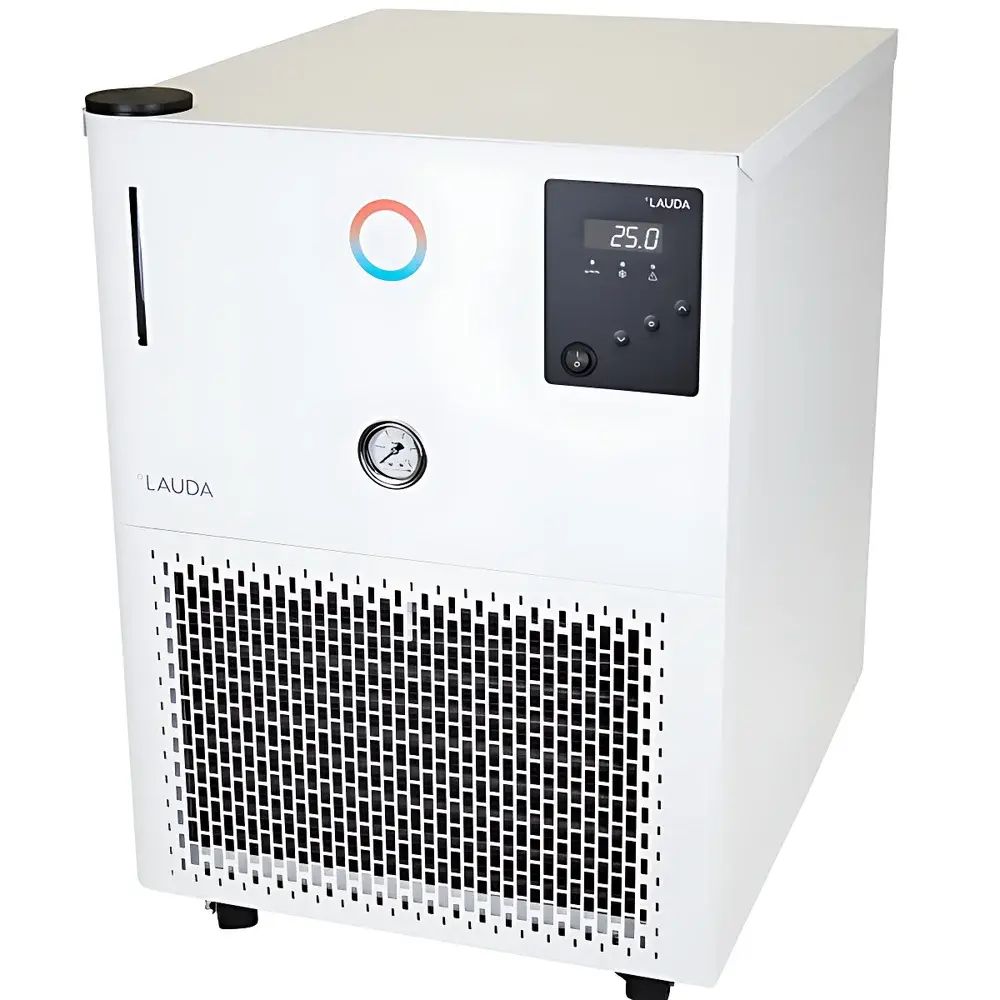
LAUDA Microcool MC 1200 Circulating Chiller
| Brand | LAUDA |
|---|---|
| Origin | Germany |
| Model | MC 1200 |
| Cooling Method | Air-Cooled |
| Temperature Range | –10 to +40 °C |
| Refrigeration Capacity | 1.20 kW at 20 °C (Ethanol) |
| Temperature Stability | ±0.5 °C |
| Pump Pressure | Up to 1.3 bar |
| Pump Flow Rate | 35 L/min |
| Reservoir Volume | 14.0 L |
| Operating Mode | Continuous |
| Power Supply | 230 V, 50 Hz |
| Refrigerant | R-134a (0.575 kg) |
| Dimensions (W × D × H) | 450 × 550 × 650 mm |
| Weight | 63 kg |
| Sound Pressure Level | 59 dB(A) |
| Max. Power Consumption | 1.15 kW |
| Max. Current | 6.5 A |
| Inlet/Outlet Thread | G 3/4" |
| Minimum Fill Volume | 7 L |
| Maximum Fill Volume | 14 L |
Overview
The LAUDA Microcool MC 1200 is a precision-engineered, air-cooled circulating chiller designed for stable thermal management of laboratory instrumentation requiring continuous, low-temperature cooling in the range of –10 to +40 °C. Built upon LAUDA’s decades of German engineering expertise in thermal control systems, the MC 1200 employs a hermetically sealed, magnetically coupled centrifugal pump—eliminating mechanical shaft seals and associated leakage risks—paired with an electronically controlled variable-speed compressor and proportional electromagnetic refrigerant valve. This architecture enables precise modulation of refrigeration output based on real-time thermal load, ensuring energy-efficient operation and high reproducibility across extended duty cycles. Its compact footprint (450 × 550 × 650 mm) and dual placement flexibility—benchtop or floor-standing—make it ideal for integration beneath fume hoods, into analytical instrument racks (e.g., HPLC, ICP-MS, laser systems), or alongside calorimeters and spectroscopic platforms where spatial constraints are critical.
Key Features
- Magnetically coupled centrifugal pump with brushless DC motor: Ensures zero fluid leakage, maintenance-free operation, and compatibility with water, water/glycol, or ethanol-based heat transfer fluids.
- Full electronic temperature controller with LED display: Simultaneously shows setpoint and actual bath temperature; intuitive three-button interface with menu-guided navigation supports rapid configuration without software dependency.
- Integrated safety monitoring system: Includes pump overtemperature protection, reservoir level sensor with visual/audible low-level alarm, and automatic shutdown on fault detection.
- Backlit transparent level window with integrated illumination: Enables immediate visual verification of coolant volume under ambient lab lighting conditions.
- Standard RS-232 serial interface: Facilitates remote monitoring, parameter logging, and integration into centralized lab automation frameworks (e.g., LabVIEW, SCADA).
- Programmable timer functions: Supports scheduled start-up and auto-shutdown to align with experimental timelines or facility power management protocols.
- Front-access fill port and rear-mounted inlet/outlet connections (G 3/4″ BSP male): Simplifies installation and service while minimizing footprint interference.
Sample Compatibility & Compliance
The MC 1200 is validated for use with non-flammable and low-toxicity heat transfer media, including deionized water, aqueous glycol solutions (up to 50% v/v), and ethanol—enabling safe operation with sensitive analytical hardware. Its design conforms to IEC 61000-6-3 (EMC emission limits) and IEC 61000-6-2 (immunity requirements), and meets CE marking directives for electrical safety (IEC 61010-1). While not certified for Class I Division 1 hazardous locations, its R-134a refrigerant charge (GWP = 1430) complies with EU F-Gas Regulation (EU) No 517/2014 for equipment placed on the market post-2020. The unit supports GLP/GMP-aligned workflows through configurable event logging (via RS-232) and traceable operational parameters—including runtime, temperature deviations, and alarm history—when interfaced with compliant data acquisition software.
Software & Data Management
No proprietary software is required for basic operation; all control and monitoring occur via the onboard controller. For advanced integration, the RS-232 interface provides ASCII command protocol documentation (available upon request), supporting bidirectional communication for reading real-time values (temperature, pump status, error codes) and writing setpoints or enabling/disabling functions. When connected to validated third-party data loggers or LIMS platforms, the MC 1200 can contribute to 21 CFR Part 11-compliant audit trails when paired with appropriate user access controls and electronic signature modules. Firmware updates are performed locally via USB (optional adapter) and include version-controlled revision history accessible through diagnostic menus.
Applications
- Cooling of high-power lasers (e.g., Ti:sapphire, DPSS) requiring stable thermal sink performance below ambient.
- Temperature stabilization of HPLC column ovens, detector cells, and autosampler chillers to ensure retention time reproducibility.
- Thermal conditioning of spectrophotometer sample compartments and CCD detectors to reduce dark current noise.
- Supporting differential scanning calorimetry (DSC) and thermogravimetric analysis (TGA) auxiliary cooling stages.
- Providing consistent coolant supply to rotary evaporators, vacuum pumps, and condensers operating under sub-ambient conditions.
- Integration into multi-instrument cooling loops via manifold distribution (with external flow balancing valves).
FAQ
What heat transfer fluids are approved for use with the MC 1200?
Water, 30–50% aqueous ethylene or propylene glycol solutions, and ethanol are validated. Avoid chlorinated solvents, oils, or fluids with pH 9.0.
Can the MC 1200 operate continuously at –10 °C ambient temperature?
No—the minimum recommended ambient operating temperature is +5 °C per specification. Below this, condensation and compressor oil viscosity issues may impair reliability.
Is the RS-232 interface opto-isolated?
Yes—galvanic isolation is implemented to prevent ground loop interference in electrically noisy lab environments.
Does the unit support external PT100 probe input for process temperature feedback?
No—temperature regulation is internal only; external sensing requires integration via PLC or third-party controller using analog/digital I/O modules.
What maintenance intervals are recommended?
Annual inspection of condenser coil cleanliness and refrigerant circuit integrity; biannual verification of pump seal integrity (visual check) and reservoir fluid conductivity/pH if using glycol mixtures.



