
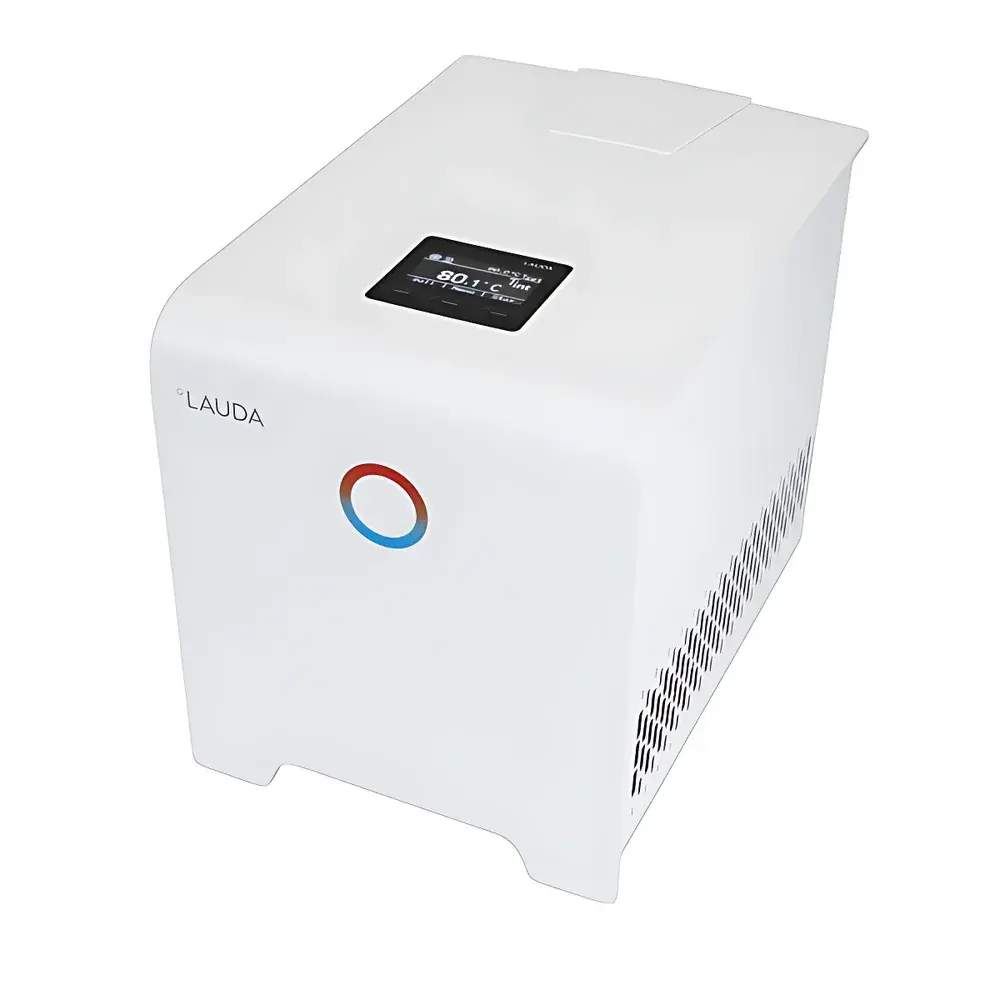
LAUDA LOOP 250 External Circulating Temperature Controller (4–80 °C)
| Brand | LAUDA |
|---|---|
| Origin | Germany |
| Model | LOOP 250 |
| Instrument Type | Integrated Circulating Chiller |
| Cooling Method | Air-Cooled |
| Temperature Range | 4–80 °C |
| Refrigeration Capacity | 130 W (at 10 °C output) |
| Temperature Stability | ±0.1 °C |
| Circulation Pump Pressure | 0.8 bar |
| Circulation Flow Rate | 2.6 L/min |
| Bath Volume | 0.32 L |
| Operating Mode | Continuous |
| Heating Power | 400 W |
| Pump Max Flow (at zero head) | 3 L/min |
| Dimensions (W×D×H) | 261 × 368 × 312 mm |
| Weight | 12 kg |
| Noise Level | 57 dB(A) |
| Power Supply | 100–240 V, 50/60 Hz |
| Protection Class | IP20 |
| Fluid Compatibility | Water, Water/Glycol Mixtures (non-flammable) |
| Interface | RS232 |
| Display | High-contrast OLED Graphical Screen |
| Control Interface | 3-button intuitive navigation |
| Connection | Quick-release 1/4″ C-type fittings |
Overview
The LAUDA LOOP 250 is an integrated external circulating temperature controller engineered for precision thermal management in laboratory environments where stability, compactness, and silent operation are critical. Unlike conventional compressor-based chillers, the LOOP 250 employs solid-state Peltier thermoelectric technology—eliminating refrigerants, mechanical compressors, and associated vibration or oil contamination risks. This architecture delivers highly reproducible temperature control across a wide operational range of 4 °C to 80 °C, with a stability of ±0.1 °C under steady-state conditions. Its air-cooled design ensures passive heat rejection without requiring external water lines or dedicated ventilation ducting, making it suitable for benchtop deployment in analytical labs, biophysics workstations, and QC testing suites. The unit operates continuously in either heating or cooling mode, automatically transitioning between functions to maintain setpoint accuracy—ideal for dynamic applications such as DNA melting curve analysis or enzyme kinetics studies requiring precise ramp-and-hold profiles.
Key Features
- Peltier-based thermoelectric cooling and heating—no refrigerant, no moving parts in the cold stage, minimal maintenance
- High-contrast monochrome OLED graphical display with real-time temperature, flow status, and system diagnostics
- Intuitive three-button interface enabling rapid parameter entry, setpoint adjustment, and menu navigation without training overhead
- Integrated circulation pump delivering up to 2.6 L/min at 0.8 bar pressure—sufficient for low-resistance external loops including UV spectrophotometer cell jackets and small bioreactors
- Quick-release 1/4″ C-type fluid connectors enabling tool-free hose attachment/detachment and minimizing downtime during instrument reconfiguration
- RS232 serial interface supporting remote command execution (e.g., setpoint change, start/stop, status query) and integration into LabVIEW or custom SCADA systems
- Compact footprint (261 × 368 × 312 mm) and lightweight construction (12 kg) optimized for space-constrained analytical benches
- Compliant with IEC 61000-6-3 (EMC emission) and IEC 61000-6-2 (immunity); CE-marked per Machinery Directive 2006/42/EC and Low Voltage Directive 2014/35/EU
Sample Compatibility & Compliance
The LOOP 250 is validated for use with non-flammable heat transfer fluids only—including deionized water and aqueous ethylene glycol mixtures (up to 30 % v/v). It is not rated for organic solvents, oils, or flammable media. Its fluid path is constructed from chemically resistant materials (PP, EPDM, stainless steel 316), ensuring compatibility with standard laboratory buffer solutions and preventing leaching or corrosion over extended operation. From a regulatory standpoint, the device supports GLP-compliant workflows through its traceable temperature logging capability (via RS232), stable setpoint retention (<0.1 °C drift over 24 h), and absence of uncontrolled thermal transients. While not FDA 21 CFR Part 11–certified out-of-the-box, its deterministic behavior and audit-ready interface enable validation under internal SOPs for pharmaceutical QC applications such as dissolution apparatus temperature control or refractometer calibration.
Software & Data Management
The LOOP 250 does not include embedded software or cloud connectivity; instead, it provides a deterministic RS232 ASCII protocol (9600 baud, 8N1) for integration into existing laboratory informatics infrastructure. Commands support full bidirectional control: setting target temperature, reading actual bath and outlet temperatures, querying pump status, and retrieving error codes (e.g., “E03” = overtemperature alarm). Third-party drivers are available for MATLAB, Python (pySerial), and LabVIEW, facilitating automated temperature profiling in kinetic assays. All communication events—including setpoint changes and fault triggers—are timestamped at the host level, enabling correlation with analytical instrument data streams. No local data storage is implemented, aligning with ISO/IEC 17025 requirements for separation of measurement and recording functions.
Applications
- UV-Vis spectrophotometry: Precise thermal control of multi-cell holders during nucleic acid melting temperature (Tm) determination (10–80 °C)
- Refractometry and polarimetry: Maintaining 20–25 °C stability for refractive index and optical rotation measurements per ASTM D1218 and USP
- Small-scale bioreactors (≤2 L working volume): Providing jacket temperature regulation for microbial or mammalian cell culture experiments (15–70 °C)
- Western blotting workflows: Cooling electrophoresis buffer tanks to 4–7 °C to prevent protein degradation during SDS-PAGE
- Capillary electrophoresis and HPLC detector cooling: Stabilizing photodiode array or fluorescence detector housings (20–30 °C)
- LED light source thermal management in microscopy and spectrofluorometry setups to minimize spectral drift
- X-ray generator cooling in benchtop diffractometers, where consistent anode temperature prevents beam instability
FAQ
Does the LOOP 250 require regular refrigerant servicing or oil changes?
No. As a Peltier-based system, it contains no refrigerant circuit, compressor, or lubricated components.
Can it be used with 50% glycol solutions?
No—only aqueous mixtures up to 30% ethylene glycol by volume are approved to ensure adequate thermal conductivity and pump compatibility.
Is the RS232 interface optically isolated?
No. Galvanic isolation is not built-in; users deploying in electrically noisy environments should implement external isolation modules.
What is the minimum recommended external loop volume?
For optimal temperature stability, the external circuit should hold ≥0.5 L of fluid; smaller volumes may exhibit increased overshoot during setpoint transitions.
Does the unit meet noise specifications in ISO 3744 acoustic testing conditions?
Yes—the stated 57 dB(A) value was measured per ISO 3744 at 1 m distance in free-field conditions with ambient background ≤40 dB(A).



