
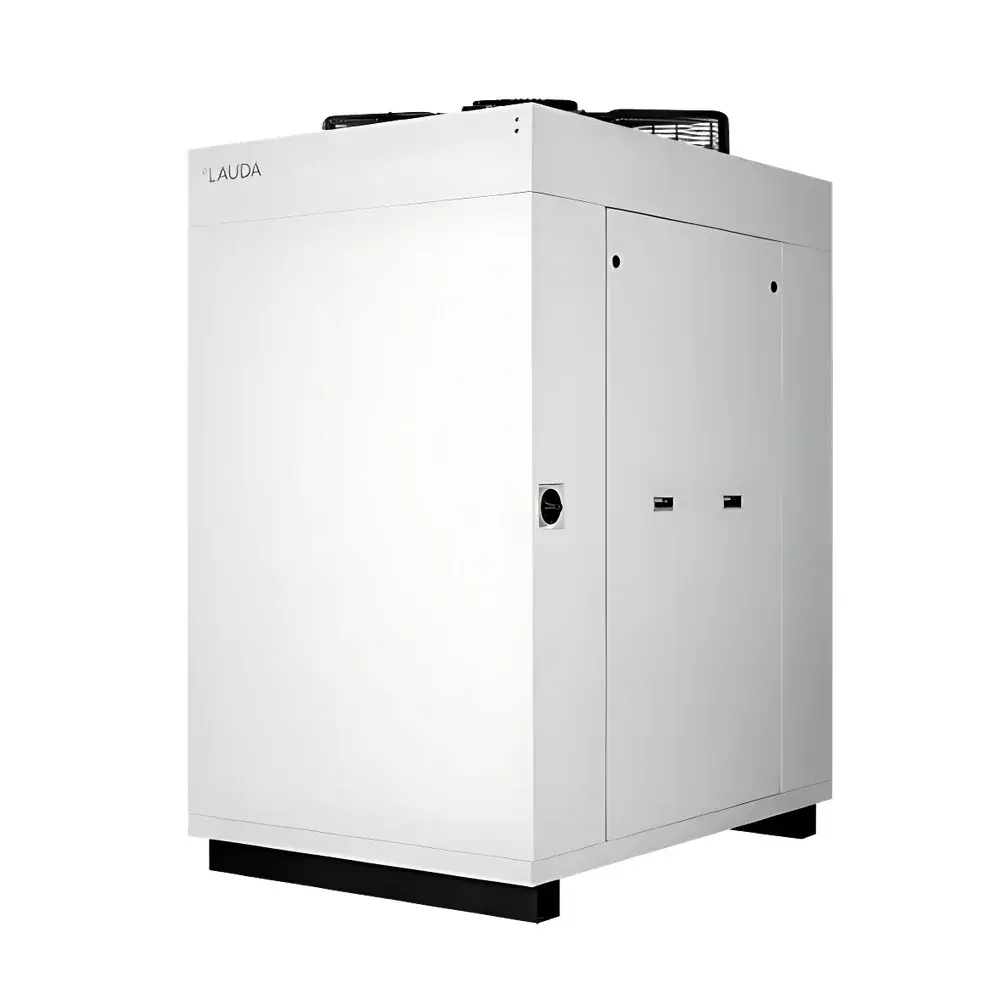
LAUDA UC 8 Ultracool Advanced Energy-Efficient Circulating Chiller
| Brand | LAUDA |
|---|---|
| Origin | Germany |
| Model | UC 8 |
| Instrument Type | Split-System |
| Cooling Method | Water-Cooled |
| Temperature Range | –10 to 35 °C |
| Cooling Capacity | 10.2 kW (at 10 °C outlet water temperature) |
| Temperature Stability | ±0.5 °C |
| Circulation Pump Pressure | 5.6 bar |
| Circulation Flow Rate | 133 L/min |
| Reservoir Volume | 35 L |
| Operation Mode | Continuous |
Overview
The LAUDA UC 8 Ultracool Advanced Energy-Efficient Circulating Chiller is a precision-engineered, split-system process chiller designed for continuous, high-stability thermal management in demanding laboratory and industrial environments. Based on LAUDA’s proprietary thermodynamic architecture and optimized refrigerant circuit design, the UC 8 employs a variable-speed scroll compressor, electronically controlled expansion valve (EEV), and adaptive fan speed regulation to dynamically match cooling output with real-time thermal load. This closed-loop control strategy enables precise temperature maintenance across its full operating range of –10 °C to +35 °C, with stability maintained within ±0.5 °C under steady-state conditions. As a CE-marked, EU Ecodesign-compliant system, the UC 8 meets Regulation (EU) 2016/2281 for liquid-chilling packages and exceeds minimum seasonal energy performance ratio (SEPR) requirements by up to 40%—a key factor in reducing total cost of ownership over equipment lifetime.
Key Features
- Energy-optimized refrigeration cycle featuring inverter-driven compressor, EC fans, and electronic expansion valve for dynamic load adaptation
- Split-system configuration enabling flexible installation: condensing unit mounted remotely (e.g., outdoors or in mechanical room), evaporator unit placed near heat source
- High-flow circulation system delivering up to 133 L/min at 5.6 bar pressure, supporting multi-point distribution networks and long coolant line runs
- 35 L stainless-steel reservoir with integrated level sensor, anti-corrosion coating, and low-temperature protection circuitry
- IP54-rated enclosure for both indoor and outdoor deployment—suitable for factory floor, cleanroom periphery, or semi-outdoor technical spaces
- Pre-integrated Ethernet port and RS485 interface compliant with Modbus RTU protocol for seamless integration into building management systems (BMS) or SCADA platforms
Sample Compatibility & Compliance
The UC 8 is compatible with standard aqueous glycol mixtures (e.g., 20–30% propylene glycol/water), deionized water, and other non-corrosive heat-transfer fluids approved for use with stainless-steel wetted components. It conforms to IEC 61000-6-2 (immunity) and IEC 61000-6-4 (emissions), EN 60335-1 (safety of electrical appliances), and EN 14511 (performance testing of liquid chillers). Its control software supports audit-trail logging and user-access levels aligned with GLP and ISO/IEC 17025 documentation requirements. While not certified for pharmaceutical GMP manufacturing environments per se, it satisfies prerequisite thermal stability and data integrity criteria for supporting analytical instrumentation (e.g., HPLC column ovens, ICP-MS sample introduction systems) under FDA 21 CFR Part 11–compliant workflows when deployed with validated software extensions.
Software & Data Management
The UC 8 operates via LAUDA’s proprietary TouchControl 3.0 interface—a 7-inch capacitive touchscreen with intuitive graphical navigation and multilingual support (English, German, French, Chinese, Japanese). All operational parameters—including setpoint, actual temperature, flow rate, compressor frequency, and energy consumption—are logged at user-configurable intervals (1 s to 60 min) and stored locally on an embedded SD card (8 GB). When connected to LAUDA Cloud via optional LTE/Wi-Fi gateway, time-series data is transmitted securely using TLS 1.2 encryption. Cloud-based dashboards enable remote monitoring, predictive maintenance alerts (e.g., filter clogging detection, refrigerant charge deviation), and comparative energy-performance benchmarking across fleets of chillers. Data export complies with CSV and ASCII formats for third-party analysis in MATLAB, Python (Pandas), or LIMS environments.
Applications
The UC 8 serves as a stable thermal sink for high-heat-flux instrumentation requiring consistent coolant delivery under variable duty cycles. Typical applications include thermal stabilization of UV-curable inkjet printheads in digital printing lines; active cooling of CO₂ and fiber laser resonators in cutting and welding stations; temperature control of RF amplifiers in semiconductor test equipment; thermal conditioning of hydrogen generators used in fuel cell R&D; and coolant supply for CNC machine tool spindles and grinding wheel dressers. Its wide temperature span and high flow capacity also support multi-instrument manifold configurations—common in centralized lab cooling infrastructures serving spectrometers, calorimeters, and rheometers.
FAQ
What refrigerant does the UC 8 use, and is it compliant with F-Gas Regulation (EU) No 517/2014?
The UC 8 uses R-513A—a low-global-warming-potential (GWP = 631) A1-class refrigerant approved under Annex I of Regulation (EU) No 517/2014 for new stationary refrigeration equipment.
Can the UC 8 operate unattended for extended periods in a 24/7 lab environment?
Yes—the system includes automatic restart after power failure, dry-run protection, high-pressure cut-off, and leak-detection logic. Its continuous-duty rating and redundant sensor architecture ensure reliability across uninterrupted operation cycles exceeding 8,760 hours/year.
Is remote firmware update supported via LAUDA Cloud?
Firmware updates are delivered through LAUDA’s secure OTA (over-the-air) channel and require manual authorization via authenticated admin login. Each update includes SHA-256 checksum verification and rollback capability.
Does the UC 8 support external temperature feedback from a process sensor?
Yes—via optional 4–20 mA or PT100 input, enabling cascade control where the chiller regulates based on actual process temperature rather than internal bath temperature.
What is the maximum allowable coolant line length between chiller and application?
For optimal flow dynamics and pressure drop control, LAUDA recommends ≤30 m total equivalent piping length (including fittings and elevation changes); longer runs require hydraulic calculation and optional booster pump integration.



