
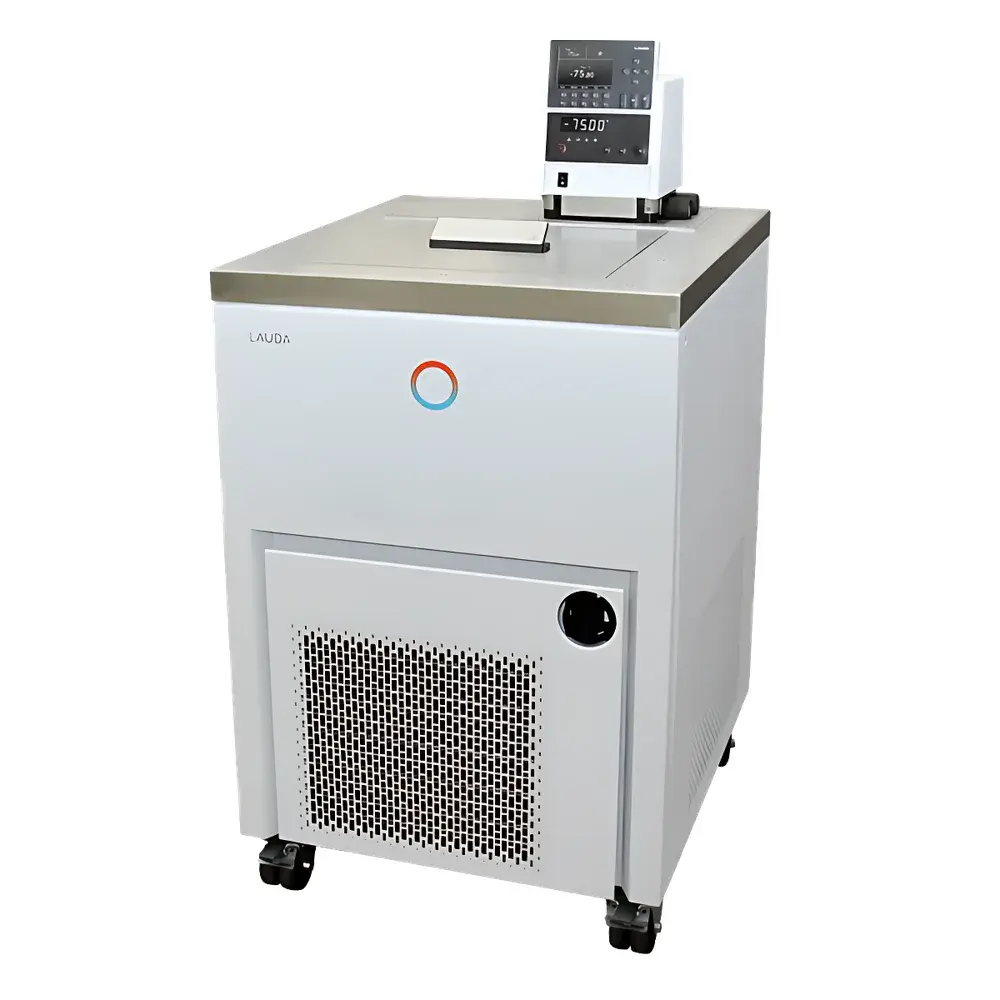
LAUDA Proline Kryomate RP 4090 CW Cryogenic & High-Temperature Circulating Bath
| Brand | LAUDA |
|---|---|
| Origin | Germany |
| Model | RP 4090 CW |
| Bath Volume | 32–44 L |
| Temperature Range | −90 °C to +200 °C |
| Temperature Stability | ±0.05 °C |
| Cooling/Heating Type | Dual-mode |
| Circulation | Internal & External |
| Refrigerants | R-452A (Stage 1), R-508B (Stage 2) |
| Pump Flow Rate | Up to 90 L/min |
| Max Pressure | 0.9 bar |
| Heater Power | 3.5 kW |
| Max Power Consumption | 7 kW |
| Dimensions (W×D×H) | 600 × 700 × 1216 mm |
| Weight | 160 kg |
Overview
The LAUDA Proline Kryomate RP 4090 CW is a floor-standing, high-performance circulating bath engineered for demanding material testing and process validation under extreme thermal conditions. Designed around a dual-stage refrigeration architecture with cascade compression, it achieves an exceptionally wide operational temperature range—from cryogenic −90 °C to high-temperature +200 °C—while maintaining ±0.05 °C stability across the entire span. Its core thermal management system integrates SmartCool™ digital cooling control, which dynamically modulates compressor duty cycles based on real-time thermal load, reducing energy consumption by up to 75% compared to conventional fixed-speed systems. Unlike single-refrigerant baths constrained by thermodynamic limits, the RP 4090 CW employs two environmentally compliant refrigerants—R-452A (GWP 2140) in Stage 1 and R-508B (GWP 13,400) in Stage 2—enabling reliable low-temperature operation without sacrificing high-end heating capacity. The unit’s robust stainless-steel bath vessel (350 × 350 × 250 mm internal dimensions) supports large-volume fluid loads (32–44 L) and accommodates bulky industrial specimens, including metal test blocks, polymer composites, and lubricant samples.
Key Features
- Dual-stage cascade refrigeration system certified to EU Regulation (EU) No 517/2014 for fluorinated greenhouse gas containment and reporting
- LAUDA Vario™ 4-stage variable-speed circulation pump with side/rear porting and integrated bypass, delivering up to 90 L/min at 0.9 bar for uniform thermal distribution
- Triple independent heating elements (3.5 kW total) with fault-tolerant redundancy: continued operation with one element offline and audible/visual alarm activation
- Bath edge and bridge heating zones prevent condensation and ice formation during sub-ambient operation, eliminating moisture-related calibration drift
- Full PID-controlled internal and external temperature regulation with programmable ramp rates, soak times, and multi-step profiles (150 segments across 5 programs)
- Detachable LAUDA Command™ controller with backlit graphical LCD, tactile keypad, Tmax overtemperature lockout, and optical RS-232/RS-485 interface (expandable to Profibus, Ethernet, or analog I/O)
- PowerAdapt™ adaptive power management ensures optimal heater output within local grid constraints (max 16 A @ 230 V)
- Comprehensive safety suite: low-bath-level detection, overtemperature cutoff, dry-run protection, and non-flammable fluid compatibility certification
Sample Compatibility & Compliance
The RP 4090 CW is validated for use with standard heat-transfer fluids—including ethanol, silicone oils, and specialized low-viscosity cryogenic media—within its full temperature envelope. Its open-bath geometry (350 mm × 350 mm aperture) enables direct immersion of large-format test articles, such as ASTM D97 pour point test vessels, ISO 6272 impact specimens, or automotive component assemblies. The system meets essential regulatory requirements for laboratory instrumentation: CE marking per Machinery Directive 2006/42/EC and Low Voltage Directive 2014/35/EU; RoHS 2011/65/EU compliance; and conformity with EN 61000-6-2 (immunity) and EN 61000-6-4 (emissions). While not inherently 21 CFR Part 11-compliant, its audit-ready data logging (via optional Ethernet module), electronic signature-capable software interface, and full event-trace history support GLP/GMP-aligned validation protocols when integrated into controlled environments.
Software & Data Management
The embedded firmware supports time-stamped temperature logging at user-defined intervals (1 s to 60 min resolution), with data export via USB or serial interface in CSV format. Optional LAUDA WebControl software enables remote monitoring and control over Ethernet (up to 50 m cable length or via LAN/WAN), including real-time curve visualization, alarm configuration, and automated report generation. All controller actions—including setpoint changes, program starts/stops, and safety events—are recorded with timestamps and operator IDs (when paired with authentication modules). Firmware updates are delivered via secure HTTPS download and verified using SHA-256 checksums. For integration into centralized lab infrastructure, the RP 4090 CW supports Modbus RTU over RS-485 and OPC UA via third-party gateway solutions.
Applications
- Low-temperature mechanical testing: ASTM E1820 fracture toughness evaluation at −80 °C, DIN 50115 cold impact resistance of polymers
- Petroleum product characterization: ASTM D97 pour point determination, ASTM D5949 cold cranking viscosity, ISO 3104 kinematic viscosity at sub-zero temperatures
- Thermal cycling validation of aerospace composites per SAE AMS2750E furnace qualification protocols
- Calibration of infrared thermometers and contact sensors across extended ranges (−90 °C to +200 °C)
- Process simulation for cryogenic manufacturing, including superconducting magnet cooldown and LNG component stress testing
- Stability testing of pharmaceutical excipients and biologics formulations under accelerated aging conditions
FAQ
What heat transfer fluids are recommended for operation below −40 °C?
Ethanol (≥99.8% purity) and specially formulated low-freezing-point silicone oils (e.g., DC 200 Fluid, 5 cSt) are validated for continuous use down to −90 °C. Glycol/water mixtures are not recommended below −20 °C due to increased viscosity and reduced thermal conductivity.
Can the RP 4090 CW supply simultaneous heating and cooling to separate external devices?
Yes—the unit features dual external ports (inlet/outlet) and supports parallel connection of up to two independent circuits via optional Y-branch manifolds. Each circuit maintains independent flow control and temperature feedback when used with external PT100 sensors.
Is remote programming possible without installing additional hardware?
Basic remote start/stop and setpoint adjustment are supported via the included RS-232 interface and LAUDA’s free terminal emulator software. Full graphical programming and data logging require the optional Ethernet communication module (Order No. 9001234).
How is condensation managed during prolonged operation at −80 °C in ambient humidity >60% RH?
The integrated bath-edge and bridge heating system operates continuously during sub-zero operation, maintaining surface temperatures above dew point. Combined with the insulated bath cover (standard), this reduces condensate accumulation by >95% relative to unheated systems.
Does the system support automated validation protocols such as IQ/OQ/PQ?
Yes—LAUDA provides documented installation qualification (IQ) and operational qualification (OQ) templates aligned with ISO/IEC 17025 and ASTM E2500. Performance qualification (PQ) is customer-specific but supported by traceable NIST-calibrated reference probes and full system uncertainty budgets available upon request.
Related Products



