
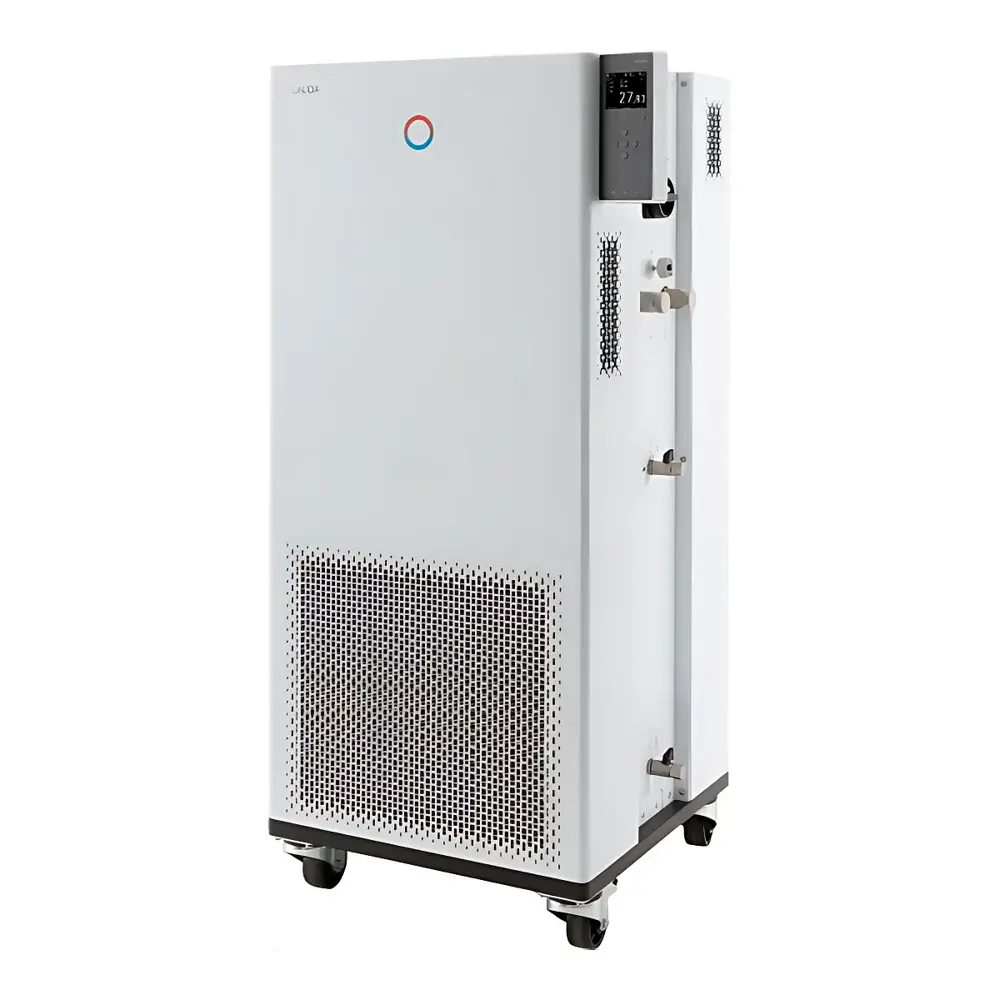
LAUDA Integral XT IN 550XTW High-Low Temperature Circulating Chiller
| Brand | LAUDA |
|---|---|
| Origin | Germany |
| Model | IN 550XTW |
| Cooling Method | Water-Cooled |
| Temperature Range | −50 °C to 220 °C |
| Cooling Capacity | 5800 W |
| Temperature Stability | ±0.05 °C |
| Pump Pressure | 3.1 bar |
| Pump Flow Rate | 65 L/min |
| Reservoir Volume | 4.8–17.2 L |
| Operation Mode | Continuous |
Overview
The LAUDA Integral XT IN 550XTW is a high-performance, water-cooled circulating chiller engineered for dynamic temperature control in demanding laboratory and industrial process applications. It operates on the principle of sealed cold-oil layer flow technology—enabling extended thermal range coverage across −50 °C to 220 °C without thermal fluid degradation or vapor lock. Unlike conventional chillers limited by refrigerant saturation or heater stability constraints, the Integral XT integrates a dual-mode thermal management architecture: a high-efficiency R-452A refrigeration circuit combined with an 8 kW electric heating system and intelligent PowerAdapt power regulation. This architecture ensures rapid ramp rates (up to 12 K/min typical under load), minimal overshoot during setpoint transitions, and stable operation under variable external pressure drops—critical for jacketed reactors, calorimeters, spectroscopic cells, and inline process sensors.
Key Features
- Eight-stage magnetically coupled Variopump with digital pressure/flow display and adjustable bypass valve for precise hydraulic optimization across low- and high-backpressure applications
- Full-electronic PID controller with adaptive auto-tuning, programmable ramp/soak profiles (150 segments across 5 programs), and dual Pt100 input support (internal + external sensor)
- Color TFT touchscreen interface with intuitive text-based navigation in six languages (English, German, French, Spanish, Italian, Russian) and real-time temperature curve visualization
- Integrated web server enabling secure browser-based remote monitoring and control via LAN—compatible with PCs, tablets, and smartphones
- SmartCool digital cooling management system with compressor cycling optimization and energy-efficient load-matching algorithms
- Comprehensive safety architecture: adjustable overtemperature protection (Tmax key), audible alarm, floating fault contacts, and self-diagnostic startup assistant
- Standard communication interfaces: USB 2.0 and Ethernet (TCP/IP); optional expansion modules available for RS232/485, Profibus, analog I/O, dry contacts, or EtherCAT
- Low internal fluid volume design with cold-layer flow sealing minimizes thermal inertia and improves response fidelity during transient conditions
- Certified compliance with CE, UL/CSA 61010-1, and RoHS; refrigerant R-452A (GWP 2140) charged per F-Gas Regulation (EU) No. 517/2014
Sample Compatibility & Compliance
The IN 550XTW is compatible with a broad spectrum of heat transfer fluids—including silicone oils, glycol/water mixtures, and specialized low-viscosity synthetic heat transfer media—within its full operational range. Its sealed cold-oil layer design prevents oxidation and vapor-phase formation at elevated temperatures, extending fluid service life and reducing maintenance intervals. The unit meets ISO/IEC 17025 requirements for traceable temperature calibration when used with certified Pt100 probes. For regulated environments, it supports audit-ready operation through configurable event logging (including setpoint changes, alarms, and pump status) and user-access-level controls aligned with FDA 21 CFR Part 11 principles—though formal validation documentation must be generated per site-specific IQ/OQ protocols.
Software & Data Management
The embedded web server provides HTTP(S)-based access to live process data, historical trend logs (stored internally for ≥30 days), and configuration parameters. All data exchanges are secured via TLS 1.2 encryption and authenticated session tokens. Logged events include timestamps, operator IDs (when configured), temperature deviations >±0.1 °C, and fault codes with descriptive diagnostics. Export functionality supports CSV format for integration into LIMS or MES platforms. Optional LAUDA LabSoft software enables centralized multi-unit fleet monitoring, automated report generation, and alarm forwarding via SMTP or SNMP traps—facilitating GLP/GMP-aligned workflow documentation.
Applications
This chiller serves as a core thermal utility in applications requiring high-fidelity, bidirectional temperature control: polymerization kinetics studies in jacketed reactors; viscosity-temperature profiling in rotational rheometers; thermal stress testing of electronic components; stabilization of laser cavities and interferometric optics; and temperature-programmed desorption (TPD) in surface science setups. Its ability to maintain ±0.05 °C stability at 220 °C—while delivering 65 L/min flow against up to 3.1 bar backpressure—makes it suitable for large-volume circulation loops in pilot-scale bioreactors and continuous-flow chemistry systems.
FAQ
What is the minimum and maximum recommended heat transfer fluid volume?
The reservoir supports 4.8 L (minimum fill for safe operation) to 17.2 L (maximum capacity). Fluid selection must comply with LAUDA’s compatibility guidelines for the target temperature range.
Does the unit support external temperature feedback for cascade control?
Yes—via the integrated external Pt100 port; the controller can operate in master-slave mode using either internal or external sensor input as primary feedback.
Is the R-452A refrigerant compliant with current EU F-Gas regulations?
Yes—the charge (1.55 kg) corresponds to 3.3 t CO₂-equivalent, well below the 5 t threshold triggering mandatory leak checks under Annex III of Regulation (EU) No. 517/2014.
Can the device be integrated into a SCADA system?
Yes—through optional RS485 (Modbus RTU), EtherCAT, or analog 4–20 mA output modules, enabling real-time setpoint synchronization and status reporting.
What is the acoustic noise level during continuous operation at full load?
66 dB(A) measured at 1 m distance under standard ambient conditions (23 °C, 50% RH), conforming to ISO 3744 test methodology.
Related Products



