
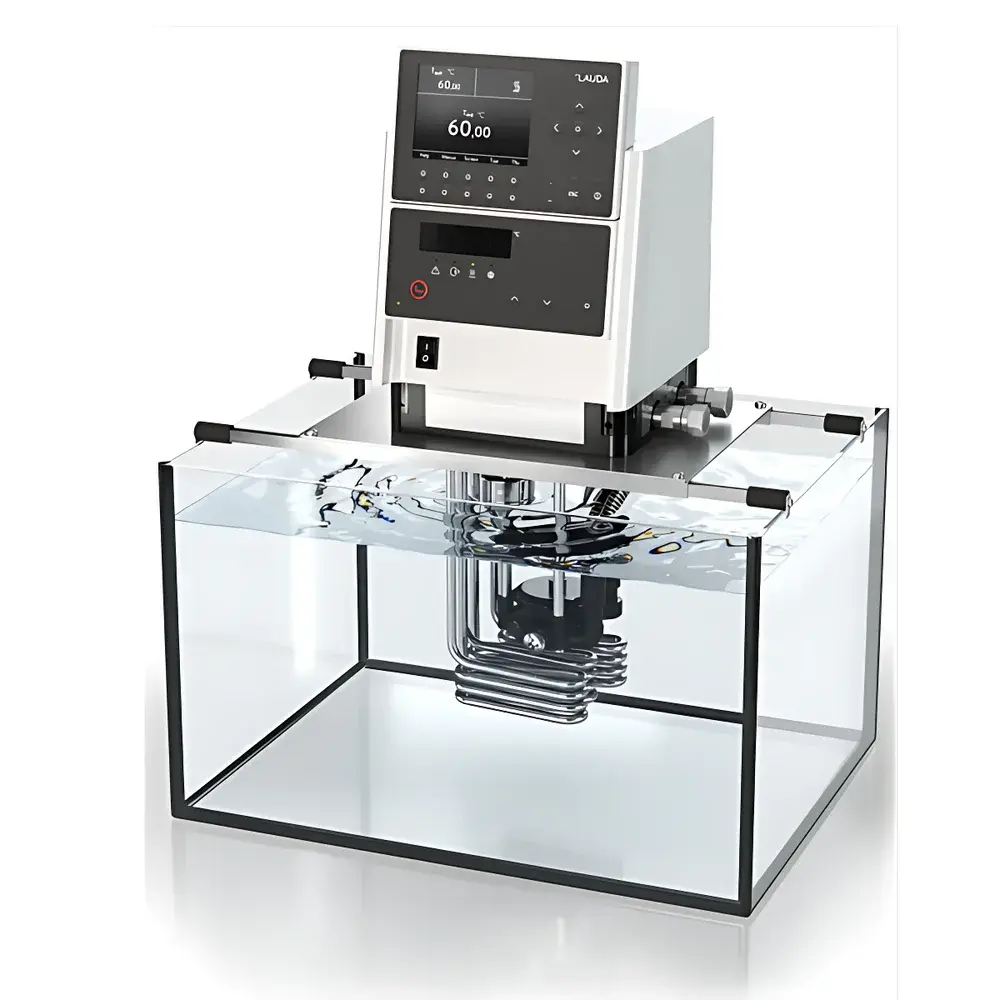
LAUDA Proline PB C Bridge-Type Circulating Thermostat for Baths
| Brand | LAUDA |
|---|---|
| Origin | Germany |
| Model | PB C |
| Temperature Range | 30–300 °C (with external cooling: 20–300 °C |
| extended range | –30–300 °C) |
| Temperature Stability | ±0.01 K |
| Heating Power | 3.6 kW |
| Max. Pump Pressure | 0.7 bar |
| Max. Suction | 0.4 bar |
| Flow Rate (pressure mode) | 25 L/min |
| Flow Rate (suction mode) | 23 L/min |
| Dimensions (W×D×H) | 320 × 185 × 576 mm |
| Weight | 8 kg |
| Interface | RS232/485 (opt. Profibus, analog, Ethernet/USB modules) |
| Programmable Steps | 150 (5 programs) |
| Varioflex Pump | 8-stage adjustable |
Overview
The LAUDA Proline PB C is a high-precision bridge-type circulating thermostat engineered for demanding laboratory and industrial applications requiring stable, programmable temperature control of external baths—particularly deep or wide-volume immersion baths up to 320 mm depth and 550 mm width. Unlike conventional bath thermostats, the PB C employs a dual-pump architecture (pressure + suction) based on LAUDA’s proprietary Varioflex technology, enabling bidirectional fluid circulation and uniform thermal distribution across large or geometrically complex bath configurations. Its microprocessor-controlled PID regulation system maintains temperature stability within ±0.01 K under dynamic load conditions, while PowerAdapt ensures optimal heat output utilization within local power supply constraints. Designed for continuous operation in ambient environments from 5 °C to 40 °C, the unit supports both heating-only and heating/cooling modes when paired with an external chiller—extending its functional range to –30 °C to 300 °C.
Key Features
- Dual-mode Varioflex pump with 8-stage adjustable pressure/suction capability (max. 0.7 bar pressure, 0.4 bar suction), optimized for viscous media and high-head bath systems
- Modular control architecture featuring two independent interfaces: fixed front-panel with backlit graphical LCD and detachable remote control unit with identical functionality and ergonomic pull-out design
- Advanced programmability: 150-step temperature/time profiles distributed across up to five independent programs, supporting ramp-hold sequences, cyclic protocols, and timed activation/deactivation
- Integrated safety system with adjustable low-limit overtemperature protection, audible alarm, and automatic shutdown—certified for use with flammable and non-flammable heat transfer fluids per DIN EN 61000-6-2 and IEC 61000-6-4
- Comprehensive diagnostics suite including self-test assistant, real-time error logging, and status-driven LED indicators for rapid troubleshooting
- Expandable communication infrastructure: standard optical-isolated RS232/485 port; optional upgrade paths to Profibus DP, analog I/O (0–10 V / 4–20 mA), dry-contact modules, or Ethernet/USB gateway for LIMS integration
- Ergonomic mechanical design: telescopic mounting rod (310–550 mm bath width compatibility), integrated side/rear pump ports with bypass valve, and compact footprint (320 × 185 × 576 mm)
Sample Compatibility & Compliance
The PB C is compatible with a broad spectrum of heat transfer media—including water, silicone oils, glycol/water mixtures, and specialized synthetic heat transfer fluids—provided they fall within the unit’s chemical resistance specifications (e.g., stainless steel wetted parts, EPDM seals). Its operational envelope meets requirements for GLP-compliant thermal validation workflows, supporting traceable temperature control in accordance with ISO/IEC 17025 and ASTM E2877-21 (Standard Guide for Thermal Validation of Liquid Baths). The device carries CE marking per EU Machinery Directive 2006/42/EC and EMC Directive 2014/30/EU. Optional firmware upgrades enable audit-trail generation and electronic signature support aligned with FDA 21 CFR Part 11 for regulated pharmaceutical and biotech environments.
Software & Data Management
While the PB C operates autonomously via its embedded controller, its RS232/485 interface enables seamless integration with third-party data acquisition platforms (e.g., LabVIEW, MATLAB, or custom SCADA systems) using ASCII-based command protocol. Logged temperature data—including setpoint, actual value, pump status, and alarm events—can be streamed in real time or retrieved as timestamped CSV files. When equipped with the optional Ethernet module, the unit supports Modbus TCP communication and web-based configuration via secure HTTP(S) interface. All programmable parameters are retained during power loss due to non-volatile EEPROM storage, and firmware updates are performed via USB stick without requiring service intervention.
Applications
- Calibration of thermometers, RTDs, and thermocouples in accredited metrology labs
- Thermal stability testing of polymers, adhesives, and composites per ISO 294-4 and ASTM D648
- Viscosity measurements requiring precise bath temperature control for rotational rheometers and capillary viscometers
- Accelerated aging studies of pharmaceutical formulations under ICH Q1A(R2) guidelines
- Material testing in environmental chambers where external bath coupling provides superior thermal inertia
- Reaction calorimetry setups requiring synchronized temperature ramping across multiple vessels
FAQ
What is the minimum external bath depth this unit can effectively control?
The PB C is specifically engineered for deep-bath applications down to 320 mm depth; however, it remains fully functional with shallower baths (≥100 mm) using appropriate flow-rate adjustment.
Can the PB C operate without an external chiller below 30 °C?
No—the base model provides heating only. Sub-ambient operation requires connection to an external refrigerated circulator or chiller via the auxiliary cooling port.
Is the detachable control panel intrinsically safe for use in explosion-hazard areas?
The remote panel is not ATEX-certified; it is rated for general laboratory use (IP20). For hazardous locations, consult LAUDA’s Ex-certified Proline variants (e.g., PB C-Ex series).
How does the PowerAdapt system affect energy consumption during long-term operation?
PowerAdapt dynamically modulates heater duty cycle to match instantaneous thermal demand, reducing peak current draw and improving overall electrical efficiency—particularly beneficial in facilities with limited circuit capacity.
Are calibration certificates available with NIST-traceable documentation?
Yes—factory calibration reports with uncertainty budgets (k=2) are provided upon request; on-site verification and recalibration services are supported globally through LAUDA’s certified service network.



