
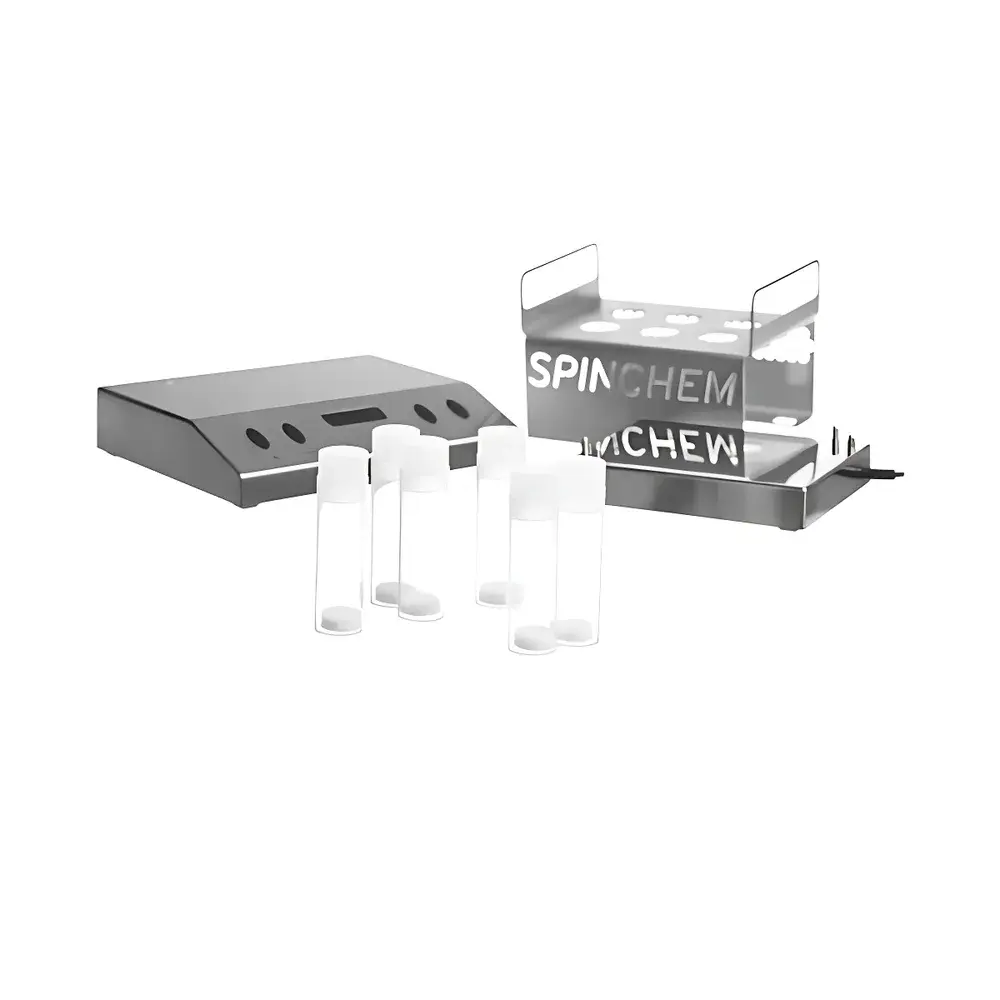
SpinChem MagRBR Magnetic Rotating Bed Reactor
| Brand | SpinChem |
|---|---|
| Origin | Sweden |
| Model | MagRBR |
| Construction Material | Stainless Steel |
| Operating Pressure | Medium Pressure |
| Working Volume | 5–100 mL |
| Vacuum Range | 10–40 MPa (upon consultation) |
| Mesh Size of Cartridge | 44 µm |
| Cartridge Volume | 0.5 mL |
| Stirring Speed Range | 100–2000 rpm |
| Temperature Range (Stirrer) | −20 to +50 °C |
| Temperature Range (Control Unit) | 0 to +40 °C |
| Power Supply | 100–240 V, 50/60 Hz |
Overview
The SpinChem® MagRBR Magnetic Rotating Bed Reactor is an engineered platform for high-efficiency, scalable enzymatic catalysis in laboratory-scale reaction optimization and biocatalyst screening. Based on the rotating bed reactor (RBR) principle, the MagRBR integrates magnetic actuation with a sealed, porous solid-phase cartridge—enabling continuous, plug-flow-like mass transfer without physical contact between catalyst and bulk solution. Unlike conventional stirred-tank reactors where immobilized enzymes are subject to shear-induced leaching or attrition, the MagRBR confines the biocatalyst within a rigid, magnetically driven rotating capsule (7.3 mm height × 18 mm diameter), eliminating filtration steps and minimizing catalyst loss. The system operates under medium-pressure conditions and supports vacuum-assisted operation down to 10 MPa, facilitating reactions requiring controlled headspace or solvent degassing. Its design adheres to fundamental principles of interfacial mass transfer kinetics and enzyme stability engineering—making it particularly suited for structure–activity relationship (SAR) studies, kinetic profiling, and rapid parameter space mapping in biocatalytic process development.
Key Features
- Magnetic rotary actuation enables precise, contactless control of rotational speed (100–2000 rpm) via external stirrer and dedicated control unit—ensuring reproducible hydrodynamic conditions across parallel experiments.
- Standardized 44 µm pore-size polyamide cartridges (0.5 mL internal volume) provide uniform flow distribution and mechanical retention of immobilized enzymes, resins, or whole-cell biocatalysts.
- Modular architecture supports simultaneous screening of up to six independent reaction conditions using a single 6-position stainless-steel tube rack—reducing experimental variability and accelerating DOE (Design of Experiments) workflows.
- Stainless-steel construction (EN 1.4404 / AISI 316L) ensures chemical compatibility with organic solvents, aqueous buffers, and acidic/basic media across −20 to +50 °C operating range.
- No post-reaction filtration required: catalyst remains fully contained; product recovery is achieved by simple cartridge removal—minimizing handling losses and cross-contamination risk.
- Pre-configured screening kits—including CalB-immobilized, lipase-immobilized, ECR (Enzyme-Carrier Resin), and monolithic resin variants—enable immediate deployment for common biotransformation classes (e.g., esterification, transesterification, kinetic resolution).
Sample Compatibility & Compliance
The MagRBR accommodates a broad spectrum of immobilized biocatalysts, including covalently bound (epoxy-, amine-, or acrylate-functionalized carriers), adsorbed (C18, macroporous polystyrene-DVB), and ionically tethered enzyme preparations. Its cartridge geometry and flow dynamics have been validated for use with commercial carriers such as Lewatit®, Sepabeads®, and Accurel® series resins. While not certified for GMP manufacturing, the system supports GLP-aligned documentation practices: all hardware components are traceable by batch number, and operational parameters (speed, time, temperature) are manually loggable per ICH-GCP Annex 11 recommendations. The absence of moving seals or gaskets simplifies cleaning validation and reduces extractables risk—critical for early-stage API synthesis and metabolite profiling in regulated environments.
Software & Data Management
The MagRBR operates as a hardware-only platform with no embedded firmware or proprietary software. Speed control is executed via analog input to the magnetic stirrer unit, allowing full integration with third-party data acquisition systems (e.g., LabVIEW, MATLAB, or Python-based DAQ platforms) through standard 0–10 V or PWM interfaces. Users maintain complete ownership of experimental metadata, enabling alignment with internal LIMS or ELN systems. For audit readiness, timestamped manual logs of rotation speed, duration, temperature, and cartridge identity meet minimum requirements for FDA 21 CFR Part 11-compliant recordkeeping when paired with institutional electronic signature policies.
Applications
- High-throughput screening of immobilized enzyme variants under varied pH, temperature, and solvent composition.
- Kinetic modeling of heterogeneous biocatalysis—particularly for diffusion-limited reactions where traditional CSTR assumptions fail.
- Optimization of enantioselective transformations (e.g., chiral alcohol resolutions) using recyclable enzyme cartridges.
- Process intensification studies comparing RBR performance against packed-bed or fluidized-bed configurations at lab scale.
- Development of continuous-flow hybrid processes—where MagRBR cartridges serve as discrete, exchangeable biocatalytic modules in multi-step syntheses.
- Evaluation of carrier–enzyme compatibility: assessing leaching, activity decay, and operational stability over repeated cycles.
FAQ
Can the MagRBR be used under inert atmosphere or reduced pressure?
Yes—the stainless-steel reactor vessels and cartridge housing support vacuum operation down to 10 MPa and are compatible with glovebox integration or Schlenk-line purging protocols.
Is cartridge sterilization possible?
Autoclaving is not recommended due to thermal limits of the polyamide housing; however, cartridges may be sanitized via 70% ethanol immersion or UV-C exposure (254 nm, 30 min) without compromising structural integrity or pore uniformity.
What is the maximum allowable viscosity for effective mass transfer?
Empirical testing shows consistent performance up to 500 mPa·s (measured at 25 °C); above this threshold, rotational speed must be increased proportionally to maintain radial flow penetration depth.
Are custom cartridge geometries or pore sizes available?
SpinChem offers OEM cartridge development—including alternative polymer matrices (e.g., PEEK, PVDF), sub-10 µm pore variants, and functionalized surface chemistries—subject to minimum order quantities and lead-time agreement.
Does the system comply with ISO 13485 or ASTM D7217?
The MagRBR is not certified to these standards; however, its mechanical design and material certifications (EN 10204 3.1) align with general-purpose laboratory equipment requirements per ISO/IEC 17025 Clause 6.4.1 for method validation infrastructure.



