
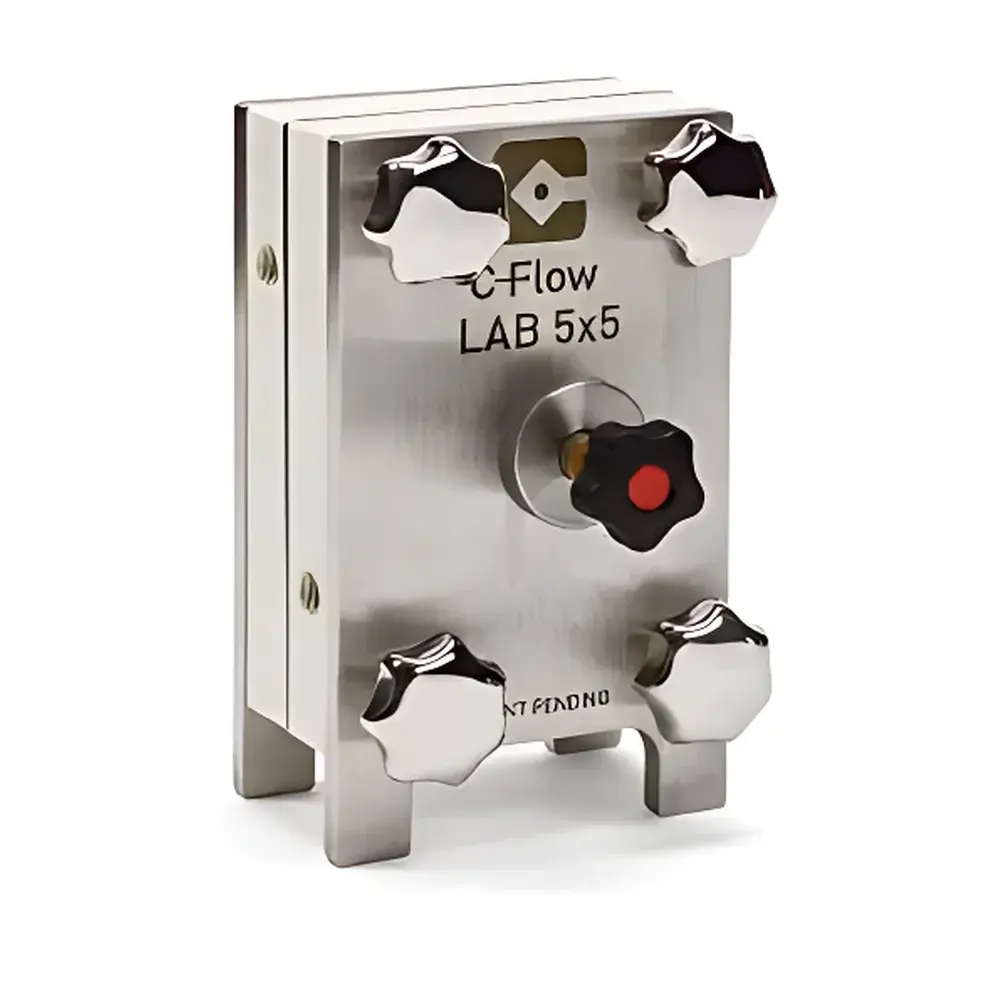
C-Flow Lab 5×5 Continuous-Flow Electrochemical Reactor
| Brand | C-Flow |
|---|---|
| Origin | United Kingdom |
| Manufacturer Type | Authorized Distributor |
| Origin Category | Imported |
| Model | Lab 5×5 |
| Usable Volume | Small-scale (1 L nominal, customizable) |
| Construction Material | 304 Stainless Steel (front panel), cPVC (cell frame) |
| Operating Pressure | Medium-pressure range (0–10 MPa, configurable) |
| Electrode Dimensions | 50 mm × 50 mm |
| Cell Height | 185 mm |
| Cell Width | 110 mm |
| Cell Depth | 60 mm |
| Unit Weight | 4200 g |
| Electrode Compatibility | 3 µm – 8 mm thickness |
| Flow Interface | Standard PVDF barbed fittings |
| Current Collector | Copper |
| Electrode Substrate | Flat-plate carbon |
| Membrane Integration | Dual-compartment configuration with replaceable ion-exchange or porous membranes |
Overview
The C-Flow Lab 5×5 Continuous-Flow Electrochemical Reactor is a modular, benchtop-scale electrochemical flow cell engineered for reproducible, scalable process development in synthetic electrochemistry and membrane-based electrochemical separations. Unlike conventional batch-type H-cells or undivided electrolyzers, the Lab 5×5 implements a true bipartite flow architecture: two independently addressable electrode compartments—oxidation and reduction—are hydraulically and ionically isolated by an interchangeable membrane (e.g., Nafion®, Fumasep®, or custom porous separators). This design enables precise control over mass transport, interfacial current density distribution, and product crossover—critical parameters in electrosynthesis, CO₂ reduction, organic electrophile activation, and redox-flow battery component testing. The reactor operates under continuous laminar flow conditions, supporting residence time tuning from seconds to minutes via adjustable flow rates (typically 0.1–20 mL/min), making it suitable for kinetic profiling, Faradaic efficiency quantification, and long-duration stability studies compliant with ASTM D7919 and ISO 16733-2.
Key Features
- Tool-free manual assembly with integrated alignment brackets for rapid cell disassembly and electrode/membrane exchange
- Universal electrode compatibility: accommodates rigid and flexible conductive substrates ranging from 3 µm thin catalyst coatings to 8 mm thick graphite or metal plates
- Dual configuration options: standalone flow cell module or fully integrated manifold-ready unit with pre-aligned fluidic ports
- Patented flow distributor plate ensuring uniform electrolyte velocity profile across the 50 mm × 50 mm active electrode area—minimizing edge effects and current density gradients
- Laser-cut 304 stainless steel front panel providing mechanical rigidity, corrosion resistance, and compatibility with high-purity solvents (acetonitrile, DMF, aqueous buffers)
- cPVC cell frame offering chemical inertness toward strong acids, bases, and halogenated electrolytes; rated for operation up to 10 MPa with appropriate sealing hardware
- Included membrane and gasket cutting template for repeatable, burr-free fabrication of custom-sized separators
Sample Compatibility & Compliance
The Lab 5×5 supports heterogeneous and homogeneous electrocatalytic systems—including immobilized molecular catalysts, nanoparticle-modified electrodes, gas-diffusion electrodes, and ion-conductive membranes. Its dual-compartment layout complies with standard electrochemical safety protocols for handling reactive intermediates (e.g., diazonium salts, radical anions) and volatile products (H₂, O₂, Cl₂). The system meets GLP documentation requirements when paired with calibrated flow meters, temperature-controlled recirculation loops, and certified reference electrodes (Ag/AgCl, SCE). All wetted materials conform to USP Class VI biocompatibility standards and are compatible with cleaning validation per ISO 15883-1.
Software & Data Management
While the Lab 5×5 operates as a hardware platform without embedded firmware, it integrates seamlessly with third-party potentiostats (BioLogic SP-300, Metrohm Autolab PGSTAT302N) and industrial-grade data acquisition systems (NI PXI, Keysight DAQ970A). Real-time synchronization of potential/current signals with flow rate, inlet/outlet pressure differentials, and inline conductivity/pH monitoring is achievable via analog I/O or Modbus TCP. Audit trails, user access controls, and electronic signature support align with FDA 21 CFR Part 11 when deployed within validated laboratory information management systems (LIMS) or ELN environments.
Applications
- Electro-organic synthesis: selective C–H functionalization, reductive dehalogenation, and paired electrolysis under controlled stoichiometry
- Fundamental electrode kinetics: determination of mass-transfer-limited current densities, Tafel analysis, and impedance spectroscopy in flowing media
- Membrane evaluation: ionic conductivity, permselectivity, and fouling resistance testing under realistic hydrodynamic conditions
- Redox flow battery R&D: half-cell performance mapping, crossover quantification, and stack component screening
- Electrochemical CO₂ conversion: product selectivity assessment across varying residence times and current densities
- Teaching laboratories: hands-on demonstration of Faraday’s laws, Ohm’s law in ionic conduction, and compartmentalized redox coupling
FAQ
What types of membranes are compatible with the Lab 5×5?
Standard configurations support proton-exchange membranes (e.g., Nafion 117), anion-exchange membranes (e.g., Sustainion® X37-50), and microporous separators (e.g., Celgard 3501); custom thicknesses and chemistries can be accommodated upon specification.
Is the reactor suitable for gas-evolving reactions?
Yes—the dual-compartment design isolates gaseous products (e.g., H₂ at cathode, O₂ at anode) and includes vented manifolds for safe gas removal; optional back-pressure regulators maintain liquid-phase continuity during continuous operation.
Can the Lab 5×5 be operated at elevated temperatures?
The base configuration is rated for ambient to 60 °C; thermal jackets and PTFE-coated internal components are available as OEM accessories for operation up to 120 °C.
How is electrode alignment ensured during repeated assembly?
Precision-machined locating pins and laser-etched registration marks on both the cPVC frame and stainless steel panel guarantee sub-100 µm positional repeatability across >500 assembly cycles.
Does the system include flow control hardware?
No—the Lab 5×5 is supplied as a reactor core only; syringe pumps, gear pumps, or HPLC-compatible flow controllers must be selected separately based on required pressure head and solvent compatibility.



