
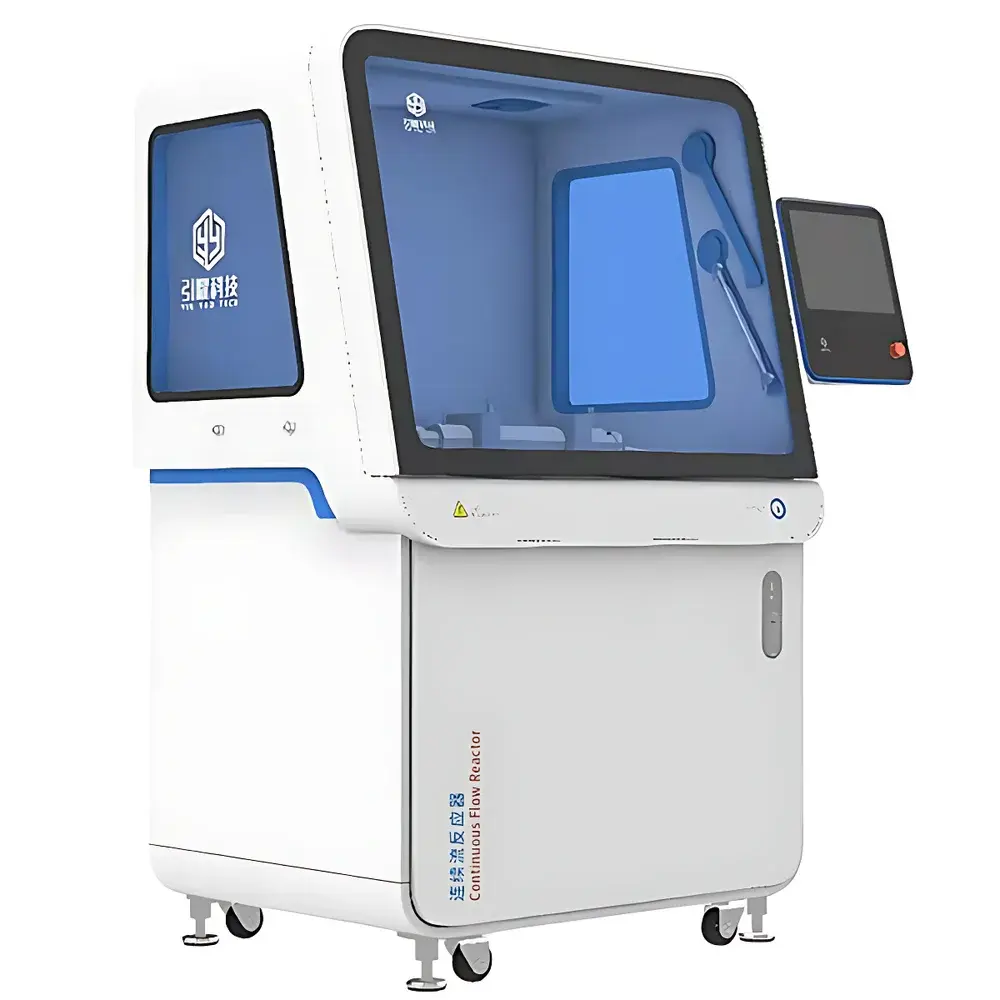
Continuous Multi-Stage Oscillatory Flow Reactor COFR by INNYAO
| Brand | INNYAO |
|---|---|
| Model | COFR |
| Origin | Zhejiang, China |
| Temperature Range | -20 °C to 180 °C |
| Equipment Type | Oscillatory Flow Reactor (OFR) for Continuous Chemical Synthesis |
| Regulatory Classification | Lab-Scale Reaction System per ISO 17025 and ASTM E2500 guidelines for equipment qualification |
Overview
The Continuous Multi-Stage Oscillatory Flow Reactor (COFR) by INNYAO is an engineered platform for precise, scalable, and reproducible chemical synthesis under controlled oscillatory flow conditions. Unlike conventional batch reactors or plug-flow systems, the COFR operates on the principle of periodic axial oscillation superimposed on steady net flow—generating well-defined, repeatable mixing intensity across multiple serial reaction zones. This hydrodynamic regime enables enhanced mass and heat transfer while maintaining narrow residence time distributions (RTDs), critical for kinetic studies, intermediate-sensitive transformations, and multi-step cascade reactions. Designed for laboratory-scale process development, the COFR supports systematic parameter screening (e.g., oscillation frequency, amplitude, net flow rate, temperature gradient) to de-risk scale-up to pilot or production-scale oscillatory baffled reactors (OBRs). Its modular architecture accommodates up to six independently thermally controlled reaction segments, allowing staged reagent addition, sequential catalysis, or controlled quenching.
Key Features
- Modular multi-stage design with up to six thermally isolated reaction zones, each equipped with independent PID-controlled heating/cooling jackets
- Programmable oscillatory actuation system delivering precise control over frequency (0.1–3 Hz), amplitude (±1–10 mm), and net flow rate (0.1–50 mL/min)
- Integrated temperature monitoring via calibrated Pt100 sensors in each zone, with real-time logging and interlock protection against thermal runaway
- Chemically resistant wetted materials: borosilicate glass tubing (DIN 28809), PTFE seals, and 316L stainless steel end fittings
- Pressure-rated operation up to 10 bar (gauge), compatible with inert gas purging and sealed reaction environments
- Front-panel HMI with intuitive touchscreen interface and optional Ethernet/RS485 connectivity for remote supervision and SCADA integration
Sample Compatibility & Compliance
The COFR is validated for use with organic solvents (e.g., THF, DMF, acetonitrile), aqueous electrolytes, slurries containing <5 wt% solid catalysts (e.g., Pd/C, Ni nanoparticles), and thermally labile intermediates. It complies with general safety requirements outlined in IEC 61010-1 for laboratory electrical equipment and incorporates dual-level overtemperature cutoffs per EN 60519-2. While not certified as GMP-compliant out-of-the-box, the system supports qualification protocols (IQ/OQ/PQ) aligned with FDA 21 CFR Part 11 data integrity expectations when paired with validated software configurations. Documentation packages include material traceability records, calibration certificates for temperature sensors, and mechanical stress analysis reports for pressure containment components.
Software & Data Management
The COFR controller firmware supports timestamped data acquisition at 10 Hz resolution for all primary variables: zone temperatures, oscillation parameters, flow rate, and system pressure. Raw data export is available in CSV and HDF5 formats, ensuring compatibility with MATLAB, Python (Pandas), and industry-standard process analytics tools (e.g., SIMCA, JMP). Optional INNYAO SynthLog™ software provides audit-trail-enabled operation logs, user access controls (role-based permissions), electronic signature capability, and automated report generation compliant with GLP documentation standards. All configuration changes are logged with user ID, timestamp, and pre-/post-values—supporting full traceability during regulatory audits.
Applications
- Kinetic profiling of fast exothermic reactions (e.g., nitration, diazotization) where thermal management and RTD control are critical
- Development of continuous asymmetric catalysis using immobilized chiral ligands in segmented reaction zones
- Photochemical synthesis under LED-illuminated transparent reactor sections (optional upgrade)
- Crystallization process intensification via controlled supersaturation generation in oscillatory shear fields
- Hydrogenation and oxidation reactions requiring strict O2/H2 concentration gradients across stages
- Teaching and demonstration of residence time distribution theory, mixing efficiency metrics (e.g., segregation index), and scale-up correlations for oscillatory flow systems
FAQ
What is the maximum allowable operating pressure for the COFR system?
The standard configuration is rated for continuous operation up to 10 bar (gauge) at 180 °C; higher-pressure variants (up to 20 bar) are available upon request with reinforced tubing and ASME-certified end fittings.
Can the COFR be integrated with in-line analytical tools such as FTIR or UV-Vis flow cells?
Yes—standard 1/4″-UNF ports and Swagelok-compatible interfaces enable seamless coupling with commercially available spectroscopic flow cells; optical path lengths of 1–10 mm are supported.
Is temperature uniformity verified across each reaction zone?
Each zone undergoes individual thermal mapping during factory acceptance testing (FAT); typical axial uniformity is ±0.5 °C over 100 mm length at steady state.
Does INNYAO provide application support for reaction optimization?
Application engineers offer protocol development assistance—including DoE-based parameter sweeps and RTD characterization—under separate technical service agreements.
How is cleaning and maintenance performed between campaigns?
The reactor tubing is fully removable and autoclavable; CIP (clean-in-place) sequences can be programmed using solvent flush cycles with programmable flow reversal and dwell times.



