
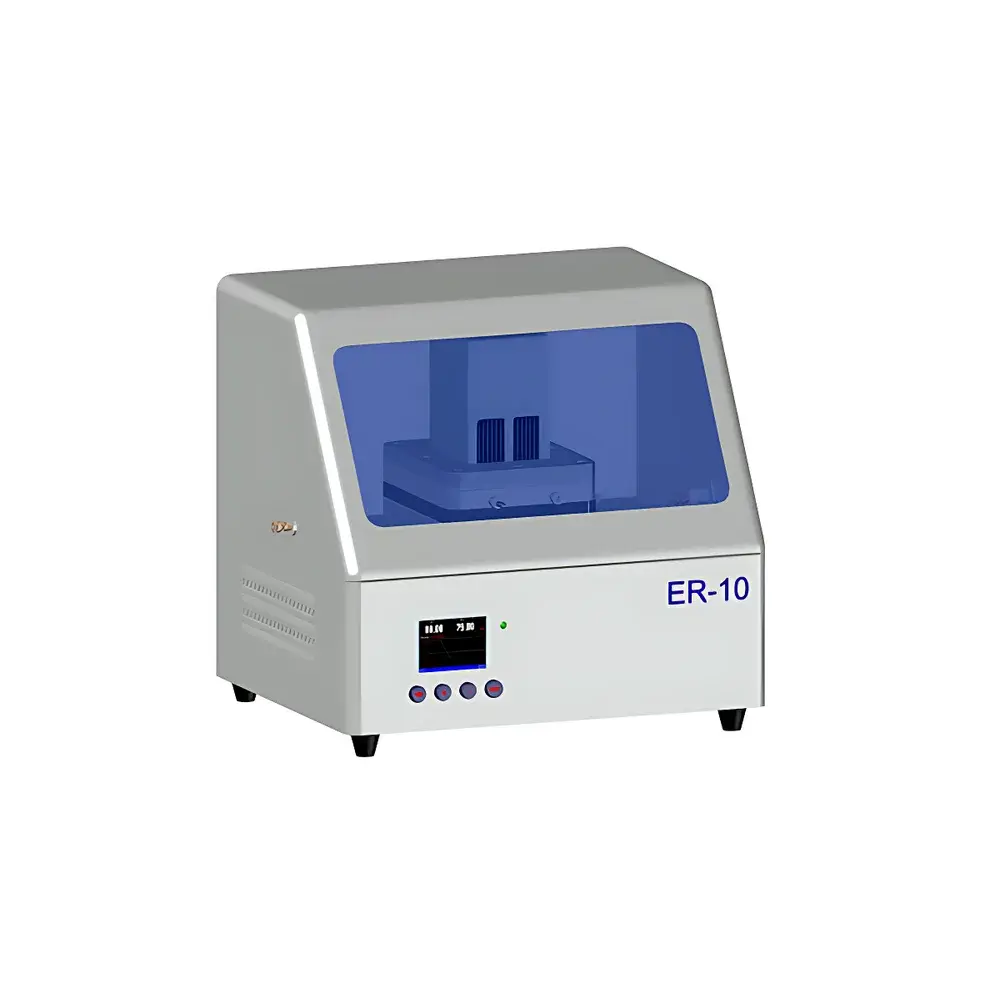
EZONE ER-10 Continuous-Flow Electrochemical Reactor
| Brand | EZONE CHEMIST |
|---|---|
| Origin | Shenzhen, China |
| Manufacturer Type | Authorized Distributor |
| Country of Origin | China |
| Model | ER-10 |
| Price Range | USD 7,000 – 14,000 (FOB) |
| Temperature Range | −10 °C to 100 °C |
| Temperature Control Accuracy | ±0.5 °C |
| Electrode Gap | Adjustable from 0.5 mm to 2.0 mm |
| Flow Rate | 0.1–10 mL/min |
| Reaction Volumes | 1 mL, 2 mL, and 5 mL |
| Operating Pressure | <10 bar |
| Cell Body Material | PTFE |
| Standard Electrodes | Graphite |
| Optional Electrodes | Nickel, Platinum, Stainless Steel |
| Flow Channel Design | Comb-type or Zig-Zag microstructured geometry |
| Optical Accessibility | Full side-view visualization window |
Overview
The EZONE ER-10 Continuous-Flow Electrochemical Reactor is an engineered platform for precision-controlled electrochemical synthesis and mechanistic investigation under dynamic flow conditions. Unlike conventional batch-type electrochemical cells—where mass transport limitations, thermal gradients, and electrode fouling constrain reproducibility—the ER-10 implements a segmented, membrane-separated dual-compartment flow cell architecture based on Couette-type laminar flow principles. Reactant solution is delivered via syringe or peristaltic pump into two parallel, optically transparent reaction zones separated by an ion-selective or proton-exchange membrane. Oxidation occurs at the anode chamber while reduction proceeds simultaneously in the cathode chamber, enabling stoichiometric control, improved current efficiency, and real-time monitoring of interfacial electron-transfer kinetics. The system is designed for laboratory-scale process development in pharmaceutical electrosynthesis, CO₂ reduction, organic redox transformations, and electrocatalyst screening—particularly where reaction intermediates are short-lived or heat-sensitive.
Key Features
- Adjustable electrode gap (0.5–2.0 mm) enables precise tuning of ohmic resistance and mass transfer coefficient—critical for optimizing Faradaic efficiency across diverse electrolyte conductivities.
- PTFE-based cell body ensures broad chemical compatibility with aggressive media including concentrated acids (e.g., H₂SO₄), halogenated solvents (e.g., CH₂Cl₂), and strong bases (e.g., KOH), supporting extended operational lifetime under corrosive conditions.
- Optically clear viewing windows allow direct in situ observation of electrode surfaces, bubble evolution, and phase separation—facilitating correlation between electrochemical signatures (e.g., cyclic voltammograms) and morphological changes.
- Modular flow channel geometry (comb-type or zig-zag) enhances radial mixing without turbulence, achieving high surface-area-to-volume ratios (>200 cm²/mL) while maintaining laminar Reynolds numbers (<200).
- Interchangeable electrode sets—including graphite (standard), nickel, platinum, and stainless steel—support application-specific electrocatalyst evaluation under identical hydrodynamic and thermal boundary conditions.
- Integrated temperature control (−10 °C to 100 °C, ±0.5 °C stability) permits kinetic studies across Arrhenius-relevant ranges and stabilization of thermally labile intermediates.
Sample Compatibility & Compliance
The ER-10 accommodates liquid-phase electrochemical systems using aqueous, non-aqueous, or mixed-solvent electrolytes. It supports standard electrochemical characterization techniques including chronoamperometry, cyclic voltammetry, and impedance spectroscopy when interfaced with commercial potentiostats (e.g., BioLogic SP-300, Metrohm Autolab PGSTAT302N). All wetted components comply with USP Class VI and ISO 10993-5 biocompatibility standards for material safety. The PTFE construction meets ASTM D471 resistance requirements for elastomer swelling in organic solvents. For regulated environments, the system supports audit-ready operation when paired with GLP-compliant data acquisition software featuring electronic signatures, user access levels, and 21 CFR Part 11–compliant audit trails.
Software & Data Management
While the ER-10 operates as a hardware-only module, it is fully compatible with third-party electrochemical workstations and LabVIEW-based custom automation frameworks. Integration with Python-driven control scripts (via PyVISA or serial protocols) allows synchronized logging of flow rate, temperature, applied potential, and current response at up to 100 Hz sampling. Raw data export formats include CSV and HDF5, ensuring interoperability with MATLAB, OriginPro, and electrochemical modeling tools such as COMSOL Multiphysics® (with AC/DC and Transport of Diluted Species modules). Users may configure automated parameter sweeps—for instance, varying flow rate while holding potential constant—to generate residence time distribution (RTD) profiles aligned with electrochemical conversion yield.
Applications
- Development of scalable electrosynthetic routes for API intermediates (e.g., deprotection, oxidative C–H functionalization, reductive dehalogenation).
- Screening of heterogeneous electrocatalysts for water splitting, nitrogen reduction, or CO₂-to-formate conversion under industrially relevant current densities (10–100 mA/cm²).
- Fundamental studies of electrode fouling mechanisms and passivation layer formation in battery electrolyte systems.
- Photoelectrochemical coupling experiments when integrated with external LED arrays or solar simulators through the optical access ports.
- Electrodialysis and membrane-based separations research, leveraging the built-in ion-exchange membrane interface and differential pH control across compartments.
FAQ
Can the ER-10 be operated at elevated pressures beyond 10 bar?
No. The standard PTFE cell body and sealing design are rated for continuous operation below 10 bar. For high-pressure applications (>20 bar), custom titanium or Hastelloy-C276 variants are available upon engineering review.
Is membrane replacement supported in the field?
Yes. The membrane cartridge is tool-free and replaceable in under 90 seconds. Standard configurations accept Nafion® 117, Fumasep® FKB, or custom-cast anion-exchange membranes.
What level of temperature uniformity is achieved across the 5 mL reaction volume?
Thermal mapping confirms ±0.8 °C maximum deviation across the active electrode zone at steady state, validated using embedded Pt100 sensors and IR thermography.
Does EZONE provide electrochemical method templates for common reactions?
Yes. Application notes—including optimized protocols for benzylic oxidation, nitroarene reduction, and Kolbe decarboxylation—are provided with each system and updated quarterly via secure customer portal.
How is electrical isolation maintained between anode and cathode circuits?
Dual isolated potentiostat channels or galvanically isolated power supplies are required. The ER-10 includes dedicated shielded BNC terminals for reference, counter, and working electrodes in each compartment to prevent ground-loop interference.



