
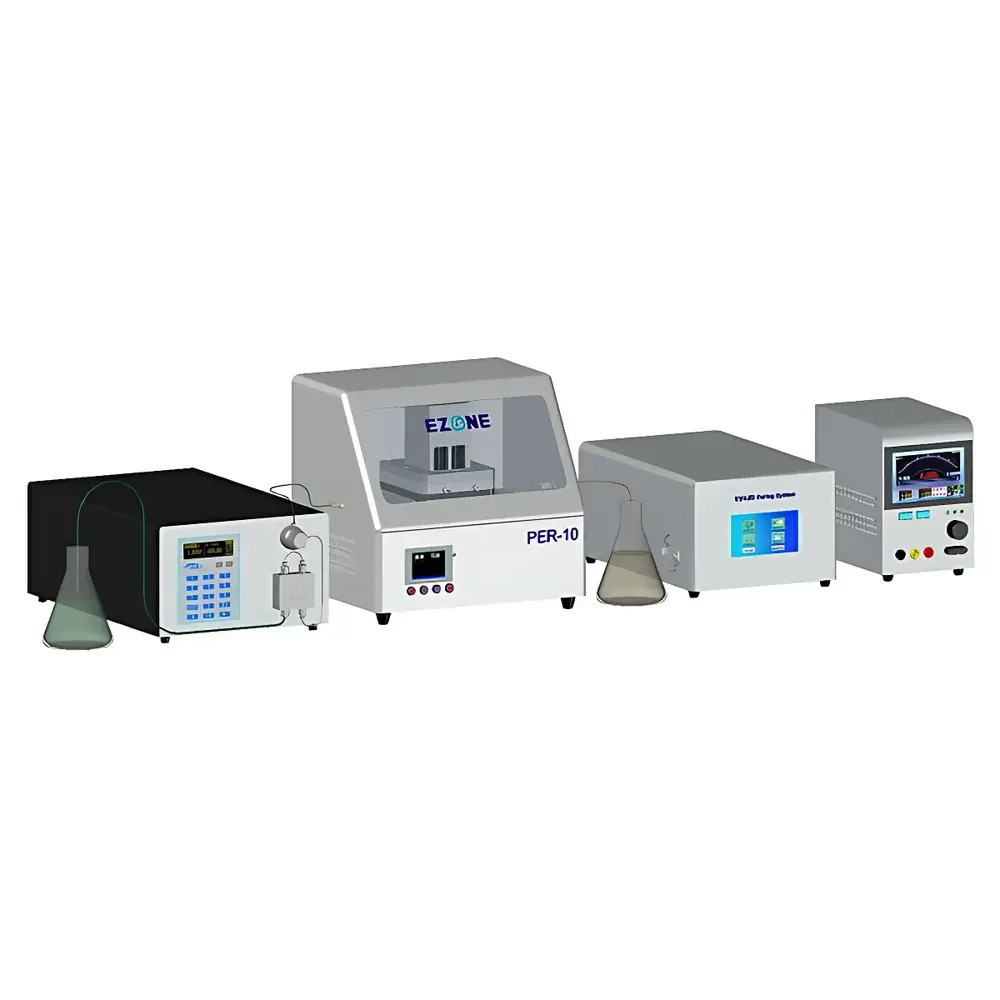
EZONE CHEMIST PER-10 Continuous-Flow Photoelectrochemical Reactor
| Brand | EZONE CHEMIST |
|---|---|
| Origin | Shenzhen, China |
| Model | PER-10 |
| Temperature Range | −10 °C to 100 °C |
| Temperature Control Accuracy | ±0.5 °C (via TEC) |
| Flow Rate | 0.1–10 mL/min |
| Reaction Volume | 1–5 mL (adjustable) |
| Electrode Gap | 0.5–2 mm (adjustable) |
| Maximum Operating Pressure | <10 bar |
| Cell Body Material | PTFE |
| Standard Electrode | Graphite |
| Optional Electrodes | Nickel, Platinum, Stainless Steel |
| Light Source | Matrix-configured LED array (wavelength selectable per configuration) |
Overview
The EZONE CHEMIST PER-10 is a benchtop continuous-flow photoelectrochemical reactor engineered for controlled, reproducible integration of photon and electron transfer in synthetic and mechanistic studies. It operates on the fundamental principle of photoelectrochemistry—where incident photons excite charge carriers in semiconductor electrodes or photosensitizers in solution, thereby driving redox reactions under applied or open-circuit electrochemical conditions. Unlike batch photochemical systems, the PER-10 employs laminar flow through a precisely defined inter-electrode gap (0.5–2 mm), ensuring uniform residence time distribution, minimized concentration gradients, and enhanced mass transport control. Its modular PTFE cell architecture, coupled with thermoelectric (TEC) temperature regulation, enables stable operation across a wide thermal range (−10 °C to 100 °C) while maintaining ±0.5 °C thermal homogeneity across the reaction zone—critical for kinetic studies, photoredox catalysis optimization, and structure–activity relationship mapping.
Key Features
- Modular PTFE reaction cell with chemically inert, low-outgassing construction compliant with ISO 8573-1 Class 4 for trace-sensitive applications.
- Adjustable electrode gap (0.5–2 mm) and interchangeable electrode holders accommodating substrates from micrometer-thin films to 5 mm-thick plates—including graphite (standard), platinum, nickel, and stainless steel.
- Matrix-configured, wavelength-tunable LED array delivering uniform irradiance (±3% spatial variation) across the active electrode surface; optional spectral bands include 365 nm, 405 nm, 450 nm, and white light (400–700 nm).
- Integrated TEC-based thermal management system with real-time PID feedback, enabling rapid thermal equilibration (24 h).
- Flow path optimized for Reynolds numbers <2000 (laminar regime) at maximum throughput (10 mL/min), ensuring predictable hydrodynamics and scalable residence time control (τ = Vreactor/Q).
- Front-access mechanical design with tool-free electrode and window module replacement—supporting rapid method development and cross-contamination mitigation in multi-step synthesis workflows.
Sample Compatibility & Compliance
The PER-10 supports aqueous, organic, and biphasic electrolyte systems—including acetonitrile, DMF, THF, water, and buffered saline solutions—compatible with common supporting electrolytes (e.g., TBAPF6, LiClO4, KCl). Its PTFE-wetted components meet USP Class VI biocompatibility requirements and exhibit resistance to strong oxidants (e.g., persulfates), halogens, and acidic/basic media (pH 0–14). The system complies with IEC 61010-1:2010 safety standards for laboratory electrical equipment and is designed to support GLP-compliant documentation when paired with validated data acquisition hardware. While not intrinsically rated for explosion-proof environments, it may be operated within ventilated fume hoods meeting ANSI/AIHA Z9.5 standards for volatile solvent handling.
Software & Data Management
The PER-10 operates as a standalone instrument with analog/digital I/O ports (0–10 V, RS-485, USB-C) for integration into third-party control ecosystems (e.g., LabVIEW, MATLAB, or Delta Tau PMAC). Temperature setpoints, flow rates (via external syringe or peristaltic pump), and LED intensity are logged synchronously with timestamped metadata (ISO 8601 format). Audit trails—including parameter changes, calibration events, and session start/stop—can be exported as CSV or SQLite files for FDA 21 CFR Part 11–aligned review. No proprietary software is required; configuration is managed via front-panel encoder or ASCII command protocol (AT-style syntax).
Applications
- Kinetic analysis of photogenerated radical intermediates in C–N bond formation (e.g., aryl amination under visible-light photocatalysis).
- Electrocatalytic CO2 reduction under simultaneous illumination—enabling decoupling of Faradaic efficiency from photon flux dependence.
- Synthetic methodology development for fragrance and flavor precursors (e.g., selective α-functionalization of carbonyls via photoinduced electron transfer).
- Teaching laboratories: quantitative demonstration of the Gerischer–Mott model, action spectra derivation, and wavelength-dependent quantum yield determination.
- Stability assessment of photoanode materials (e.g., BiVO4, Fe2O3) under operational current density and illumination stress.
FAQ
What electrode configurations are supported?
The PER-10 accepts planar, mesh, and rod-type electrodes with thicknesses from 10 µm to 5 mm. Standard mounting uses spring-loaded PTFE-insulated contacts; custom fixtures for rotating disk or gas-diffusion electrodes can be supplied upon request.
Is the system compatible with standard potentiostats?
Yes—it features 4-mm banana jack terminals for working, counter, and reference electrode connections, fully compatible with Gamry, BioLogic, and PalmSens potentiostats operating in two- or three-electrode mode.
Can residence time be precisely controlled?
Residence time (τ) is calculated as τ = Veff/Q, where Veff (1–5 mL) is adjustable via calibrated volume inserts, and Q (0.1–10 mL/min) is controlled externally; typical τ ranges from 6 s to 300 min with ≤2% coefficient of variation across replicate runs.
Does the LED array support intensity modulation?
Yes—intensity is digitally adjustable from 0–100% in 1% increments via analog voltage input or serial command, enabling pulsed illumination protocols (e.g., 10 Hz square-wave modulation) for transient photocurrent analysis.
What maintenance is required?
No routine consumables beyond standard electrode polishing and O-ring replacement every 12 months under continuous use; all wetted seals are FFKM-rated for >500 h chemical exposure at 80 °C.



