
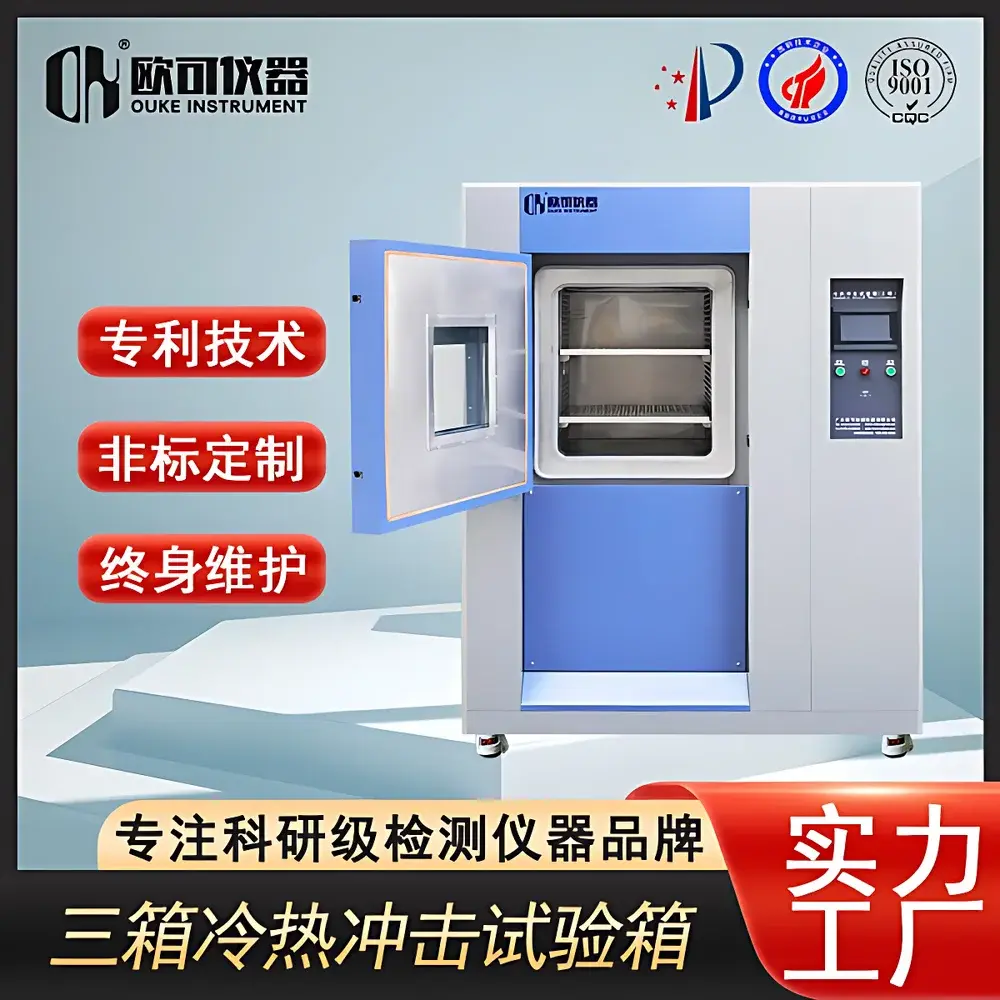
OK-TS-49.0011 LED Thermal Shock Test Chamber
| Brand | OK Instruments |
|---|---|
| Origin | Guangdong, China |
| Manufacturer Type | Direct Manufacturer |
| Model | OK-TS-49.0011 |
| High-Temperature Range | +150 °C |
| Low-Temperature Range | −50 °C |
| Thermal Shock Range | −50 °C to +150 °C |
| Temperature Stability | ±2 °C |
| Heating Rate | 10 °C/min |
| Cooling Rate | 10 °C/min |
Overview
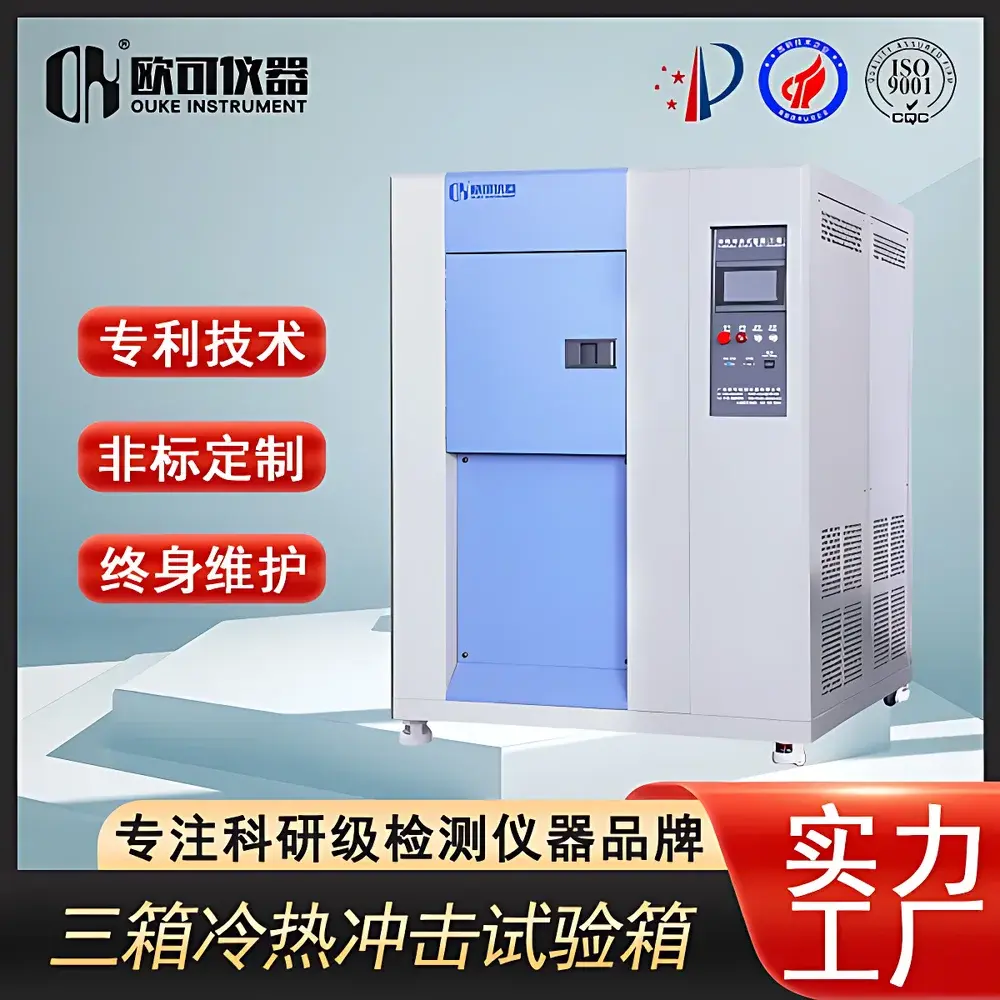
The OK-TS-49.0011 LED Thermal Shock Test Chamber is a dual-zone, mechanically actuated thermal shock system engineered for accelerated reliability validation of solid-state lighting components and assemblies. It operates on the principle of rapid, controlled temperature transition between independently conditioned high- and low-temperature chambers—enabling precise simulation of extreme ambient thermal transients encountered in real-world deployment environments. Unlike standard environmental chambers, this system prioritizes thermal inertia minimization and zone isolation integrity to achieve repeatable, high-fidelity shock profiles. The chamber is specifically optimized for LED-based products—including automotive headlamps, outdoor signage modules, architectural luminaires, and display backlight units—where material mismatch (e.g., AlN substrates, silicone encapsulants, FR-4 PCBs, and aluminum housings) induces interfacial stress under cyclic thermal loading. Its design conforms to the physical test requirements defined in IEC 60068-2-14 (Test N: Change of Temperature), with mechanical architecture supporting both qualification-level and production-line screening protocols.
Key Features
- Dual-chamber configuration with independent high-temperature (+150 °C) and low-temperature (−50 °C) zones, thermally isolated by vacuum-insulated stainless-steel partitions and inert gas purge capability.
- Mechanized sample transfer mechanism using a motor-driven basket with position-synchronized pneumatic locking, ensuring sub-60-second transition time between stable thermal zones.
- High-efficiency cascade refrigeration system with R404A/R23 mixed-refrigerant circuitry, enabling sustained cooling rates of 10 °C/min from +25 °C to −50 °C without compressor overload.
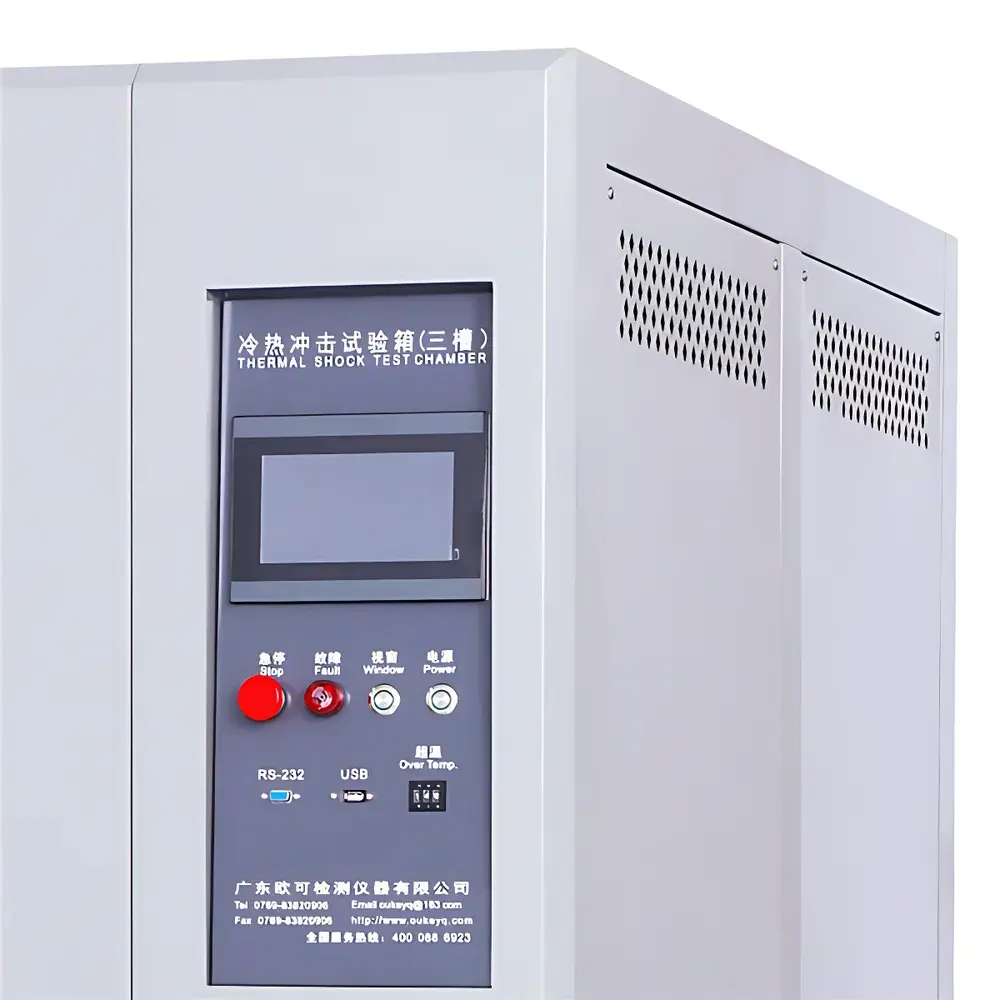
- Industrial-grade PID+ fuzzy logic temperature controller with 0.1 °C resolution, programmable ramp/soak profiles, and real-time deviation monitoring against setpoints.
- Stainless-steel interior (SUS304, 2B finish), reinforced structural frame, and double-glazed observation window with anti-fog heating element for continuous visual inspection during operation.
- Comprehensive safety architecture including over-temperature cut-off, refrigerant pressure monitoring, door interlock, and emergency power-off with manual reset.
Sample Compatibility & Compliance
The OK-TS-49.0011 accommodates LED modules up to 400 mm × 400 mm × 300 mm (W×D×H) on its standard load basket, rated for 25 kg static capacity. It supports both powered-in-use testing (via integrated 240 V AC feedthrough terminals) and passive thermal cycling. The chamber meets essential electromagnetic compatibility (EMC) requirements per EN 61326-1 and complies with electrical safety standards IEC 61010-1. While not certified to ISO/IEC 17025, its temperature uniformity (±2 °C across working volume) and stability metrics align with GLP-aligned laboratory validation practices. All operational parameters—including dwell times, transition sequences, and cycle counts—are traceable via timestamped internal logging, supporting audit readiness for ISO 9001:2015 and IATF 16949 quality management systems.
Software & Data Management
Equipped with OK-TCM v3.2 thermal control software, the system enables full-cycle programming with up to 99 segments per profile, including variable soak durations, ramp rates, and loop nesting. Data acquisition records temperature at 1 Hz from three calibrated PT100 sensors (high-zone, low-zone, and basket-mounted), exported in CSV format compliant with ASTM E29–23 rounding conventions. Audit trail functionality logs user actions, parameter changes, and alarm events with immutable timestamps—meeting baseline requirements for FDA 21 CFR Part 11 electronic record integrity when deployed in regulated manufacturing settings. Optional Ethernet/IP interface allows integration into MES or SCADA platforms via Modbus TCP.
Applications
- Accelerated life testing of LED package-level interconnects (e.g., die-attach voiding, wire bond lift-off, phosphor layer delamination).
- Evaluation of thermal interface material (TIM) performance under repeated expansion/contraction cycles between MCPCBs and heat sinks.
- Qualification of optical components—including PMMA lenses, silicone domes, and anti-reflective coatings—for resistance to microcracking and haze formation.
- Verification of driver electronics robustness, particularly electrolytic capacitor aging, MOSFET gate oxide stress, and solder joint fatigue in SMPS topologies.
- Pre-compliance screening against JESD22-A104 (Temperature Cycling) and GB/T 2423.22 for domestic and export-oriented LED manufacturers.
FAQ
What distinguishes a two-box thermal shock chamber from a three-box configuration?
A two-box system uses physical movement of the test specimen between isolated hot and cold zones, delivering faster thermal transitions and higher effective dT/dt at the sample surface. A three-box design maintains the sample stationary while routing conditioned air—making it suitable for live-operational testing but typically exhibiting slower effective shock rates due to air mass thermal inertia.
Does this chamber support automated cycling with unattended operation?
Yes—up to 999 cycles can be programmed and executed autonomously, with configurable pre-cycle stabilization, post-cycle cooldown, and fault-recovery logic that preserves data integrity upon power interruption.
Can temperature uniformity be verified and documented per ISO 17025 requirements?
While the chamber itself is not ISO/IEC 17025-accredited, its sensor layout, calibration traceability (NIST-traceable PT100 probes), and logging resolution fully support third-party validation per ISO/IEC 17025 Clause 6.4.1 when operated under documented SOPs.
Is the system compatible with industry-standard thermal shock test specifications such as MIL-STD-883 Method 1010?
The OK-TS-49.0011 meets the fundamental thermal range and transition rate requirements of MIL-STD-883 Method 1010.2 (Temperature Cycling), though full compliance requires additional instrumentation (e.g., external thermocouple attachment per Test Condition B) and procedural adherence to DoD-specific documentation protocols.
What maintenance intervals are recommended for sustained performance?
Refrigerant charge verification and condenser coil cleaning every 6 months; door gasket inspection and lubrication quarterly; annual recalibration of all PT100 sensors using a certified dry-block calibrator.



