
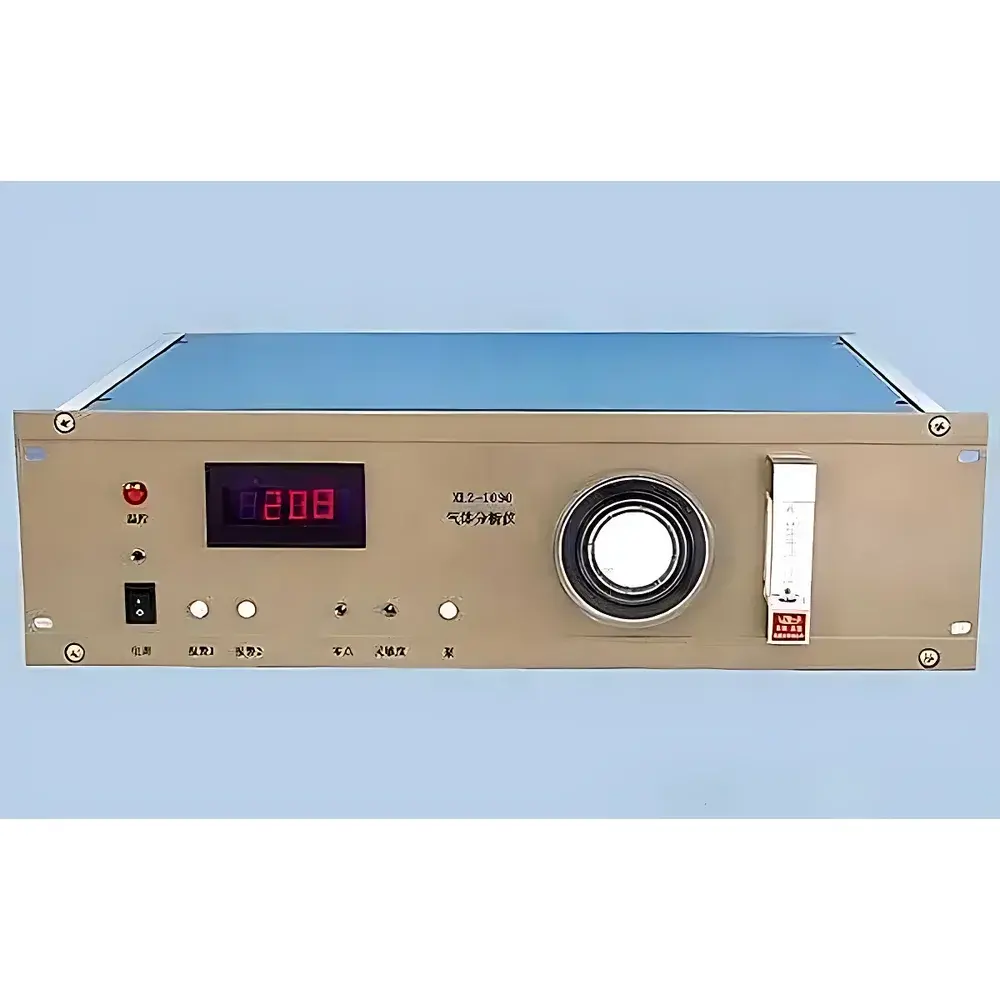
SIELINS XLZ-1090GXH NDIR Carbon Dioxide Analyzer
| Brand | SIELINS |
|---|---|
| Origin | Beijing, China |
| Model | XLZ-1090GXH |
| Principle | Non-Dispersive Infrared (NDIR) Absorption |
| Type | Online Fixed-Mount Gas Analyzer |
| Response Time (T90) | ≤15 s |
| Repeatability | ≤1% FS |
| Zero Drift | ≤±1% FS / 48 h |
| Span Drift | ≤±1% FS / 48 h |
| Linearity Error | ≤±1% FS |
| Detection Range | 0–50 ppm to 0–100% v/v (configurable) |
| Resolution | 1 ppm (trace), 0.01% v/v (major) |
| Sample Flow Rate | 0.5–3 L/min |
| Operating Temperature | 0–40 °C |
| Relative Humidity | ≤90% RH |
| Power Supply | 220 V ±10%, 50 ±0.5 Hz, 150 W |
| Output Signals | 4–20 mA, 0–20 mA, 0–10 mV, 1–5 V (load ≤600 Ω) |
| Display | Digital LCD with real-time concentration readout |
Overview
The SIELINS XLZ-1090GXH is a fixed-installation, non-dispersive infrared (NDIR) carbon dioxide analyzer engineered for continuous, real-time quantification of CO₂ in complex gas matrices. Its measurement principle relies on the characteristic absorption band of CO₂ near 4.26 µm — a region where infrared radiation is selectively attenuated in proportion to gas concentration, per the Beer-Lambert law. Unlike dispersive spectrometers, this instrument employs a single broadband IR source, a dual-compartment (half-cell) gas chamber, and a thermopile or pyroelectric detector optimized for high signal-to-noise ratio and long-term baseline stability. The optical architecture eliminates moving parts and spectral calibration drift, delivering robust performance in industrial and environmental monitoring applications where reliability over extended unattended operation is critical.
Key Features
- True NDIR architecture with single-source, half-cell gas cell design — minimizes cross-sensitivity to water vapor and common interferents (e.g., CO, CH₄) through spectral filtering and pressure/temperature compensation algorithms
- Digital signal processing core with auto-zero tracking and span validation routines — ensures metrological integrity across 48-hour intervals without manual intervention
- Configurable measurement range from trace-level (0–50 ppm) to full-scale (0–100% v/v), supporting both ambient air quality compliance and high-concentration process stream monitoring
- Fast T90 response time ≤15 seconds — validated per ISO 12039 and ASTM D6522 protocols for dynamic gas concentration tracking
- High-resolution output options including isolated 4–20 mA analog signal (≤600 Ω load), 1–5 V DC, and digital display with dual-unit capability (ppm/% v/v)
- Industrial-grade enclosure rated IP54 — suitable for mounting in control rooms, stack interfaces, or outdoor enclosures with temperature-controlled housing
Sample Compatibility & Compliance
The XLZ-1090GXH is validated for continuous analysis of CO₂ in multi-component gas streams containing CO, SO₂, CH₄, NH₃, H₂O, and N₂/O₂ background matrices — typical of flue gas, biogas, fermentation off-gas, and indoor air. It meets fundamental requirements of EN 15267-3 (QAL1 certification framework) and supports alignment with EPA Method 3A and ISO 21258 for CO₂ emission monitoring. While not pre-certified for CEMS (Continuous Emission Monitoring Systems), its stability metrics (≤±1% FS zero/span drift over 48 h) and repeatability (≤1% FS) satisfy preliminary qualification criteria under EU 2017/1405 and China’s HJ 75-2017 technical specifications for stationary source monitoring. Optional heated sample line integration mitigates condensation-related errors in high-humidity environments.
Software & Data Management
The analyzer operates autonomously with embedded firmware enabling local data logging (up to 30 days at 1-min intervals) and configurable alarm thresholds (high/low, rate-of-change). Analog outputs interface directly with PLCs, DCS systems, or SCADA platforms compliant with Modbus RTU (via optional RS-485 module). For regulatory reporting, the device supports audit-trail-ready operation when integrated with third-party data acquisition software compliant with FDA 21 CFR Part 11 — including electronic signature capture, user access levels, and immutable event logs for zero/span verification, calibration history, and fault diagnostics. All firmware updates are performed via secure USB interface with version rollback capability.
Applications
- Environmental monitoring: Ambient CO₂ surveillance in urban zones, landfill gas collection systems, and greenhouse gas inventory reporting per IPCC Tier 1 methodologies
- Industrial process control: Real-time CO₂ concentration feedback in cement kiln exhaust, syngas conditioning, ammonia synthesis purge streams, and ethanol fermentation tanks
- Indoor air quality (IAQ): Demand-controlled ventilation (DCV) in commercial buildings, schools, and healthcare facilities per ASHRAE Standard 62.1
- Research & development: Combustion efficiency studies, catalytic converter testing, soil respiration assays, and plant physiology experiments requiring sub-ppm resolution
- Public health infrastructure: CO₂ trending in subway stations, airports, and large-volume HVAC systems to assess ventilation adequacy and airborne pathogen risk mitigation
FAQ
Does the XLZ-1090GXH require periodic calibration with certified gas standards?
Yes — initial factory calibration is traceable to NIST-standard gas mixtures; field recalibration is recommended every 3–6 months depending on operating environment and regulatory requirements. Built-in zero/span verification simplifies routine checks.
Can the analyzer operate reliably in high-humidity flue gas applications?
It is designed for dry or moderately humid samples (≤90% RH); for saturated or condensing streams, integration with a Peltier-cooled or permeation-type sample conditioner is required to prevent optical window fouling and measurement bias.
Is the instrument compatible with explosion-proof hazardous area classifications?
The base unit is rated for non-hazardous locations (Class I, Division 2 not applicable); ATEX/IECEx-certified variants with intrinsic safety barriers are available upon request with modified housing and signal isolation.
What maintenance intervals are recommended for long-term operational continuity?
Optical path cleaning every 12 months, detector performance validation annually, and filter replacement (inlet particulate/sintered metal) every 6 months under continuous operation in dusty environments.
Does the device support remote diagnostics or predictive maintenance alerts?
Via optional RS-485 + Modbus integration, users can monitor internal diagnostics (lamp intensity, detector voltage, temperature stability) and configure threshold-based alerts for early degradation detection — enabling proactive service scheduling.
Related Products







