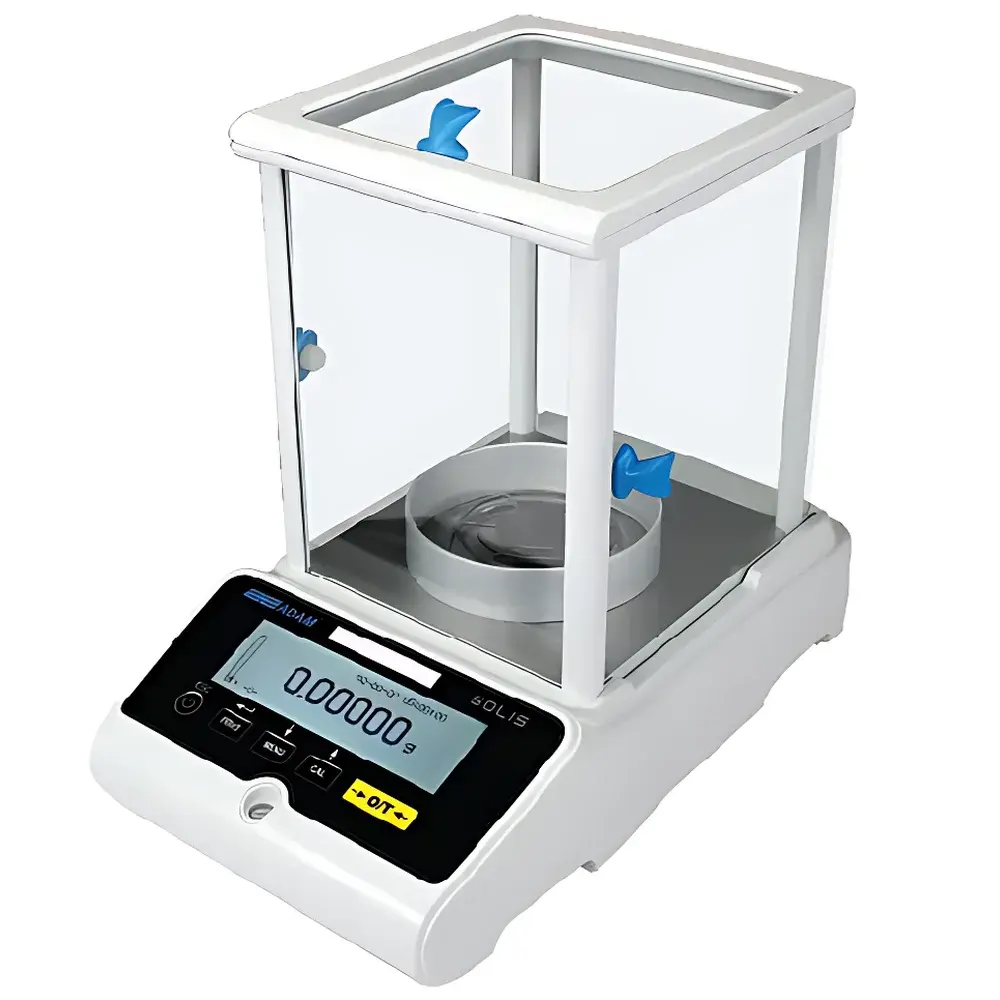
Adam Solis SAB Series Semi-Micro Analytical Balance
| Brand | Adam |
|---|---|
| Origin | United Kingdom |
| Manufacturer Type | Original Equipment Manufacturer (OEM) |
| Product Category | Imported Instrument |
| Model | SAB |
| Instrument Type | Analytical Balance |
| Capacity Range | 200–500 g |
| Readability | 0.01 mg (10 µg) / 0.1 mg (100 µg) |
| Calibration | Internal Automatic Calibration & External Calibration |
| Maximum Capacity | 510 g |
| Repeatability | 0.02 mg |
| Display | 15 mm high graphic LCD |
| Interface | RS-232 |
| Operating Temperature | 10–30 °C |
| Power Supply | 24 V DC, 50/60 Hz, 500 mA adapter |
| Net Weight | 6.7–7.0 kg |
| Dimensions (W×D×H) | 224 × 374 × 338 mm |
| Pan Size | 80 mm diameter |
| Draft Shield | Standard glass square draft shield (192 × 195 × 230 mm) |
| Housing Material | ABS plastic |
| Compliance | GLP-compliant data logging, password protection, audit-ready timestamped output |
Overview
The Adam Solis SAB Series Semi-Micro Analytical Balance is an engineered precision instrument designed for laboratories requiring trace-level mass measurement with metrological integrity. Built on a robust mechanical architecture and calibrated to international mass standards, the Solis SAB operates on electromagnetic force restoration (EMFR) principle—ensuring stable, drift-compensated measurements across variable environmental conditions. With readability down to 0.01 mg (10 µg) and repeatability of ±0.02 mg, it meets the performance criteria for Class I analytical applications as defined in OIML R 76 and ISO/IEC 17025-accredited environments. Its semi-micro designation reflects its optimized balance between ultra-fine resolution and practical working capacity—ideal for sample masses ranging from sub-milligram pharmaceutical actives to multi-gram reference standards in QC release testing.
Key Features
- Electromagnetic force restoration sensor with active temperature compensation and zero-tracking algorithm for long-term stability
- Internal automatic calibration (i-models) triggered by time, temperature drift, or user command; external calibration compatible with certified Class E2 or F1 weights (e-models)
- 15 mm high-contrast graphical LCD with adjustable backlight and intuitive icon-based navigation
- Integrated level indicator and dual-adjustment leveling feet for rapid horizontal alignment—critical for minimizing eccentric load error
- RS-232 serial interface compliant with standard ASCII protocol for seamless integration with LIMS, ELN, and statistical process control (SPC) software
- GLP-compliant data output: automatic timestamping (date/time), operator ID prompt, and printable audit trail including calibration history and weighing events
- Dual-mode security: configurable password protection (4-digit numeric or alphanumeric) restricting access to calibration, configuration, and data export functions
- Modular weighing modes: static weighing, parts counting (with preset unit weight), percentage weighing, checkweighing with visual/audible limit alerts, density determination (with optional kit), animal/dynamic weighing, formulation mode, and hold-lock display
- Stainless steel 304 weighing pan (80 mm Ø) and chemically resistant ABS housing rated IP42 for routine lab spill resilience
- Optional digital filtering (low/medium/high) to suppress mechanical vibration artifacts without compromising response time
Sample Compatibility & Compliance
The Solis SAB accommodates a broad spectrum of sample types—from hygroscopic powders and volatile solvents (when used under controlled draft shield conditions) to dense metallic alloys and porous polymer granules. Its square glass draft shield (192 × 195 × 230 mm) provides consistent airflow management and minimizes convection-induced errors per USP and ASTM E898 guidelines. All models comply with electromagnetic compatibility (EMC) per EN 61326-1 and safety standards EN 61010-1. The internal calibration mechanism satisfies ISO 9001 clause 7.6 requirements for measurement traceability, while GLP-aligned data handling—including immutable timestamps, user authentication, and non-editable printouts—supports regulatory submissions under FDA 21 CFR Part 11 and EU Annex 11 where electronic records are subject to audit.
Software & Data Management
Data capture is native via RS-232 using standard terminal emulation (e.g., Tera Term, PuTTY) or vendor-neutral SCPI command sets. Output formats include tab-delimited ASCII strings containing measured value, unit, status flag (e.g., “STABLE”, “UNSTABLE”), date/time stamp, and operator code. When connected to laboratory informatics systems, the Solis SAB supports automated data ingestion into validated platforms such as LabWare LIMS or Thermo Fisher SampleManager. Optional Windows-based Adam DU software enables real-time graphing, statistical analysis (mean, SD, CV%, min/max), batch report generation, and export to CSV/PDF. All data logs retain full metadata required for ISO/IEC 17025 clause 7.7 traceability audits.
Applications
- Pharmaceutical quality control: assay validation, content uniformity testing, and reference standard preparation per USP and EP 2.1.3
- Academic research: stoichiometric reagent dosing, catalyst loading quantification, and nanomaterial mass fraction analysis
- Materials science: powder blend homogeneity assessment, coating thickness calculation via mass loss, and additive manufacturing feedstock verification
- Food & beverage QA: nutritional labeling compliance, moisture content determination (via gravimetric loss-on-drying), and allergen threshold verification
- Environmental testing labs: filter weighing for PM2.5/PM10 analysis per EPA Method IO-4.2 and ISO 12103-1
- Contract manufacturing organizations (CMOs): GMP-aligned batch record generation with electronic signature support
FAQ
What is the difference between ‘i’ and ‘e’ model suffixes in the SAB series?
The ‘i’ denotes internal automatic calibration (motor-driven calibrator built-in); ‘e’ indicates external calibration only—requiring manual placement of certified weights.
Is the Solis SAB compliant with FDA 21 CFR Part 11?
Yes—when used with password-controlled access, timestamped output, and non-modifiable print/export logs, it fulfills electronic record and signature requirements for regulated environments.
Can the balance be integrated into a networked lab environment?
While natively RS-232, Ethernet or Wi-Fi connectivity requires an external serial-to-Ethernet converter; Adam provides configuration guidance for common industrial gateways.
What maintenance intervals are recommended for optimal performance?
Daily verification with traceable check weights, quarterly sensitivity testing, and annual full recalibration by an ISO/IEC 17025-accredited service provider are advised.
Does the draft shield affect measurement accuracy for static versus dynamic samples?
The square glass shield maintains laminar airflow; however, for highly volatile or thermally unstable samples, pre-equilibration inside the shield for ≥60 seconds prior to tare is recommended per ASTM E898-22 section 6.3.