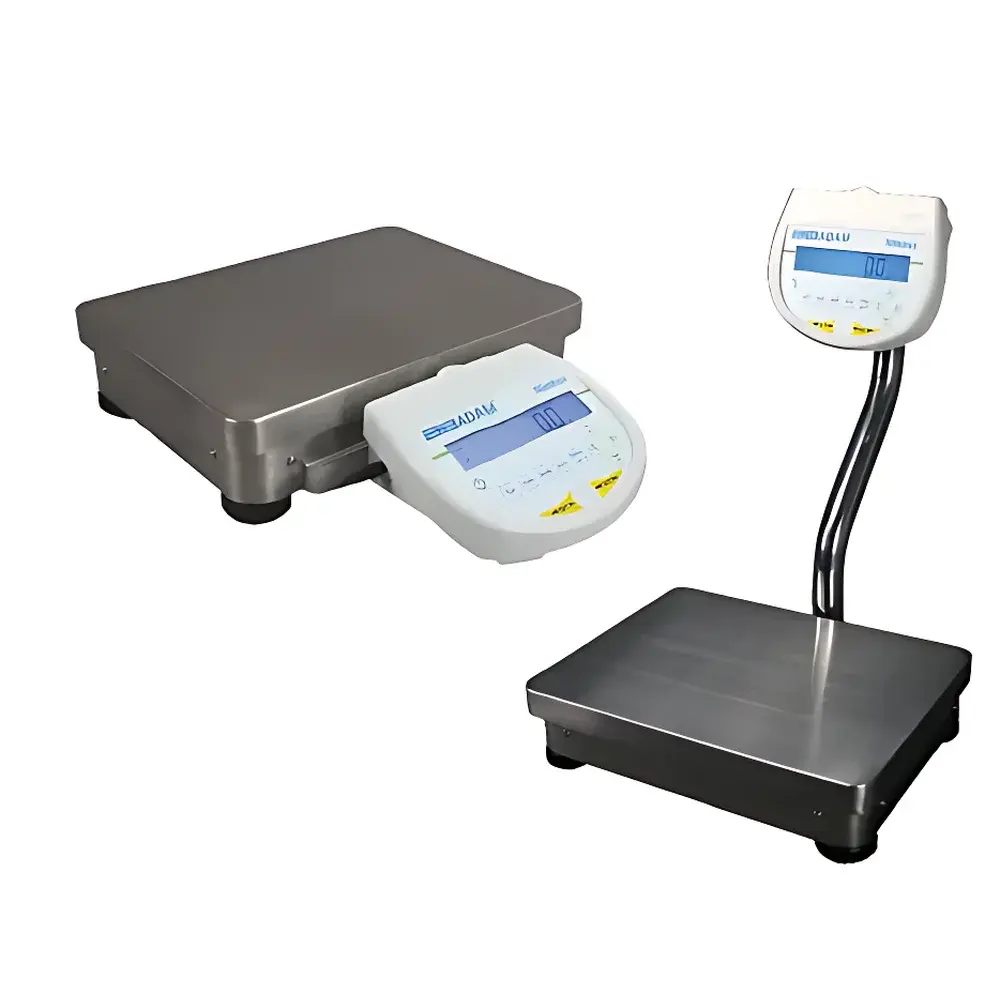
Adam Nimbus High-Capacity Precision Balance
| Brand | Adam |
|---|---|
| Origin | UK |
| Manufacturer | Adam Equipment |
| Model | NBL / NBL-p |
| Capacity | 2000–5000 g (up to 32,000 g) |
| Readability | 0.1 g |
| Internal Resolution | 0.00001 g (10 µg) |
| Repeatability | ±0.2 g |
| Linearity Error | ±0.4 g |
| Operating Temperature | 0–40 °C |
| Power Supply | 12 V DC, 50/60 Hz, 800 mA |
| Display | Backlit LCD (digit height 20 mm) |
| Weighing Pan | 304 Stainless Steel (400 × 300 mm) |
| Dimensions (W×D×H) | 401 × 460 × 102 mm (base), column: 401 × 500 × 600 mm |
| Net Weight | 4.5–7.3 kg |
| Communication | USB + bidirectional RS-232 |
| Weighing Modes | Standard, Net/Gross, Checkweighing, Percentage, Piece Counting, Animal/Dynamic, Density, Below-Balance |
Overview
The Adam Nimbus High-Capacity Precision Balance is an industrial-grade analytical and semi-micro weighing platform engineered for laboratories and production environments requiring high stability, long-term repeatability, and traceable metrological performance at elevated capacities. Unlike conventional precision balances limited to sub-5 kg ranges, the Nimbus series leverages electromagnetic force restoration (EMFR) technology combined with a robust cast-aluminum monocoque chassis to deliver 0.1 g readability across capacities up to 32,000 g — bridging the functional gap between precision balances and compact floor scales. Its design prioritizes mechanical isolation: integrated leveling feet and real-time bubble-level indicators ensure gravitational vector alignment under variable floor conditions, while the hermetically sealed keypad and corrosion-resistant 304 stainless-steel pan mitigate contamination risks in QC labs, pharmaceutical manufacturing, and materials testing facilities. The balance operates within ISO 9001-certified environmental tolerances (0–40 °C, ≤80% RH non-condensing) and conforms to international metrological requirements defined in OIML R76-1 and EN 45501 for Class II and III instruments.
Key Features
- Backlit LCD display with 20 mm digit height — optimized for visibility in low-light or high-glare environments, including cleanrooms and warehouse loading bays
- Full cast-aluminum, oxidation-resistant housing — provides structural rigidity, thermal mass stabilization, and EMI shielding without compromising serviceability
- Dual-side tare keys — ergonomically positioned for ambidextrous operation during high-throughput batch weighing
- Configurable digital filtering — adjustable damping parameters suppress mechanical vibration from adjacent equipment (e.g., HVAC units, centrifuges, or conveyors)
- Zero-tracking algorithm — dynamically compensates for minor drift due to air currents or thermal settling, maintaining zero stability over extended measurement cycles
- Multi-unit support — includes g, kg, ct, GN, N, lb, oz, ozt, dwt, and one user-definable unit — enabling seamless integration into global supply chain documentation workflows
- Internal temperature monitoring — triggers automatic recalibration when ambient deviation exceeds ±1.5 °C from last calibration event, ensuring continuous traceability
Sample Compatibility & Compliance
The Nimbus accommodates heterogeneous sample forms — from bulk powders and granular APIs in pharmaceutical blending operations to machined metal components in aerospace QA. Its 400 × 300 mm stainless-steel pan supports oversized or irregularly shaped items, while the optional below-balance hook assembly enables suspended density determination per ASTM D792 and ISO 1183-1. All models meet CE marking requirements under the Measuring Instruments Directive (MID 2014/32/EU) and are validated for GLP-compliant data integrity when paired with compliant printers or LIMS interfaces. External calibration using certified Class M1 or M2 weights satisfies ISO/IEC 17025 clause 6.5.2 and FDA 21 CFR Part 11 audit trail prerequisites when timestamped calibration logs are exported via RS-232.
Software & Data Management
Data capture is natively supported through dual serial protocols: USB CDC class (plug-and-play with Windows/macOS/Linux) and hardware-handshaking RS-232 (compatible with legacy label printers, SPC software, and ERP systems like SAP QM). Each weighing record includes embedded metadata — date/time stamp (RTC-synchronized), operator ID field, gross/net/tare flags, and unit identifier — eliminating manual transcription errors. Optional Adam DU software enables automated report generation (PDF/CSV), statistical process control charting (X̄-R, Cpk), and electronic signature capture for regulated environments. All firmware updates are digitally signed and delivered via secure HTTPS, preserving cryptographic integrity per IEC 62443-3-3.
Applications
- Pharmaceutical: Raw material receipt inspection, blend uniformity testing, and tablet weight variation per USP <41>
- Food & Beverage: Batch formulation verification, net content compliance (EU Directive 76/211/EEC), and HACCP critical control point monitoring
- Materials Science: Density profiling of composites, powder flow characterization, and alloy composition validation
- Academic Research: Gravimetric analysis of catalysts, soil moisture content determination, and polymer degradation kinetics
- Manufacturing QA: Component count verification, torque wrench calibration load application, and casting defect analysis via mass deviation mapping
FAQ
Does the Nimbus support internal calibration?
Internal calibration is not available on standard NBL/NBL-p models; only external calibration using traceable weights is supported. This design ensures metrological transparency and eliminates dependency on proprietary calibration masses.
Can the balance be used in a humid environment?
Yes — the IP54-rated enclosure (per IEC 60529) protects against dust ingress and water splashes. However, prolonged exposure to >80% RH or condensation requires environmental conditioning per ISO 17025 clause 5.3.2.
Is GLP-compliant audit trail functionality built-in?
Audit trails require external software (e.g., Adam DU or third-party LIMS); the balance itself transmits immutable timestamped data packets but does not store or manage user access logs internally.
What is the warm-up time required before first use?
Minimum 30 minutes at stable ambient temperature (±2 °C/hour variation) is recommended to achieve thermal equilibrium in the EMFR sensor and analog front-end circuitry.
Are replacement pans and leveling feet available as spare parts?
Yes — all mechanical components, including 304 SS pans (P/N: NBL-PAN), adjustable feet kits (P/N: NBL-FOOT-KIT), and RS-232 cables (P/N: CAB-RS232), are stocked globally and ship with ISO 17025-accredited calibration certificates.