
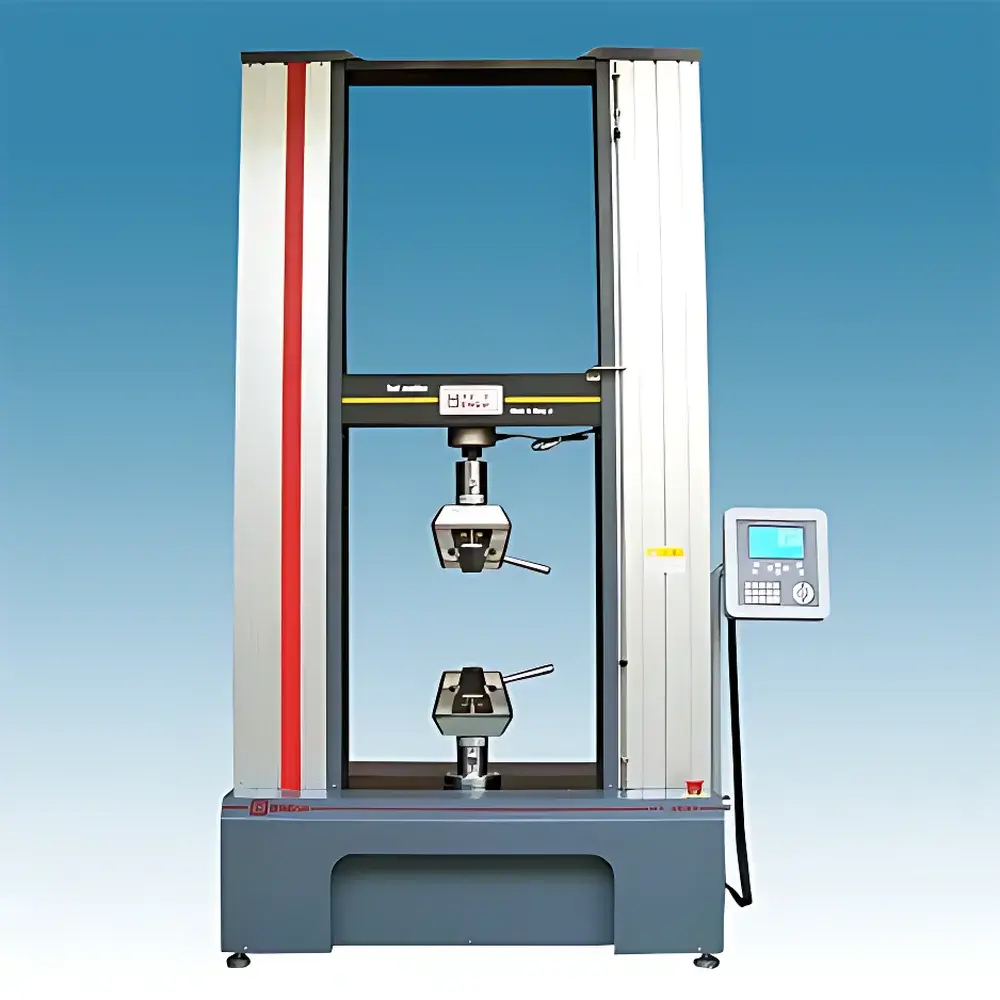
Hengyi HY-10080FRR 100 kN Electromechanical Universal Testing Machine
| Brand | Hengyi / Hengyitest |
|---|---|
| Origin | Shanghai, China |
| Manufacturer Type | Direct Manufacturer |
| Regional Category | Domestic (China) |
| Model | HY-10080FRR |
| Instrument Type | Electromechanical Universal Testing Machine |
| Load Capacity | 100 kN |
| Accuracy Class | ≤ 0.5% |
| Effective Test Width | 600 mm |
| Effective Test Height | 800 mm |
| Speed Range | 0.001–500 mm/min |
| Force Resolution | ±500,000 counts (full-scale, no range switching) |
| Displacement & Strain Measurement Accuracy | ±0.5% of reading |
| Stress/Strain Control Rate Accuracy | ±0.5% of set value (≥0.05% FS/s) |
| Power Supply | 220 V AC, 2000 W |
| Weight | 1250 kg |
| Dimensions (W×D×H) | 1000 × 680 × 2200 mm |
Overview
The Hengyi HY-10080FRR is a high-rigidity, dual-column electromechanical universal testing machine engineered for precision static mechanical characterization of materials across research, quality control, and production environments. Based on servo-controlled electromechanical actuation and compliant with ISO 7500-1, ASTM E4, and GB/T 228.1 standards, it delivers traceable force measurement, repeatable displacement control, and robust data integrity under both tension and compression loading modes. Its modular frame architecture supports single- or dual-test-space configurations, enabling simultaneous or sequential evaluation of specimens requiring different fixtures or environmental conditions. Designed for long-term stability and minimal maintenance, the system integrates high-precision load cells, preloaded ball screws, and industrial-grade motion control to ensure consistent performance across thousands of test cycles—critical for laboratories operating under GLP, GMP, or ISO/IEC 17025 accreditation requirements.
Key Features
- Heavy-duty dual-column steel frame with optimized stiffness-to-weight ratio; optional dual-test-space configuration available for concurrent tensile/compression or multi-specimen workflows.
- High-torque Panasonic AC servo motor and digital driver—zero-maintenance operation with smooth torque delivery across full speed range (0.001–500 mm/min).
- Two preloaded, ground-precision ball screws with anti-backlash design ensure axial alignment stability and eliminate mechanical hysteresis during cyclic loading.
- Imported bidirectional load cell (U.S.-sourced) with automatic sensor recognition, calibrated to ±0.5% accuracy per ISO 376, supporting seamless interchange of transducers from 1 N to 100 kN.
- Digital controller with open/closed-loop operation modes, multilingual UI (English, German, French, Spanish, Chinese), and unit conversion (N, kN, lbf, kgf, MPa, psi) without firmware reconfiguration.
- Ergonomic handheld remote control for jog-mode positioning, emergency stop, and rapid test initiation—reducing operator fatigue during high-throughput screening.
Sample Compatibility & Compliance
The HY-10080FRR accommodates an extensive spectrum of specimen geometries and material classes, including thin films (e.g., PVDF, PET), elastomers (silicone, EPDM), fine wires (<0.1 mm diameter), biomedical sutures, metallic foils (Cu, Al, NiTi), composite laminates, thermoplastic polymers (PP, PC, PEEK), adhesives, packaging substrates (corrugated board, blister foil), and structural components (fasteners, weld joints, automotive interior trim). All standard test methods—including ASTM D638 (tensile), D790 (flexure), D143 (wood), ISO 527, ISO 178, and GB/T 1040—are directly executable via preset method templates. The system supports full compliance documentation: factory calibration certificates (traceable to NIM, China), optional Shanghai Institute of Measurement verification report, and audit-ready electronic records compatible with FDA 21 CFR Part 11 when paired with validated software modules.
Software & Data Management
Bundled with HengyiTest Pro v4.x, the platform provides real-time data acquisition at up to 10 kHz sampling rate, synchronized force-displacement-strain logging, and automated calculation of key mechanical parameters: Young’s modulus (E), yield strength (Rp0.2), ultimate tensile strength (UTS), elongation at break (%EL), compressive yield stress, flexural modulus, peel adhesion (N/mm), and tear resistance (kN/m). Raw data exports in ASCII, CSV, and XML formats ensure interoperability with MATLAB, Python (Pandas), and LIMS systems. Audit trail functionality logs user actions, parameter changes, and calibration events—meeting ISO/IEC 17025 clause 7.7 and GLP Principle 5 requirements. Optional cloud sync enables secure remote monitoring and cross-site result comparison without exposing internal network infrastructure.
Applications
- Materials R&D: Quantifying strain-rate sensitivity of shape-memory alloys, creep behavior of polymer blends, and interfacial shear strength in fiber-reinforced composites.
- Medical Device Validation: Tensile testing of suture threads per ISO 10993-12, compression testing of orthopedic foam scaffolds, and peel strength assessment of sterile barrier packaging.
- Automotive QA: Evaluating weld integrity of battery busbars, tensile strength of seatbelt webbing (FMVSS 209), and compression set of NVH damping pads.
- Renewables Sector: Mechanical qualification of photovoltaic ribbon solder joints (IEC 61215), tensile strength of wind turbine blade root bonds, and flexural rigidity of composite spar caps.
- Electronics Manufacturing: Bond strength verification of die attach materials, pull-test validation of wire bonds (MIL-STD-883 Method 2011), and bending fatigue of flexible PCBs.
FAQ
What standards does the HY-10080FRR comply with for force calibration?
It conforms to ISO 7500-1 Class 0.5, ASTM E4, and JJG 139–2014 (Chinese national metrology regulation), with factory calibration traceable to the National Institute of Metrology (NIM), China.
Can the system perform closed-loop strain control for ASTM E8/E21 tests?
Yes—equipped with optional extensometers (contact or non-contact), it supports strain-controlled ramping and hold protocols per ASTM E8 (metals) and E21 (high-temperature testing).
Is the controller compatible with third-party data acquisition systems?
The device features Ethernet TCP/IP and RS-232 interfaces with Modbus RTU/ASCII protocol support, enabling integration into SCADA or custom LabVIEW-based test orchestration platforms.
What safety certifications does the mechanical frame carry?
The structure meets CE Machinery Directive 2006/42/EC requirements, including EN ISO 13857 (safe distances) and EN 60204-1 (electrical safety), with documented risk assessment per ISO 12100.
How is system validation performed for regulated environments?
IQ/OQ/PQ protocols are provided with purchase; installation qualification includes dimensional verification, operational qualification covers speed/force/position linearity checks, and performance qualification uses certified reference specimens per ISO 9513.



