
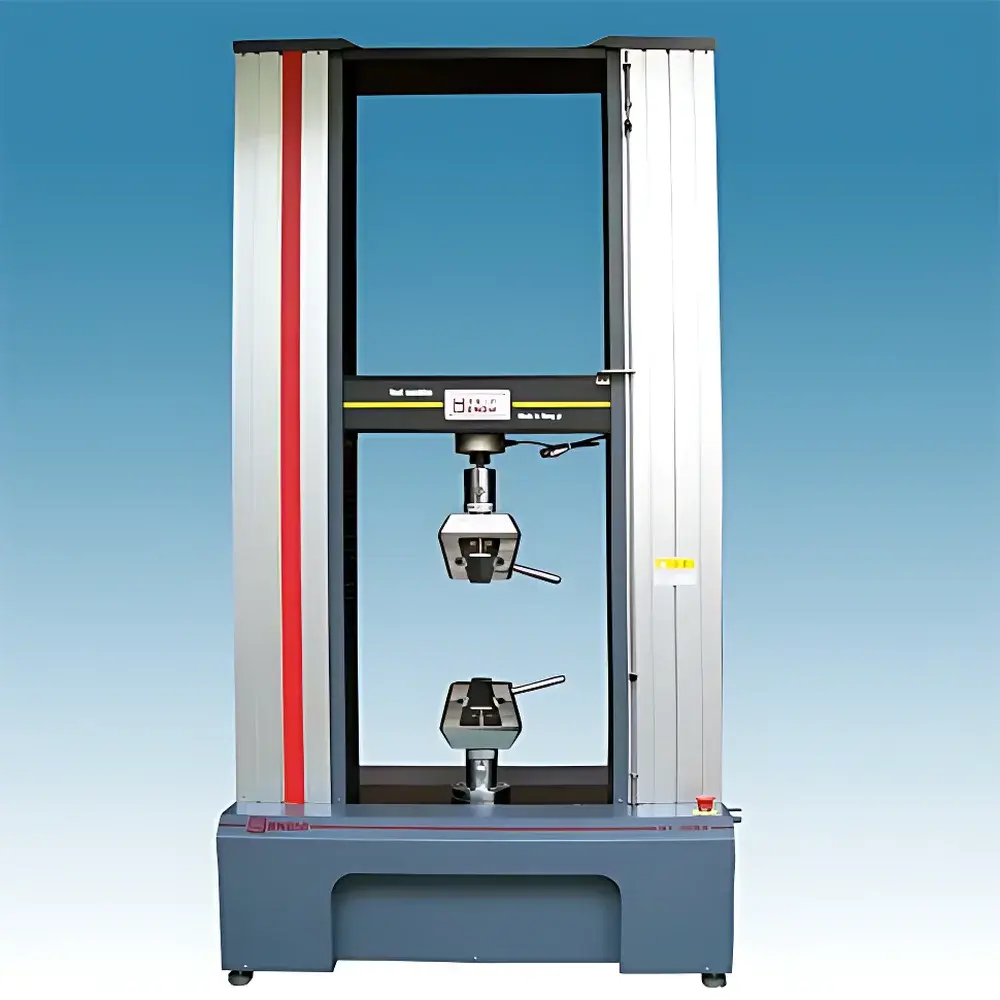
Hengyi HY-10080 100 kN Floor-Standing Electromechanical Tensile Testing Machine
| Brand | Hengyi |
|---|---|
| Origin | Shanghai, China |
| Manufacturer Type | Direct Manufacturer |
| Product Category | Domestic |
| Model | HY-10080 |
| Instrument Type | Electromechanical Tensile Tester |
| Maximum Test Load | 100 kN |
| Force Measurement Range | 0.001–100% FS |
| Force Accuracy | ±0.5% of reading |
| Test Stroke | 800 mm |
| Displacement Resolution | 0.001 mm |
| Speed Range | 0.001–500 mm/min |
| Speed Accuracy | ±0.5% of set value |
| Position Accuracy | ±0.5% of reading |
| Strain Control Range | 0.002–6% FS/s |
| Stress Control Range | 0.005–6% FS/s |
| Load Cell Resolution | ±500,000 counts (full-scale, no range switching) |
| Effective Test Width | 600 mm (expandable) |
| Power Supply | 220 V AC, 2 kW |
| Machine Weight | 1250 kg |
| Dimensions (W×D×H) | 1000 × 680 × 2200 mm |
Overview
The Hengyi HY-10080 is a floor-standing, electromechanical universal testing machine engineered for high-fidelity static mechanical characterization of metallic and non-metallic materials under uniaxial tension, compression, bending, shear, peel, tear, and cyclic loading conditions. Based on servo-controlled electromechanical actuation and compliant with ISO 7500-1 Class 0.5 calibration standards, the system delivers traceable force measurement across its full 100 kN capacity — enabling precise determination of tensile strength, yield strength (Rp0.2, Rp0.5), Young’s modulus (E), elongation at break, proof strength, compressive yield, flexural modulus, and fracture behavior. Its rigid double-column frame architecture minimizes deflection under load, ensuring high reproducibility in chain-specific applications such as conveyor chain, traction chain, plate chain, and specialty alloy chain qualification per ASTM A977, ISO 15630-3, and EN 81-30 requirements.
Key Features
- Class 0.5 force accuracy certified per ISO 7500-1, with ±0.5% reading uncertainty over 0.001–100% full scale
- High-resolution displacement sensing (0.001 mm) and closed-loop strain control (0.002–6% FS/s)
- Adjustable crosshead travel (800 mm standard; extendable) and test width (600 mm base; customizable)
- Dual-speed motorized crosshead drive (fast positioning + fine test speed control from 0.001 to 500 mm/min)
- Integrated electronic limit switches, overload protection (110% FS cutoff), and real-time self-diagnostic monitoring of load cell, drive, and power systems
- Robust structural design: 1250 kg cast-iron and steel frame with reinforced base plate and vertical column alignment
- Comprehensive safety suite: emergency stop, software-based load/displacement/strain termination triggers, and automatic return-to-home post-test
Sample Compatibility & Compliance
The HY-10080 accommodates a broad spectrum of standardized and custom specimens — including welded chain links (up to 5 mm galvanized steel plate equivalents), polymer-coated cables, PV ribbon interconnects, biomedical sutures, automotive fasteners, composite laminates, and flexible packaging substrates. It supports specimen geometries compliant with ASTM D638, ISO 527-2 (tensile), ASTM D790 (flexure), ASTM D1876 (T-peel), ASTM D624 (tear), ISO 1133 (melt flow index correlation), and EN 10002-1. All hardware and firmware configurations are designed for GLP/GMP-aligned environments: audit trails, user access levels, electronic signatures, and data integrity safeguards align with FDA 21 CFR Part 11 requirements when paired with validated Hengyi TestMaster™ software.
Software & Data Management
TestMaster™ v4.x — the native Windows-based control and analysis platform — provides real-time force-displacement-strain synchronization, multi-curve overlay, automated calculation of ISO/ASTM-defined mechanical parameters, and export-ready reporting in PDF, Excel, and XML formats. The software supports method templates for chain tensile protocols (e.g., preload ramp, constant-rate extension, break detection with energy absorption integral), batch testing queues, and configurable pass/fail criteria against specification limits. Raw data files include timestamped metadata (operator ID, environmental conditions, calibration status), and all processing steps are fully traceable. Optional integration with LIMS via HL7 or OPC UA ensures seamless data flow into enterprise quality management systems.
Applications
- Tensile strength and elongation testing of industrial chains (roller, silent, leaf, and engineering class) per DIN 766, ISO 692, and ANSI B29.1
- Mechanical validation of welded joints, heat-affected zones, and surface-treated chain components
- Peel strength assessment of coated or laminated chain surfaces (90°, 180°, T-peel per ASTM D903)
- Compression testing of sprocket teeth, bushings, and bearing inserts
- Bending fatigue simulation via controlled moment application on chain segments
- Characterization of high-strength alloys (e.g., stainless 410, alloy 800H), polymer composites, and wire rope assemblies
- Quality assurance in automotive supply chains (e.g., timing chains, seatbelt pretensioner cables)
- R&D support for material substitution studies, thermal aging effects, and corrosion resistance evaluation
FAQ
What standards does the HY-10080 comply with for force calibration?
It meets ISO 7500-1 Class 0.5 requirements, with factory calibration traceable to NIM (National Institute of Metrology, China) and optional UKAS-accredited third-party verification.
Can the machine perform cyclic loading tests?
Yes — with TestMaster™ software, users can define stepwise load/displacement waveforms (sine, triangle, trapezoidal) and configure dwell periods, peak limits, and cycle termination conditions.
Is it possible to upgrade the load cell capacity post-purchase?
The system supports modular load cell interchange (e.g., 10 kN, 50 kN, 100 kN) using standardized mounting interfaces and auto-recognition firmware.
Does the system include environmental chamber compatibility?
Standard configuration operates at ambient conditions (10–35°C, ≤80% RH); optional temperature-controlled chambers (−70°C to +300°C) integrate via mechanical docking and digital I/O handshaking.
How is data integrity ensured during long-duration tests?
All raw sensor data is logged at ≥1 kHz sampling rate with embedded CRC checksums; file encryption and write-once archival modes prevent post-acquisition modification.



