
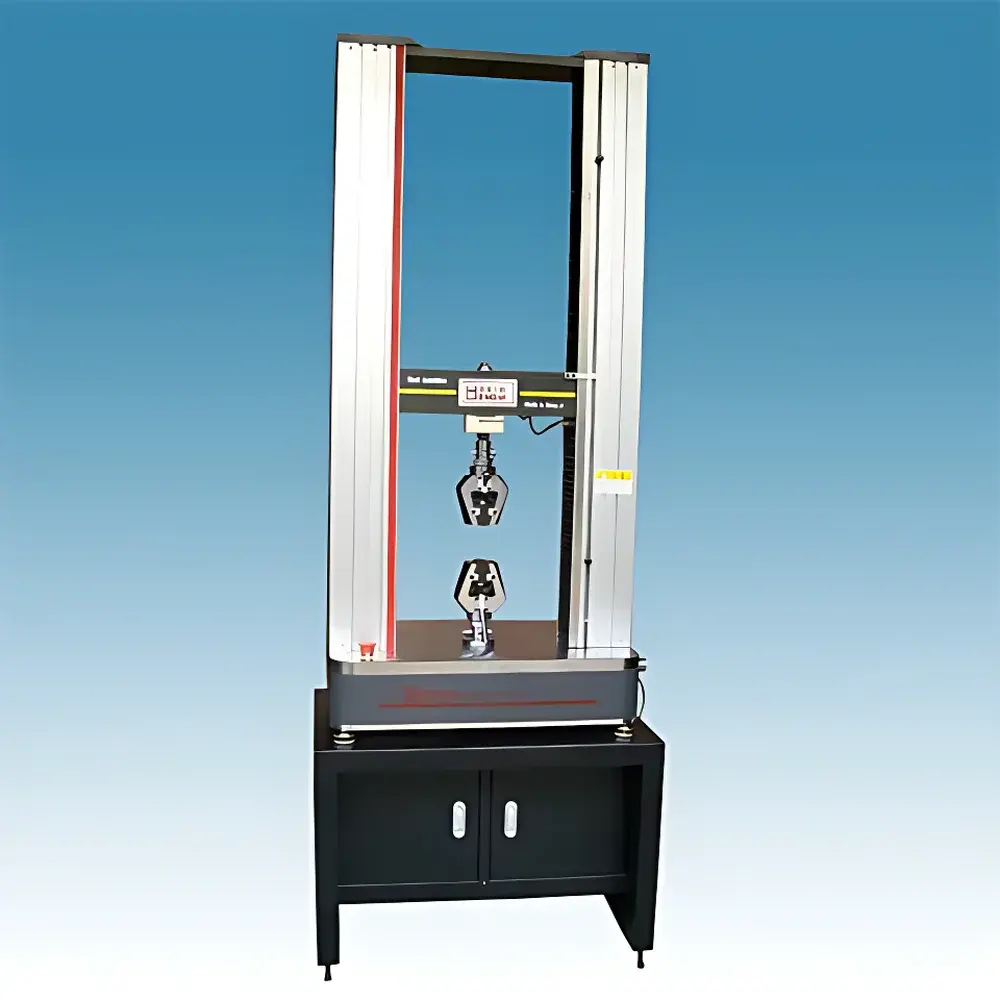
Hengyi HY-3080RTTYHB Electromechanical Universal Tensile Testing Machine
| Brand | Hengyi / Hengyitest |
|---|---|
| Origin | Shanghai, China |
| Manufacturer Type | OEM Manufacturer |
| Regional Category | Domestic (China) |
| Model | HY-3080RTTYHB |
| Instrument Type | Electromechanical Tensile Testing Machine |
| Maximum Test Load | 30 kN |
| Force Measurement Range | 30 N – 30 kN (0.1%–100% FS) |
| Force Accuracy | ≤ ±0.5% of reading |
| Crosshead Travel | 800 mm |
| Displacement Resolution | 0.001 mm |
| Speed Range | 0.001–1000 mm/min |
| Speed Accuracy | ±0.5% of set value |
| Strain/Displacement Accuracy | ±0.5% of reading |
| Stress Control Rate Range | 0.005–6 %FS/S |
| Strain Control Rate Range | 0.002–6 %FS/S |
| Load Cell Resolution | ±500,000 counts (full-scale,不分档) |
| Effective Test Width | 380 mm (expandable) |
| Power Supply | 220 V AC, 0.75 kW |
| Host Dimensions | 700 × 420 × 1600 mm |
| Net Weight | 210 kg |
Overview
The Hengyi HY-3080RTTYHB is a precision-engineered electromechanical universal tensile testing machine designed for static mechanical property evaluation of solid materials under uniaxial loading conditions. Based on servo-controlled electromechanical actuation and high-fidelity load/displacement feedback, it implements standardized quasi-static testing protocols in accordance with ISO 6892-1, ASTM E8/E21, ASTM D638, ISO 527, ISO 179, and GB/T 228.1. Its dual-column rigid frame architecture ensures minimal deflection during high-load operation (up to 30 kN), while the preloaded precision ball screws and bidirectional load cell deliver stable force transmission and high repeatability across the full measurement range (30 N to 30 kN). The system supports both open-loop speed control and closed-loop stress/strain rate control modes—enabling compliance with method-specific regulatory requirements in quality assurance, R&D, and certification laboratories.
Key Features
- Robust dual-column steel frame with optimized rigidity and thermal stability, minimizing frame compliance and enhancing measurement fidelity at high loads.
- High-torque, maintenance-free servo motor and digital servo driver delivering smooth, low-noise motion across the full speed range (0.001–1000 mm/min) with ±0.5% speed accuracy.
- Pre-tensioned, ground-precision ball screws (dual) ensuring axial alignment, minimal backlash, and long-term positional repeatability.
- Calibrated bidirectional load cell (30 kN capacity) with internal 500,000-count A/D resolution, offering consistent linearity and hysteresis < ±0.05% FS across the entire range without range switching.
- Digital controller supporting multi-language UI (English, Chinese, Spanish, German, French), unit conversion (N, kN, lbf, kgf), and configurable control modes (load, displacement, strain, or stress rate).
- Integrated safety architecture including electronic travel limits, overload protection (>110% FS), real-time system diagnostics, and emergency stop circuitry compliant with IEC 61800-5-2.
- Portable hand-held controller for intuitive jog, start/stop, and parameter adjustment—reducing operator dependency on PC interface during routine testing.
Sample Compatibility & Compliance
The HY-3080RTTYHB accommodates a broad spectrum of specimen geometries and material classes—including thin films (e.g., PET, PE, BOPP), elastomers, metallic foils (Al, Cu), photovoltaic interconnect ribbons, biomedical tubing, suture threads, orthopedic fasteners, polymer composites, and cellular foams. Standardized grips (pneumatic, wedge, vise, and custom fixtures) enable secure clamping without slippage or premature failure. All force, displacement, and strain measurements conform to ISO/IEC 17025 traceability requirements when used with accredited calibration certificates. The system supports audit-ready data integrity features aligned with FDA 21 CFR Part 11 principles—including user-level access control, electronic signatures, and immutable audit trails—when paired with validated software modules.
Software & Data Management
The embedded controller provides real-time plotting of force–displacement, stress–strain, and modulus curves with auto-scaling axes and dynamic grid overlay. Post-test analysis includes automatic yield point detection (0.2% offset, tangent, or maximum slope methods), tensile strength, elongation at break, Young’s modulus, and secant modulus calculation. Raw data export is supported in CSV and XML formats for integration into LIMS or statistical process control (SPC) platforms. Optional PC-based software extends functionality with customizable test method templates, batch reporting, GLP-compliant electronic lab notebook (ELN) logging, and automated report generation per ISO 14289 or ASTM E1434. All calculations are performed using deterministic algorithms implemented in compiled C++—not interpreted scripting—ensuring numerical reproducibility across installations.
Applications
This system serves as a primary mechanical characterization tool in accredited metrology labs, QC departments of automotive Tier-1 suppliers, polymer R&D centers, medical device manufacturers (ISO 10993-12 compliant), packaging validation labs (ASTM D882), photovoltaic component testing facilities, and university materials science programs. Typical use cases include tensile property verification of battery electrode coatings, adhesion strength assessment of pressure-sensitive tapes, creep behavior analysis of thermoplastic elastomers, and mechanical screening of biodegradable sutures under simulated physiological strain rates. Its modular design permits future upgrades such as environmental chambers (-70°C to +250°C), video extensometry, or digital image correlation (DIC) integration.
FAQ
What standards does the HY-3080RTTYHB comply with for tensile testing?
It supports execution of tests per ISO 6892-1, ASTM E8, ASTM D638, ISO 527, ISO 179, and GB/T 228.1—subject to proper calibration, fixture selection, and operator training.
Can the system perform closed-loop strain-controlled testing?
Yes—it supports strain rate control from 0.002% to 6% FS/S with accuracy better than ±0.5% of set rate above 0.05% FS/S.
Is the load cell calibrated and traceable to national standards?
Each unit ships with a factory calibration certificate traceable to CNAS-accredited standards; optional UKAS or DAkkS-certified recalibration services are available.
Does the controller support automated pass/fail evaluation based on specification limits?
Yes—user-defined acceptance criteria (e.g., min. tensile strength ≥ 45 MPa, elongation ≥ 25%) can be programmed and enforced during test execution.
What is the recommended maintenance schedule?
No scheduled lubrication is required for the servo drive or ball screws; annual verification of load cell linearity, displacement encoder accuracy, and safety interlocks is advised per ISO/IEC 17025 internal audit protocols.



