
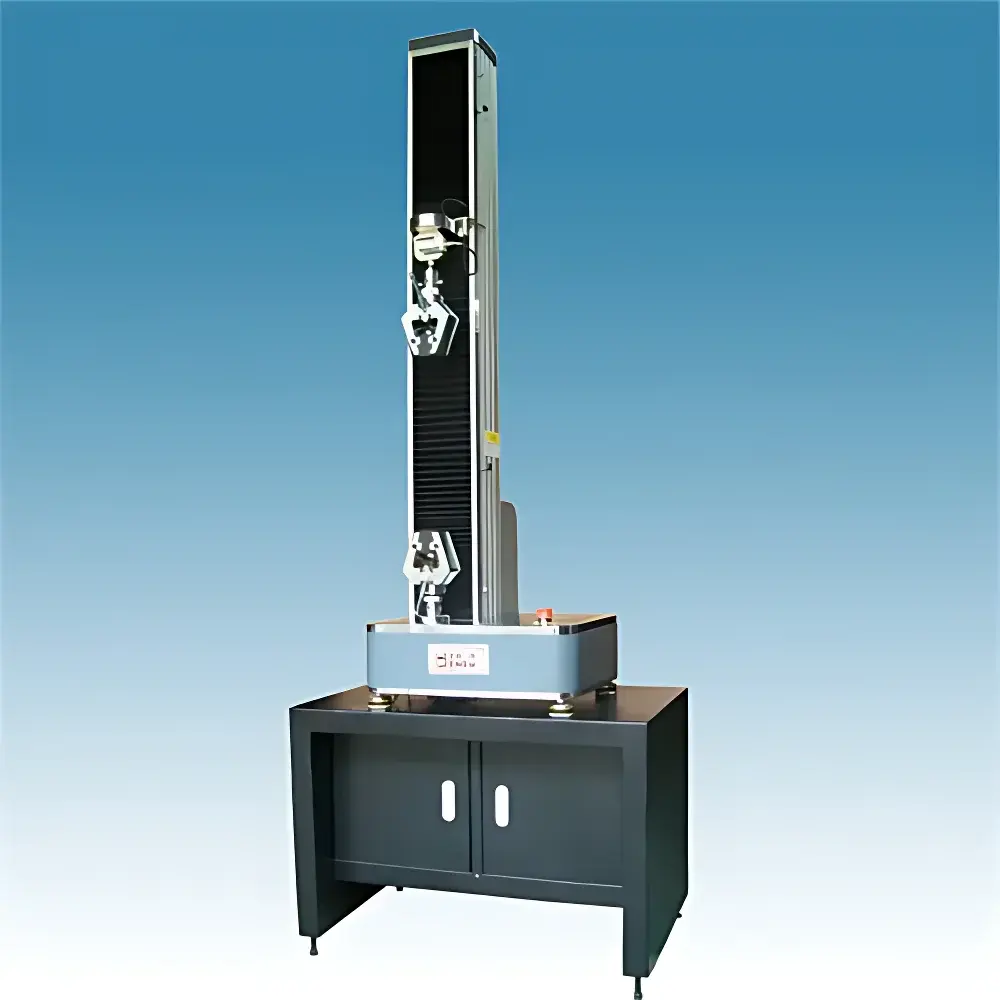
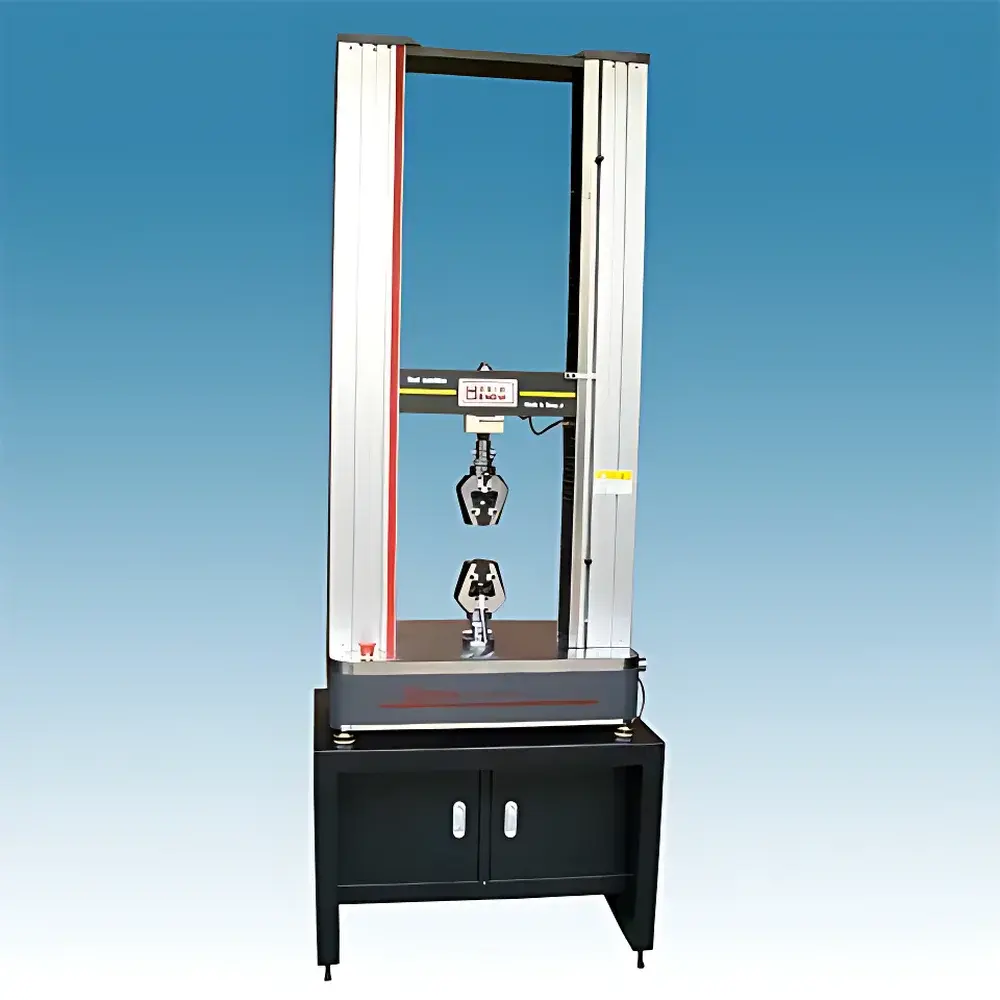
Hengyi HY-0580KRLM Hydrogel Cyclic Tensile-Compression Testing Machine
| Brand | Hengyi / Hengyitest |
|---|---|
| Origin | Shanghai, China |
| Manufacturer Type | Direct Manufacturer |
| Regional Category | Domestic (China) |
| Model | HY-0580KRLM |
| Instrument Type | Electromechanical Universal Testing Machine |
| Maximum Test Load | 5000 N |
| Force Measurement Range | 5–5000 N (Full Scale) |
| Force Accuracy | ±0.5% of reading |
| Test Stroke | 800 mm |
| Displacement Resolution | 0.001 mm |
| Speed Range | 0.001–500 mm/min |
| Speed Accuracy | ±0.5% of set value |
| Position Accuracy | ±0.5% of reading |
| Strain Control Range | 0.002–6% FS/s |
| Stress Control Range | 0.005–6% FS/s |
| Load Cell Options | Interchangeable from 1 N to 5000 N |
| Effective Test Width | 120 mm |
| Power Supply | 220 V AC, 750 W |
| Dimensions (W×D×H) | 470 × 400 × 1510 mm |
| Net Weight | 95 kg |
Overview
The Hengyi HY-0580KRLM Hydrogel Cyclic Tensile-Compression Testing Machine is an electromechanical universal testing system engineered for high-fidelity static and dynamic mechanical characterization of soft, viscoelastic, and highly deformable materials—particularly hydrogels, biological tissues, elastomers, adhesives, thin films, and low-modulus polymers. It operates on a precision servo-controlled linear actuation principle, delivering repeatable force application and displacement control across bidirectional (tension-compression) loading modes. Unlike conventional tensile testers optimized for rigid metals or plastics, the HY-0580KRLM integrates ultra-fine resolution load sensing (down to 1 N full-scale options), sub-micron displacement tracking, and programmable cyclic waveform generation—enabling standardized fatigue protocols such as ISO 1099 (metallic fatigue), ASTM D412 (rubber tensile), ASTM F2193 (hydrogel compression), and custom-defined hysteresis, stress-relaxation, and creep-recovery sequences. Its architecture supports both open-loop displacement control and closed-loop feedback modes for force, stress, strain, or displacement—critical for capturing nonlinear viscoelastic responses typical of hydrated polymer networks.
Key Features
- Precision dual-mode actuation: Simultaneous tension and compression capability with zero-crossing force transduction, enabling true uniaxial cyclic loading without manual reconfiguration.
- Modular load cell system: Interchangeable transducers (1 N to 5000 N) mounted directly in-line with the crosshead, minimizing parasitic bending moments and ensuring traceable calibration per ISO 7500-1 Class 0.5.
- High-resolution motion control: Servo motor-driven ball screw assembly with 0.001 mm displacement resolution and speed range spanning 0.001–500 mm/min—suitable for quasi-static creep tests and rapid-cycle fatigue (up to 5 Hz equivalent under light loads).
- Intelligent safety architecture: Dual-stage protection including electronic travel limits, overload cutoff (>110% FS), real-time drive diagnostics (overcurrent/overvoltage monitoring), and emergency stop with hardware interlock.
- Thermally stable frame: Rigid cast-iron base and reinforced aluminum uprights minimize thermal drift and mechanical compliance—critical for long-duration relaxation experiments requiring <0.1% load drift over 24 h.
- Flexible fixture interface: Standard M6 threaded mounting plate compatible with pneumatic, manual, and custom-designed grips—including solvent-resistant clamps for hydrogel specimens and low-force jaw sets for fibers <0.1 mm diameter.
Sample Compatibility & Compliance
The HY-0580KRLM accommodates a broad spectrum of specimen geometries and mechanical behaviors: hydrogels (bulk, film, injectable), silicone elastomers, alginate and chitosan matrices, biomedical adhesives, thin metallic foils (Cu/Al ≤ 50 µm), photovoltaic ribbons, suture threads, hydrophilic membranes, and composite laminates. Specimen widths up to 120 mm and stroke capacity of 800 mm support ASTM D882 (thin plastic film), ISO 527-3 (films and sheets), and ISO 19976 (hydrogel compression). The system complies with mechanical testing standards including ISO 7500-1 (static calibration), ISO 5893 (testing machines), and ASTM E4 (load verification). Software-generated reports include audit trails, calibration certificates, and metadata required for GLP/GMP-regulated environments—supporting 21 CFR Part 11–compliant electronic signatures when deployed with validated HYtest software modules.
Software & Data Management
Hengyi’s HYtest v4.2 software provides synchronized multi-channel acquisition (force, displacement, time, optional extensometer input) and real-time visualization across six independent axes: Load vs. Displacement, Stress vs. Strain, Stress vs. Time, Strain vs. Time, Load vs. Time, and Cycle Number vs. Energy Dissipation. Up to 16 curves may be overlaid with user-defined color, line weight, and annotation—enabling direct comparison of preconditioning cycles, hysteresis loops, or batch-to-batch variability. All raw data are stored in vendor-neutral CSV and XML formats; proprietary .HYD files retain full experimental metadata (calibration IDs, operator logs, environmental timestamps). Advanced analysis tools include automatic yield point detection (Rp0.2, ReH/ReL), modulus calculation (secant/tangent), hysteresis area integration, and cycle-by-cycle parameter extraction (max load, residual strain, energy loss ratio). Export modules support PDF report generation compliant with ISO/IEC 17025 documentation requirements.
Applications
- Hydrogel fatigue life assessment under repeated physiological strain (e.g., cartilage mimics, wound dressings, contact lens materials).
- Adhesive bond durability evaluation for medical device assembly (silicone-hydrogel interfaces, tissue sealants).
- Mechanical preconditioning of electrospun nanofibrous scaffolds prior to cell seeding.
- Creep-recovery profiling of biodegradable polymers (PLA, PCL) under simulated body temperature conditions.
- Quality control of thin-film packaging integrity (peel strength, puncture resistance, delamination onset).
- Stress-relaxation kinetics of soft robotics actuators and dielectric elastomer membranes.
- Standardized tensile testing of photovoltaic interconnect ribbons per IEC 61215-2 MQT 17.
FAQ
What is the minimum measurable force resolution with the 5 N load cell option?
With the optional 5 N load cell and 500,000-count A/D converter, the system achieves a theoretical force resolution of 0.01 mN—validated per ISO 7500-1 Annex B for low-load applications.
Can the machine perform fully automated multi-step tests (e.g., preload → hold → ramp → cycle → unload)?
Yes. HYtest software supports nested test sequences with conditional branching, dwell timers, and real-time pass/fail logic based on force/displacement thresholds.
Is third-party calibration certification available?
Hengyi provides factory calibration traceable to CNAS-accredited laboratories (certificate included); optional UKAS or DAkkS-certified recalibration services are available upon request.
Does the system support extensometer inputs for true strain measurement?
The HY-0580KRLM includes two analog differential voltage inputs (±10 V) compatible with clip-on, video, or non-contact extensometers—enabling Poisson’s ratio determination and localized strain mapping.
How is data integrity ensured during extended unattended operation (e.g., 72-h creep tests)?
Continuous RAM buffering, periodic auto-save (configurable interval), and CRC-32 checksum validation prevent data corruption; power-loss recovery resumes from last valid checkpoint.



