
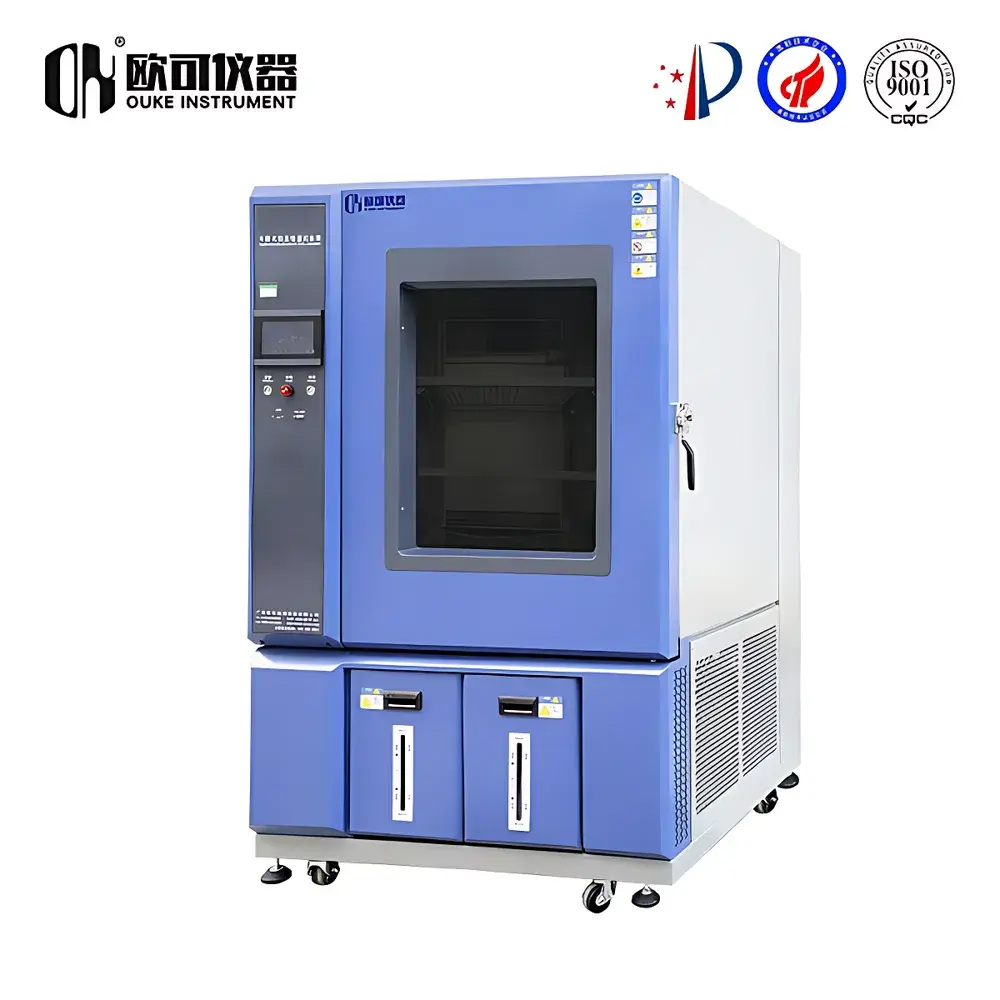
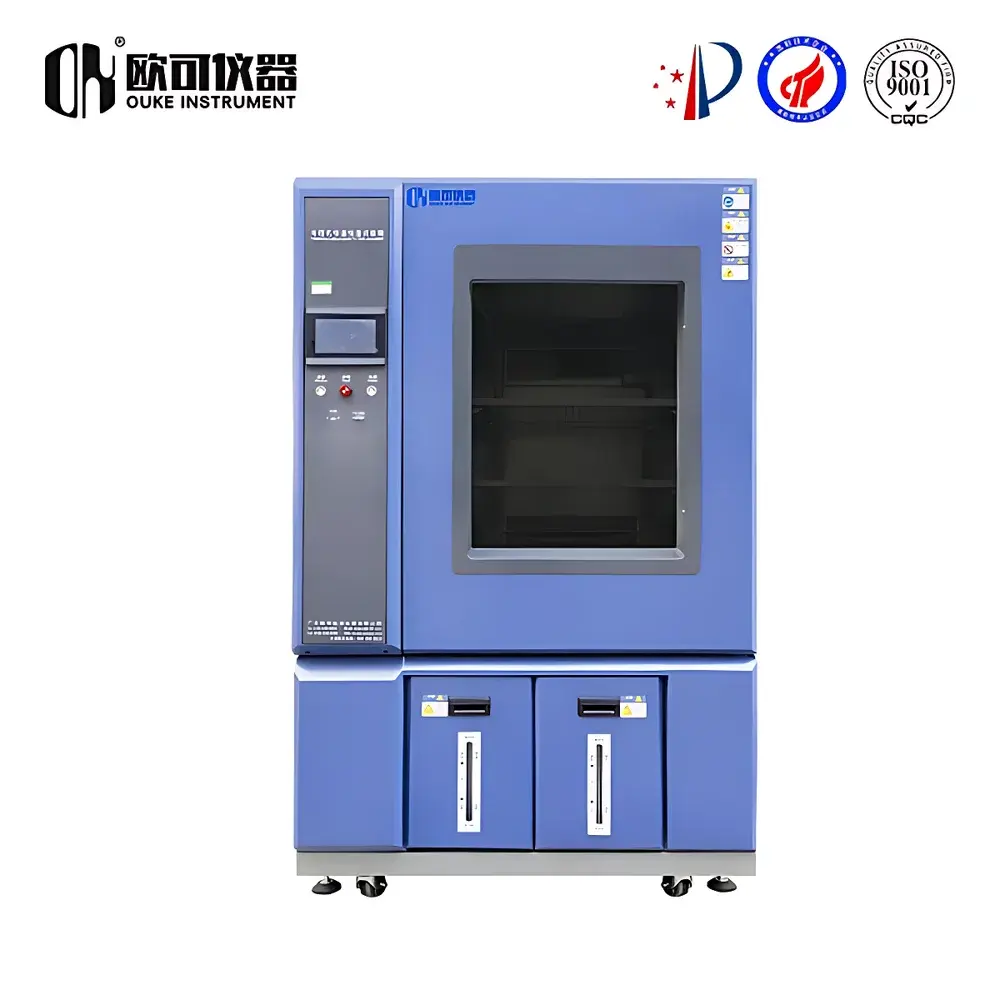
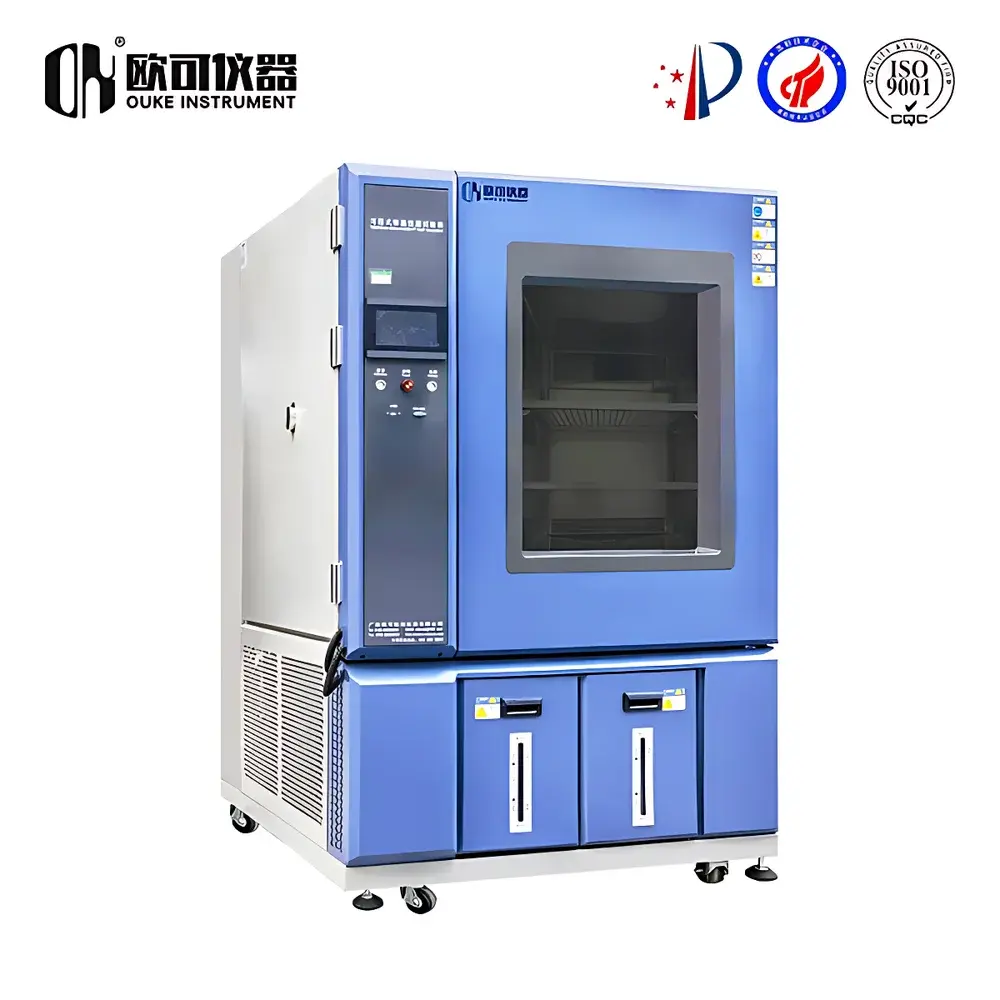
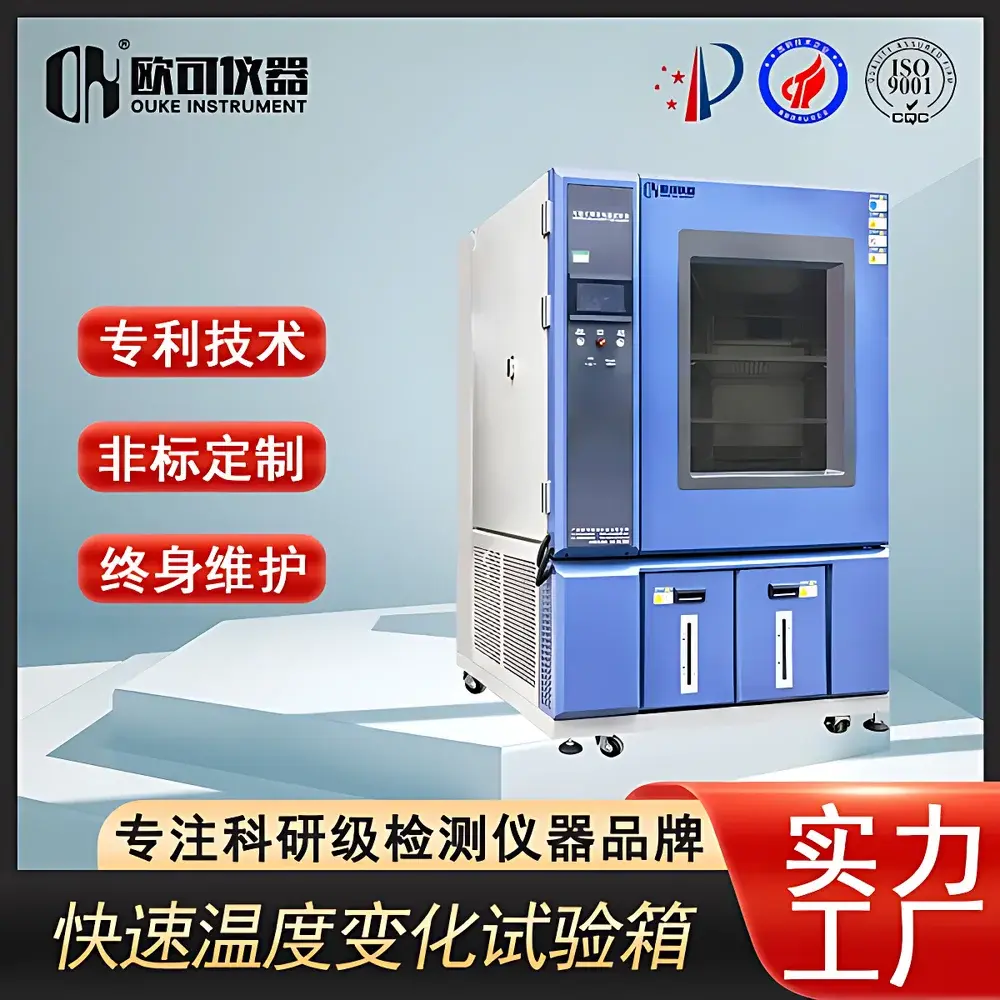
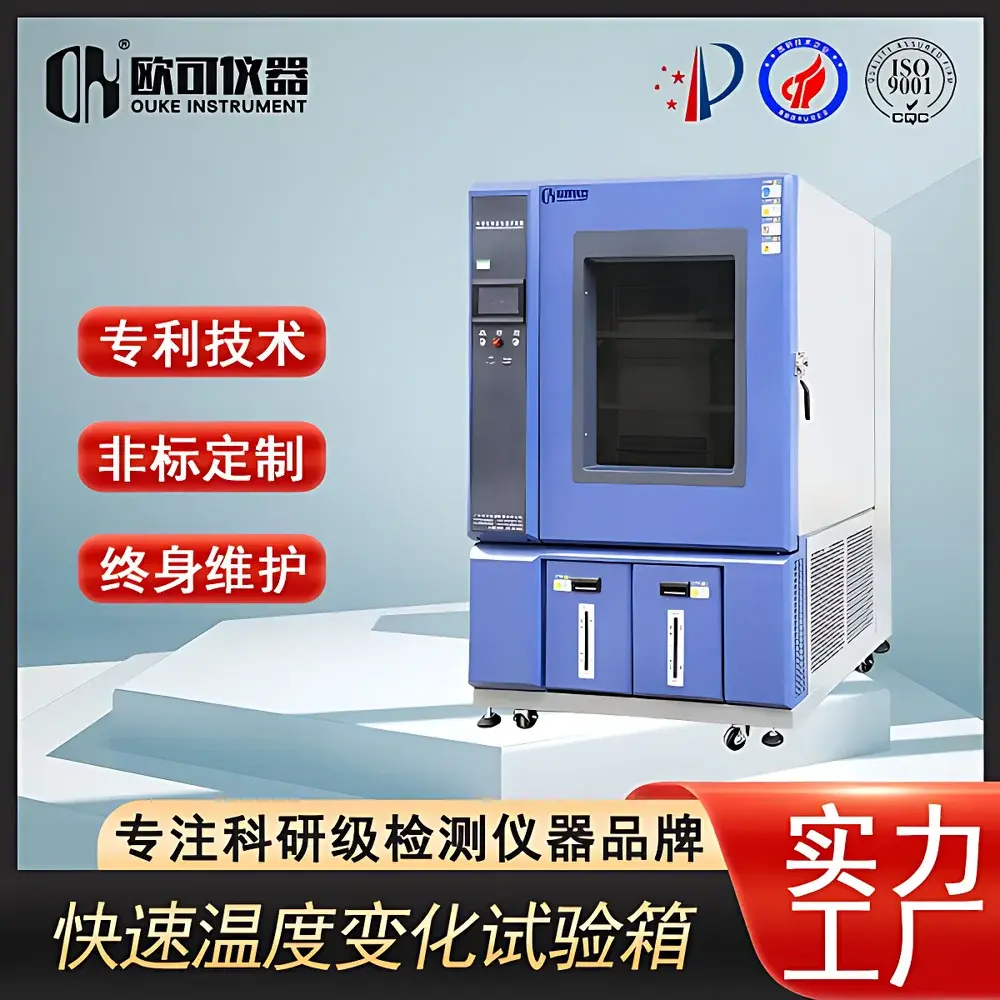
OK KS-TH-150 High-Speed Temperature Transition Chamber
| Brand | OK Instruments |
|---|---|
| Origin | Guangdong, China |
| Manufacturer Type | OEM/ODM Manufacturer |
| Country of Origin | China |
| Model | KS-TH-150 |
| Price | USD 14,200 (FOB Guangdong) |
| Temperature Range | −70 °C to +150 °C |
| Standard Ramp Rate | 10 °C/min (average, empty chamber, per IEC 60068-3-11) |
| Optional Ramp Rates | 5 °C/min, 15 °C/min, or 25 °C/min (configurable with dual-stage mechanical cascade or LN₂-assisted cooling) |
| Internal Chamber Volume | 150 L |
| Control Accuracy | ±0.3 °C (uniformity), ±0.5 °C (fluctuation) |
| Compliance | IEC 60068-2-14, IEC 60068-3-11, GB/T 2423.22, MIL-STD-810H Method 503.5 |
Overview
The OK KS-TH-150 High-Speed Temperature Transition Chamber is an engineered environmental stress screening (ESS) system designed for accelerated thermal cycling applications in reliability engineering and product qualification laboratories. It operates on the principle of controlled, high-rate thermal transients—distinct from standard temperature chambers—by delivering programmable, linear ramp profiles between extreme low and high setpoints. Unlike conventional thermal chambers limited to 1–3 °C/min, the KS-TH-150 achieves certified average ramp rates of up to 25 °C/min under defined test conditions (per IEC 60068-3-11 Annex A), enabling rapid identification of latent defects arising from coefficient-of-thermal-expansion (CTE) mismatches, interfacial delamination, solder joint fatigue, and microcrack propagation. Its architecture integrates a dual-stage mechanical cascade refrigeration system as standard—with optional liquid nitrogen (LN₂) assist—for deterministic control over thermal inertia, making it suitable for both HASS (Highly Accelerated Stress Screening) and HASA (Highly Accelerated Stress Audit) protocols in accordance with industry best practices.
Key Features
- Programmable multi-segment thermal profiles with up to 99 cycles, 999 steps, and real-time ramp/soak/dwell sequencing
- Dual-stage cascade refrigeration system (R404A/R23) ensuring stable operation across −70 °C to +150 °C without cryogen dependency
- Optional LN₂ injection module for ramp rates exceeding 20 °C/min in critical R&D validation scenarios
- High-efficiency axial fan array with optimized air baffle design, achieving ≤2.0 °C temperature uniformity (±0.5 °C at 100 mm from chamber walls)
- Industrial-grade 10.4″ color touchscreen controller with Ethernet/RS485 interface, supporting Modbus TCP and OPC UA data export
- Integrated safety interlocks: overtemperature cut-off, refrigerant pressure monitoring, door switch logic, and LN₂ leak detection (optional)
- Stainless-steel interior (SUS304), double-wall insulation (polyurethane foam + vacuum panel), and reinforced observation window with anti-fog heating
Sample Compatibility & Compliance
The KS-TH-150 accommodates electronic assemblies, PCBs, automotive ECUs, semiconductor packages, aerospace avionics modules, and battery cells—up to 25 kg payload (aluminum reference mass). Chamber volume (150 L) supports standard test fixtures per JEDEC JESD22-A104 and IPC-9701. All thermal profiles comply with IEC 60068-2-14 (Change of Temperature) and its associated measurement methodology in IEC 60068-3-11. The system meets requirements for GLP-compliant data integrity when configured with audit-trail-enabled firmware (IEC 62304 Class B, FDA 21 CFR Part 11 ready via optional software license). Calibration traceability is maintained to NIST-traceable standards through annual verification using calibrated PT100 probes per ISO/IEC 17025-accredited procedures.
Software & Data Management
The embedded OK-TCMS (Thermal Control & Monitoring System) firmware provides full-cycle logging at 1 Hz resolution, storing time-stamped temperature, ramp rate, chamber pressure, compressor discharge/suction temperatures, and alarm history. Export formats include CSV, PDF test reports, and XML for LIMS integration. Optional OK-DataLink software enables remote supervision, multi-chamber synchronization, and statistical analysis (Cp/Cpk, Weibull plotting) of thermal cycle repeatability. All user actions—including profile edits, manual overrides, and calibration entries—are recorded with timestamp, operator ID, and IP address for full 21 CFR Part 11 compliance (electronic signatures, audit trail, data immutability).
Applications
- HASS screening during new product introduction (NPI) to establish design margin and identify process-induced weaknesses
- HASA sampling in high-volume manufacturing lines to verify ongoing process stability and solder joint integrity
- Reliability growth testing per Telcordia GR-468-CORE and AEC-Q200 for passive and active components
- Environmental stress screening (ESS) of military-grade electronics per MIL-STD-810H Method 503.5
- Thermal shock validation of EV battery modules under ISO 16750-4 and UN ECE R100 Annex 8A
- Qualification of optical sensors and MEMS devices subject to field-deployed thermal transients
FAQ
What defines “high-speed” temperature transition in this chamber?
It refers to certified average ramp rates ≥5 °C/min over the full temperature span (e.g., −40 °C ↔ +85 °C), measured per IEC 60068-3-11 using a 1 kg aluminum block with embedded thermocouples.
Is the stated 10 °C/min rate achievable with loaded samples?
Yes—when specified with load condition (e.g., “10 °C/min @ 10 kg Al load”), the system guarantees performance within ±10% deviation; users must declare thermal mass and emissivity during configuration.
How does mechanical cascade compare to LN₂ cooling for long-term use?
Mechanical cascade offers lower total cost of ownership (TCO) over 5+ years and eliminates consumables; LN₂ delivers higher peak rates but incurs recurring logistics and handling costs—ideal for short-duration R&D stress mapping.
Can the chamber be integrated into an automated test cell?
Yes—standard Ethernet/IP and Modbus TCP interfaces support seamless integration with MES, SCADA, and robotic handler systems via digital I/O triggers and status feedback.
Does OK Instruments provide calibration and IQ/OQ documentation?
Yes—factory-issued IQ/OQ protocols aligned with ISO/IEC 17025 are included; on-site calibration services with accredited certificates are available globally through authorized service partners.
Related Products



