
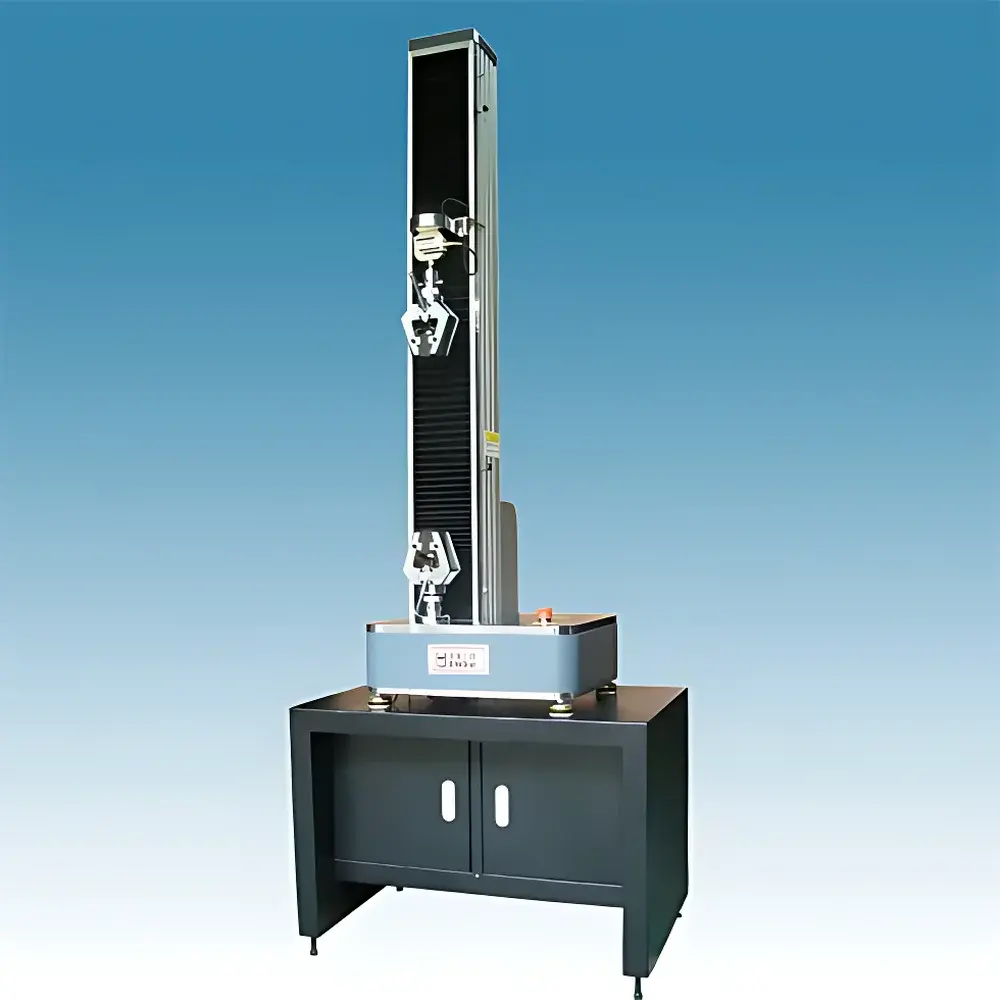
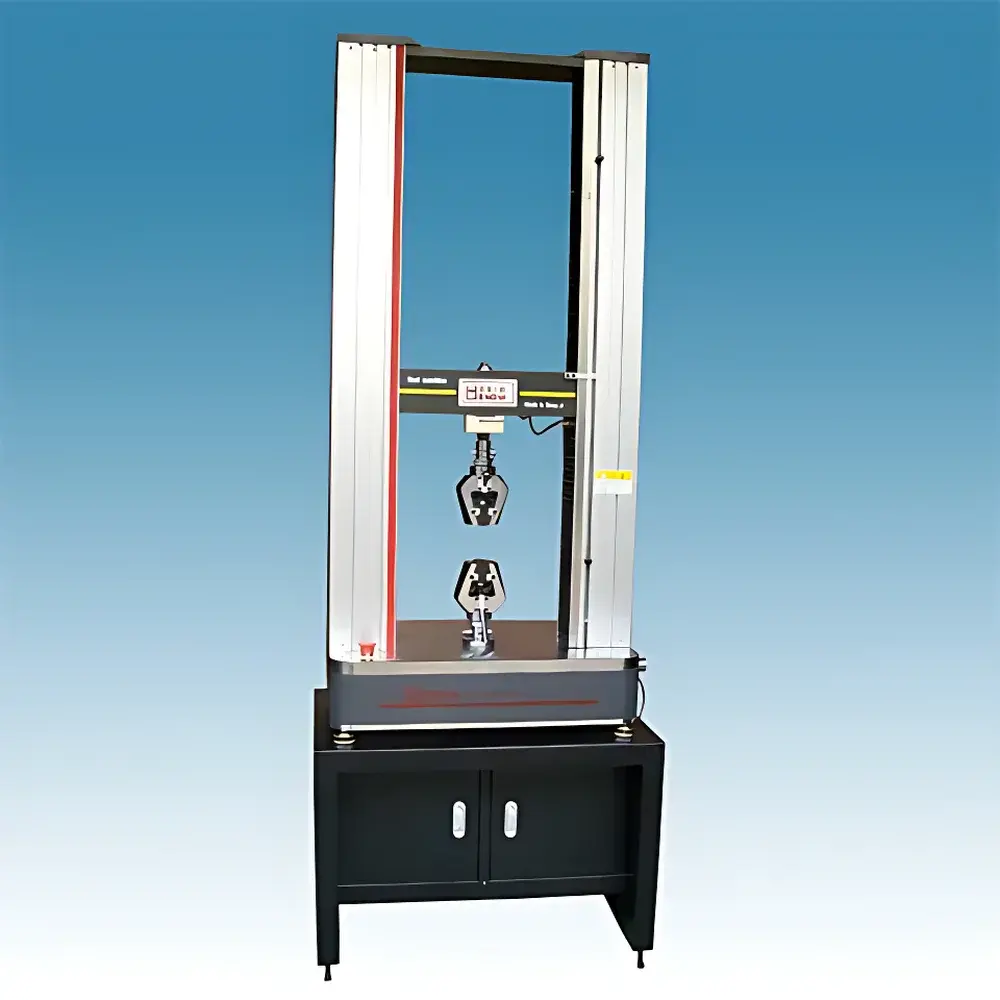
Hengyi HY-0580 (Single-Column) Automotive Glass Seal Strip Pull-Out Force Tester
| Brand | Hengyi / Hengyitest |
|---|---|
| Origin | Shanghai, China |
| Manufacturer Type | Direct Manufacturer |
| Product Category | Domestic |
| Model | HY-0580 (Single-Column) TYYHH |
| Instrument Type | Electromechanical Universal Testing Machine |
| Load Capacity Options | 1N, 5N, 10N, 20N, 50N, 100N, 200N, 500N, 1000N, 2000N, 3000N, 5000N (interchangeable load cells) |
| Force Accuracy | ≤0.5% of reading |
| Effective Test Width | 120 mm |
| Effective Test Height | 800 mm |
| Speed Range | 0.001–500 mm/min (adjustable) |
| Speed Accuracy | ±0.5% of set value |
| Displacement Measurement Accuracy | ±0.5% of reading |
| Force Resolution | ±500,000 counts (full-scale, no range switching) |
| Power Supply | 220 V AC, single-phase, 750 W |
| Net Weight | 120 kg |
| Dimensions (W×D×H) | 470 × 400 × 1510 mm |
Overview
The Hengyi HY-0580 (Single-Column) Automotive Glass Seal Strip Pull-Out Force Tester is a precision-engineered electromechanical universal testing system designed specifically for quantifying the interfacial adhesion strength between automotive glass assemblies and elastomeric sealing profiles. It operates on the fundamental principle of uniaxial tensile separation—applying controlled, linear displacement to a standardized 100 mm seal strip specimen at a defined rate (e.g., 100 mm/min) while continuously measuring the force required to initiate and sustain detachment from the glass substrate. This methodology directly addresses OEM engineering specifications for seal retention integrity under mechanical stress, thermal cycling, and long-term aging conditions. Unlike general-purpose tensile testers, the HY-0580 integrates application-specific mechanical constraints—including horizontal pull alignment, low-force high-resolution transduction, and programmable stop criteria (e.g., peak force, displacement threshold, or time-based termination)—to ensure metrological consistency across production validation, supplier qualification, and R&D benchmarking workflows.
Key Features
- Single-column rigid frame architecture optimized for stability during low-load, high-sensitivity pull-out measurements (down to 1 N full scale).
- Modular load cell system supporting 12 selectable capacities (1 N to 5000 N), enabling traceable calibration across multiple material stiffness regimes without hardware reconfiguration.
- High-resolution force measurement with ±500,000 internal counts and no auto-ranging—ensuring constant resolution across the entire dynamic range and eliminating step-change artifacts in critical low-force transitions.
- Precise speed control (0.001–500 mm/min) with ±0.5% accuracy, validated per ISO 5893 and ASTM E4, essential for replicating standardized test protocols such as those specified in SAE J2527 and GMW14872.
- Dual-mode positioning: motorized fast approach (up to 200 mm/min) and fine-adjustment creep mode (0.001 mm/min), facilitating rapid sample setup and micro-displacement verification prior to test initiation.
- Integrated safety architecture including electronic travel limits, overload cutoff (>110% FS), real-time drive diagnostics (overvoltage/overcurrent monitoring), and emergency stop compliance with IEC 60204-1.
Sample Compatibility & Compliance
The HY-0580 accommodates standardized 100 mm seal strip specimens mounted on representative glass substrates or aluminum carrier plates. Its 120 mm test width and 800 mm vertical clearance support not only seal pull-out but also auxiliary mechanical evaluations—including peel (ASTM D903), tensile (ISO 37, GB/T 1040), compression (ISO 75), and flexural testing (ISO 178)—using optional fixtures. The system conforms to national and international metrological and safety standards, including GB/T 2611–2007 (General Technical Requirements for Testing Machines), GB/T 16491–2008 (Electronic Universal Testing Machines), GB/T 16852.1–2008 (Calibration of Static Uniaxial Testing Machines), and ISO 7500-1:2018 (Verification of Static Uniaxial Testing Machines). All force and displacement measurements are traceable to national metrology institutes via factory calibration certificates compliant with ISO/IEC 17025 requirements.
Software & Data Management
The embedded control software provides ISO/IEC 17025-aligned test sequence definition, real-time curve overlay, and automated report generation in PDF and CSV formats. Users may configure pass/fail criteria based on peak pull force, energy-to-detachment (area under curve), or displacement at specific load thresholds. Audit trails record operator ID, timestamp, calibration status, environmental conditions (optional sensor input), and any manual intervention—supporting GLP and GMP documentation requirements. The system supports FDA 21 CFR Part 11-compliant user access controls (role-based permissions, electronic signatures) when deployed in regulated quality assurance environments. Data export interfaces include USB 2.0 and Ethernet TCP/IP for integration into LIMS or MES platforms.
Applications
- Validation of EPDM, TPE, and silicone seal adhesion to laminated automotive glass under ambient and elevated temperature conditions.
- Comparative analysis of primer efficacy, surface pretreatment methods, and curing process parameters.
- Supplier qualification testing per OEM technical specifications (e.g., Ford WSS-M99P1111-A, VW TL 52202).
- Mechanical durability assessment of bonded glazing systems subjected to simulated road vibration and thermal shock cycles.
- Material development support for next-generation low-VOC, recyclable sealing compounds requiring precise interfacial strength characterization.
FAQ
What standards does the HY-0580 comply with for automotive seal testing?
It meets GB/T 2611–2007, GB/T 16491–2008, ISO 7500-1:2018, and supports method implementation aligned with SAE J2527, GMW14872, and ISO 11339 for rubber-to-glass adhesion evaluation.
Can the system be used for non-automotive applications?
Yes—the modular design and broad force/speed range allow adaptation to biomedical device bonding, packaging tape peel, gasket compression set, and polymer film tensile testing with appropriate fixtures and software configuration.
Is third-party calibration certification available?
Yes—factory calibration reports traceable to CNAS-accredited laboratories are provided; optional on-site recalibration and ISO/IEC 17025-certified validation services are available upon request.
How is data integrity ensured during long-duration tests?
The system logs all raw acquisition channels (force, displacement, time) at ≥100 Hz sampling rate with timestamped metadata; automatic checksum verification prevents data corruption during storage or transfer.
Does the software support multi-user environments with audit trail requirements?
Yes—role-based login, electronic signature capture, and immutable event logging satisfy FDA 21 CFR Part 11 and EU Annex 11 requirements for regulated laboratories.



