
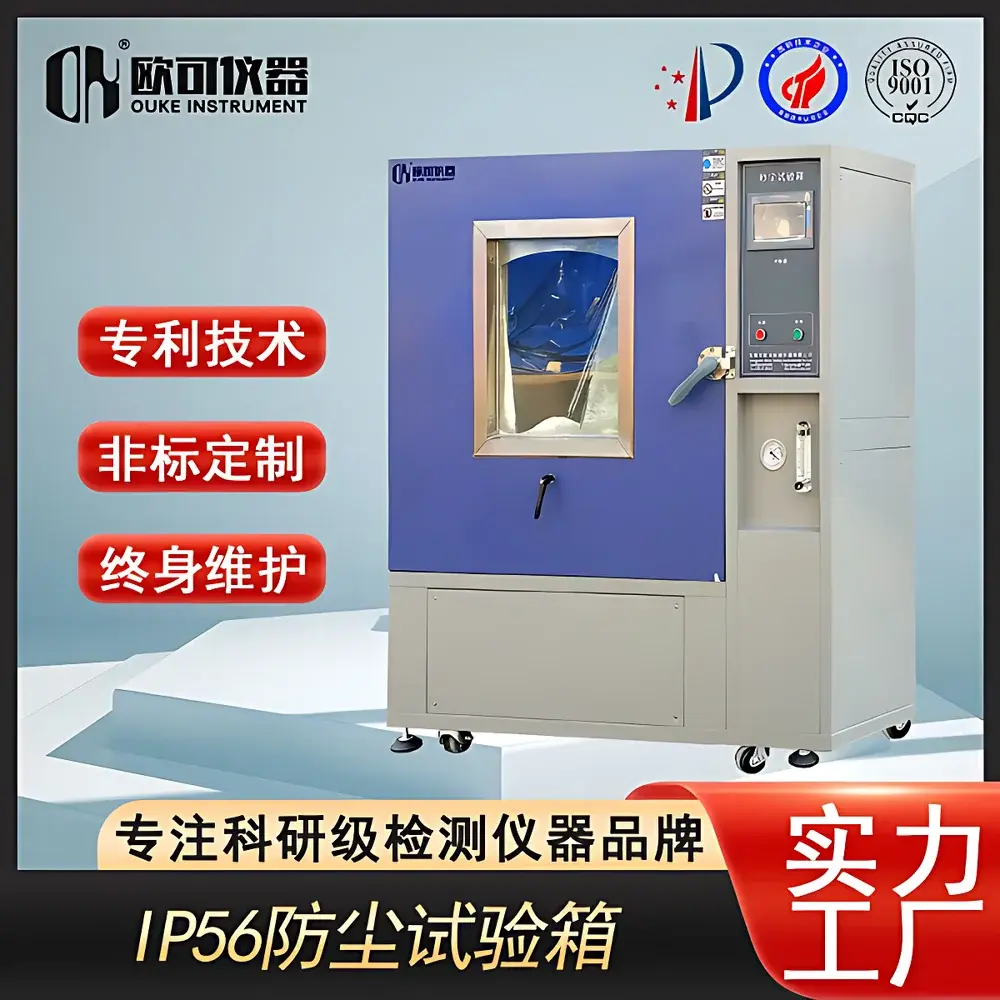
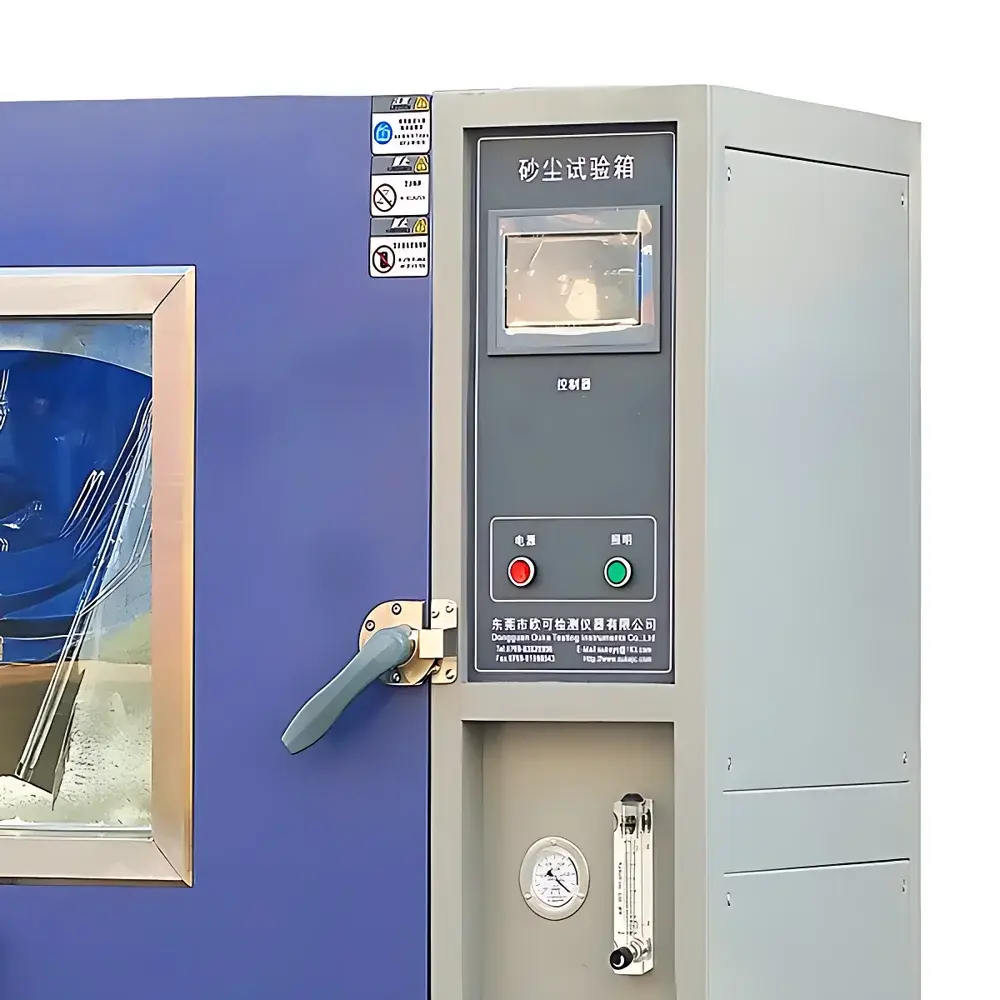
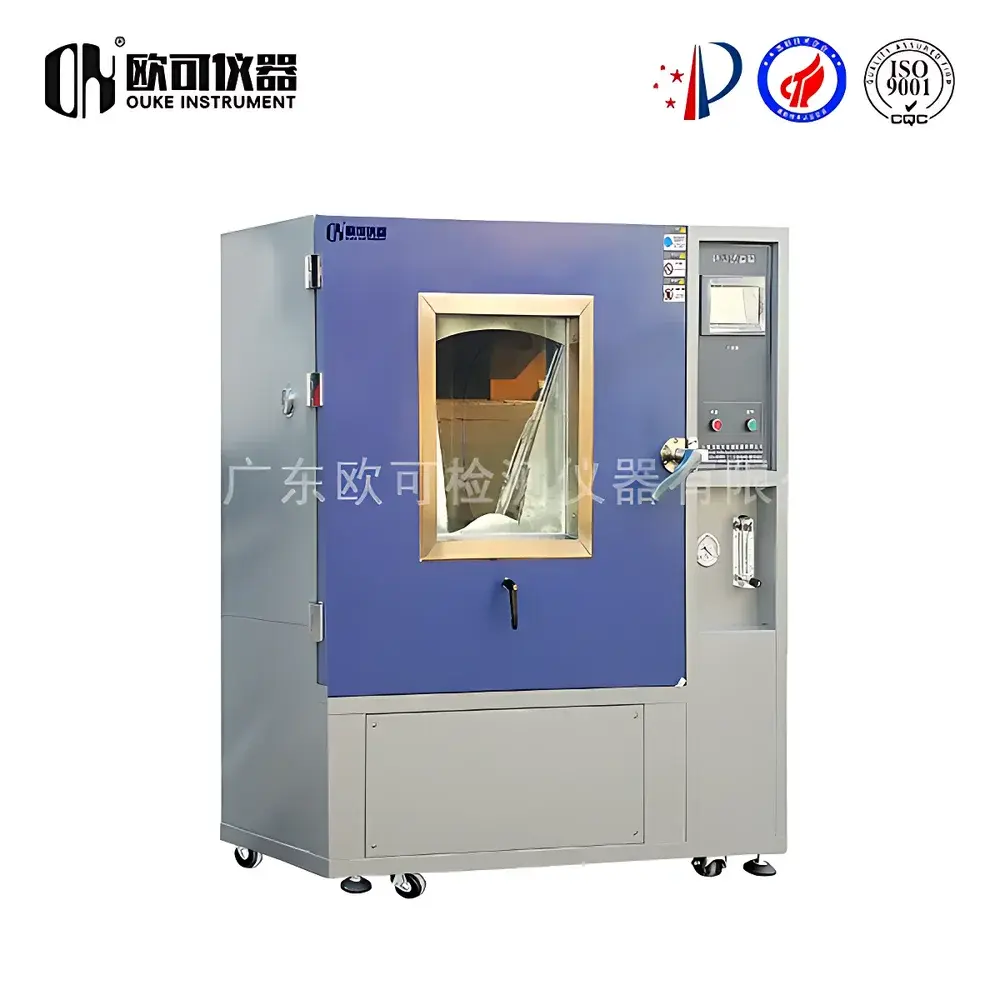
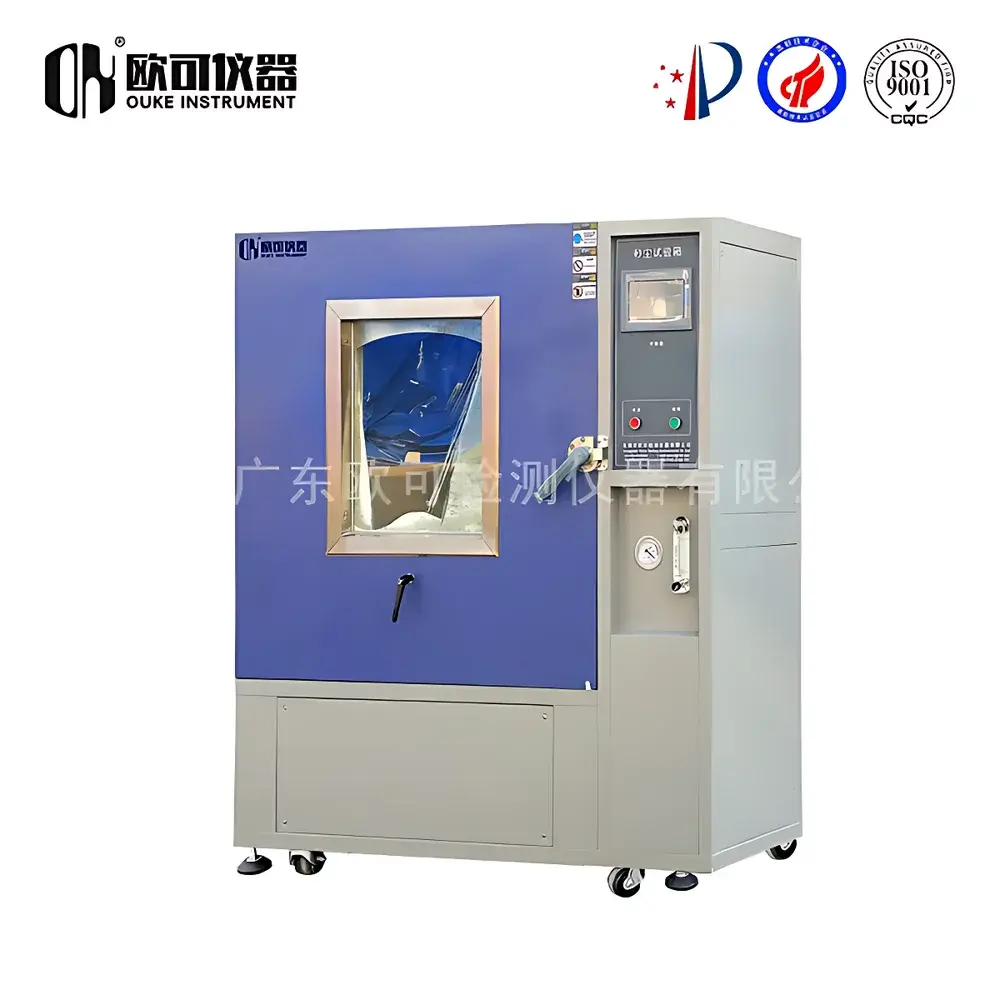
OK-HC-900.0000 Sand and Dust Test Chamber
| Brand | OK Instruments |
|---|---|
| Origin | Guangdong, China |
| Manufacturer Type | Direct Manufacturer |
| Model | OK-HC-900.0000 |
| Silica Content | 97–99% SiO₂ |
| Sand Blowing Concentration | 1.1 g/m³ ±0.25 g/m³ to 2.2 g/m³ ±0.5 g/m³ |
| Sand Blowing Velocity | 0–29 m/s |
| Dust Blowing Concentration | 0.1–10.6 g/m³ ±7 g/m³ |
| Dust Blowing Velocity | 8.9 m/s ±1.2 m/s |
Overview
The OK-HC-900.0000 Sand and Dust Test Chamber is an engineered environmental simulation system designed to replicate controlled airborne particulate conditions—specifically sand and dust—according to internationally recognized test standards. It operates on the principle of forced-air suspension and directed particle impingement, enabling precise reproduction of both low-velocity dust settling (IP5X) and high-velocity sand abrasion (IP6X). This chamber supports quantitative evaluation of enclosure integrity, surface erosion resistance, optical component degradation, and functional reliability under prolonged exposure to particulate-laden atmospheres. Unlike generic climate chambers, the OK-HC-900.0000 integrates aerodynamic flow conditioning, gravimetric dust dosing, and real-time concentration monitoring to ensure metrological traceability across test cycles.
Key Features
- Stainless steel inner chamber constructed from SUS 304 grade stainless steel for corrosion resistance and long-term particulate containment.
- Dual-layer silicone-sealed observation door with abrasion-resistant tempered glass window, certified for zero particulate leakage during operation.
- Programmable high-pressure centrifugal blower system delivering stable airflow from 0 to 29 m/s, with closed-loop velocity feedback control.
- Automated vibratory dust feeder with adjustable amplitude and frequency, ensuring repeatable delivery of standardized silica-based test dust (SiO₂ ≥97%).
- Rotating sample turntable (optional configuration) compliant with IEC 60529 Annex B requirements for IP6X testing.
- Integrated HEPA filtration and cyclonic recovery system to capture >99.97% of airborne particles ≥0.3 µm, minimizing operator exposure and lab contamination upon door opening.
- PLC-based controller with 7-inch color touchscreen HMI, supporting multi-step test profiles, data logging (timestamped wind speed, concentration, runtime), and USB export.
- Safety interlocks including motor overload protection, over-temperature cutoff, door-open shutdown, and emergency stop circuitry compliant with IEC 61000-6-2/6-4 EMC directives.
Sample Compatibility & Compliance
The OK-HC-900.0000 is validated for testing enclosures up to 900 mm × 900 mm × 900 mm (W×D×H), accommodating automotive lighting assemblies, ADAS sensors, industrial connectors, outdoor telecom cabinets, and consumer electronics housings. It meets the physical test requirements of multiple international standards:
- IEC 60529 / GB/T 4208: Full support for IP5X (dust-protected) and IP6X (dust-tight) verification protocols, including specified dust concentration ranges, exposure durations, and post-test inspection criteria.
- ISO 20653: Configurable for road vehicle-specific dust classes (e.g., Class 1A, 2B) with calibrated particle size distribution and airflow profiles.
- MIL-STD-810G/H Method 510.5 & GJB 150.12A: Capable of replicating desert operational environments—including suspended dust transport and sand impact dynamics—with documented repeatability across batches.
All calibration procedures align with ISO/IEC 17025 principles; optional NIST-traceable anemometer and gravimetric dust sampler validation kits are available upon request.
Software & Data Management
The embedded control firmware supports GLP-compliant data integrity per FDA 21 CFR Part 11 requirements, including user-level access control, electronic signatures, and audit trail generation for all parameter modifications and test executions. Logged data includes real-time wind velocity (±0.3 m/s accuracy), cumulative exposure time, and system status flags. Export formats include CSV and PDF reports compatible with LIMS integration. Remote monitoring via Ethernet (Modbus TCP) enables centralized facility management without compromising local safety logic integrity.
Applications
- IP rating certification for electrical enclosures in automotive, aerospace, and renewable energy sectors.
- Evaluation of coating adhesion and substrate erosion on optical lenses, display covers, and sensor windows exposed to abrasive particulates.
- Functional endurance testing of moving components (e.g., rotary switches, potentiometers, HVAC actuators) under continuous dust ingress conditions.
- Validation of filter media efficiency and sealing gasket performance in off-road equipment and military-grade electronics.
- Supporting design FMEA by quantifying failure modes associated with particulate accumulation in heat sinks, ventilation grilles, and connector interfaces.
FAQ
What silica purity does the standard test dust meet?
The supplied test dust complies with IEC 60529 specifications: ≥97% crystalline SiO₂, with particle size distribution conforming to ISO 12103-1 A2 Fine Test Dust.
Can the chamber operate continuously for 72+ hours?
Yes—the thermal management system and sealed bearing fan assembly are rated for uninterrupted operation up to 168 hours, subject to scheduled filter maintenance every 200 operational hours.
Is third-party calibration documentation included?
Each unit ships with a factory calibration certificate covering airflow sensors and timer circuits; accredited third-party calibration (ISO/IEC 17025) is available as an optional service.
Does the system support custom dust types beyond silica?
With prior engineering review, alternative particulates—including aluminum oxide, iron oxide, or site-simulated soil composites—can be qualified for use, provided they meet minimum fluidization characteristics and do not compromise filtration integrity.
How is concentration uniformity verified inside the working volume?
Uniformity is validated using a 3×3×3 grid of isokinetic sampling ports per IEC 60529 Annex D; typical spatial deviation is ≤±15% across the defined test zone at nominal operating conditions.



