
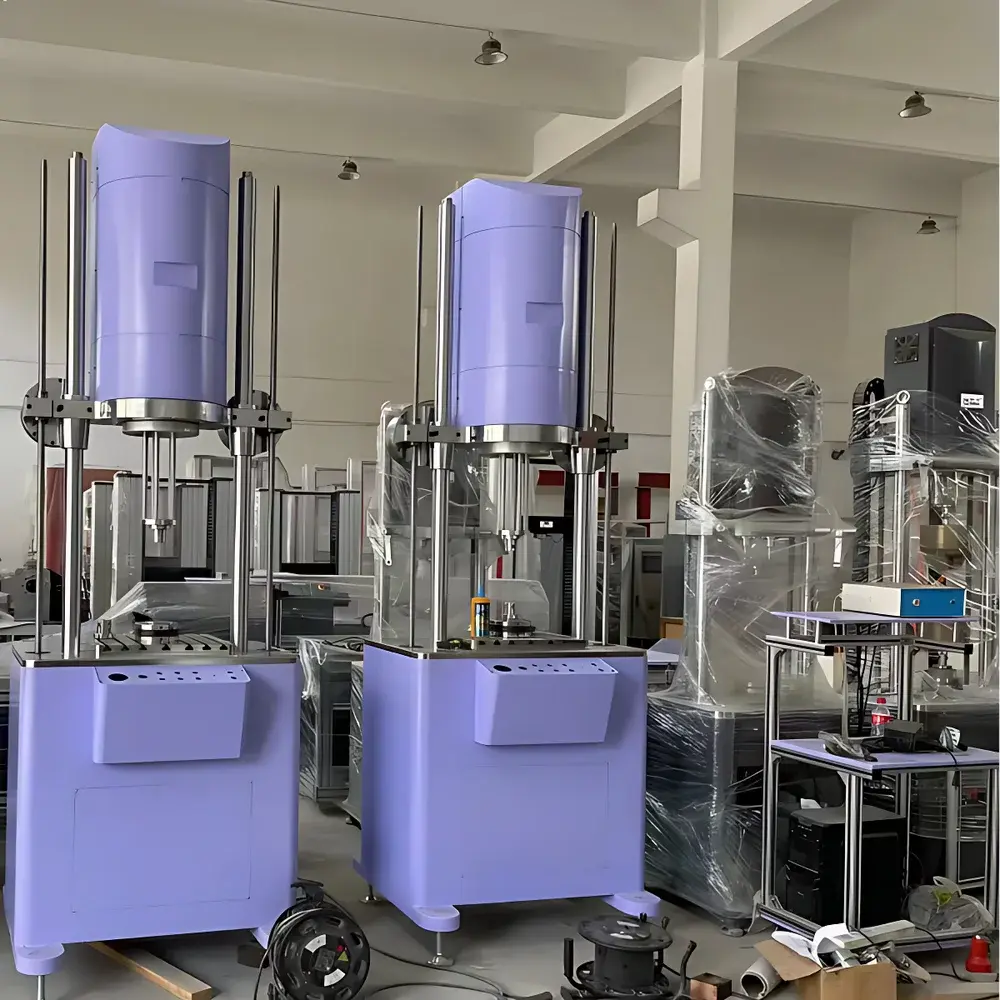
Hengyi HY(DP)502005GG Femoral Replacement Component Combined Axial-Torsional Dynamic Fatigue Testing Machine
| Brand | Hengyi / Hengyitest |
|---|---|
| Origin | Shanghai, China |
| Manufacturer Type | Direct Manufacturer |
| Country of Origin | China |
| Model | HY(DP)502005GG |
| Price Range | USD 2,800 – 7,000 (FOB Shanghai) |
| Maximum Test Load | ±5000 N and ±50 N·m |
| Frequency Range | 0–50 Hz |
| Machine Weight | 800 kg |
Overview
The Hengyi HY(DP)502005GG Femoral Replacement Component Combined Axial-Torsional Dynamic Fatigue Testing Machine is a dedicated electromechanical servo-controlled system engineered for the biomechanical evaluation of orthopedic implant components—particularly femoral stems, modular necks, and revision-grade prosthetic interfaces—under physiologically relevant multiaxial loading conditions. It operates on a dual-actuator architecture: a high-precision linear electrodynamic actuator for axial (tension/compression) loading and a coaxial rotary servo motor for controlled torsional excitation. The system applies synchronized or independent sinusoidal, triangular, square, trapezoidal, ramp, or user-defined block-spectrum waveforms to replicate in vivo gait-cycle stresses—including combined bending-torsion moments and cyclic axial compression—per ISO 14879-1 (hip joint replacements), ASTM F1800 (fatigue testing of spinal implants), and ISO 7206-4 (femoral stem fatigue). Designed for regulatory-compliant preclinical validation, it supports static preload application prior to dynamic cycling and enables real-time monitoring of force, torque, displacement, and angular rotation with traceable metrology.
Key Features
- Dual-axis closed-loop control: Independent yet synchronizable axial (±5000 N) and torsional (±50 N·m) actuation with sub-millisecond phase alignment capability.
- Wide-frequency operational envelope: 0–50 Hz dynamic cycling range, optimized for low-frequency physiological simulation (0.5–5 Hz gait-relevant spectra) and accelerated durability screening.
- High-resolution measurement system: Force resolution ≤ 0.01 N; torque resolution ≤ 0.01 N·m; linear displacement resolution ≤ 0.01 mm; angular resolution ≤ 0.1° over 0–1000° swing range.
- Modular environmental integration: Standard mounting interfaces for optional high-temperature furnaces (up to 300 °C), environmental chambers (−40 °C to +150 °C), or corrosion test enclosures (ASTM B117 salt fog).
- Comprehensive hardware safety architecture: Dual-stage overload protection (torque/force limit switches + software-triggered emergency stop), mechanical end-stop limits, thermal monitoring of actuators and power electronics, and automatic fault logging with diagnostic codes.
- Robust structural frame: 800 kg reinforced steel base with 450 mm lateral clearance and 500 mm vertical test height—designed to minimize resonance at critical frequencies and ensure long-term dimensional stability under repeated load reversal.
Sample Compatibility & Compliance
The HY(DP)502005GG accommodates standard and custom-configured test specimens per ISO 12417-1 (implant materials), ASTM F2503 (metallic biomaterials marking), and ISO 5832 series (Ti-6Al-4V, CoCrMo, stainless steel 316L). It supports standardized fixtures for ASTM F1714 (modular femoral head-neck junctions), ISO 14801 (dental implant fatigue), and custom adapters for spinal rods, vertebral body replacements, and shape-memory alloy (NiTi) constructs. All control firmware and data acquisition modules comply with GLP audit requirements, including electronic signature support, full audit trail (per FDA 21 CFR Part 11), and timestamped raw data export without post-processing interpolation. Calibration certificates are traceable to CNAS-accredited national standards (GB/T 2611, JJG 1063).
Software & Data Management
The Windows-based Hengyi TestMaster™ v4.2 software provides full instrument control via RS-232/USB interface. It enables real-time plotting of up to six simultaneous channels (e.g., axial force vs. time, torque vs. angle, hysteresis loops), with dynamic auto-scaling, zoom/pan, and overlay of reference cycles. Users define complex multi-step test protocols—including ramp-to-stress, hold-at-load, stepwise amplitude modulation, and conditional termination (e.g., 10% torque degradation from baseline, cycle count threshold, or displacement drift >0.2 mm). Data is stored in open-format .CSV and binary .HDT files; reporting templates conform to ISO/IEC 17025 documentation requirements. Export options include native Word (.DOCX) and Excel (.XLSX) reports with embedded curves, metadata headers (operator ID, calibration date, environmental conditions), and customizable pass/fail criteria tables.
Applications
- Fatigue life assessment of cemented and cementless femoral stems under ISO 14879-1 simulated walking loads.
- Interface integrity testing of modular taper junctions (e.g., head-neck, neck-shaft) under combined torsion-bending moments per ASTM F2009.
- Cyclic durability evaluation of additively manufactured (AM) porous titanium acetabular cups and trabecular metal scaffolds.
- Functional characterization of NiTi shape-memory alloys used in dynamic spinal fixation systems.
- Accelerated aging studies of polymer-based bearing surfaces (UHMWPE, PEEK) under torsionally coupled compression.
- Validation of finite element models (FEM) using experimentally derived hysteresis energy dissipation data.
FAQ
What standards does this system support for orthopedic implant testing?
It natively supports ISO 14879-1, ASTM F1800, ISO 7206-4, ASTM F2503, and ISO 12417-1, with configurable waveform libraries matching each standard’s prescribed loading profiles.
Can the system perform tests under physiological temperature or saline immersion?
Yes—via optional environmental chambers or custom-built immersion baths with integrated load-cell feedthroughs and corrosion-resistant actuator seals.
Is the software compliant with FDA 21 CFR Part 11 for regulated laboratories?
Yes—TestMaster™ v4.2 includes role-based access control, electronic signatures, immutable audit logs, and data integrity verification hashes.
What is the maximum specimen length that can be accommodated in compression mode?
Standard compression height is 500 mm; extended columns and custom fixtures support specimens up to 750 mm with recalibrated buckling constraints.
Does the system provide hysteresis loop analysis for viscoelastic biomaterials?
Yes—the software calculates energy dissipation per cycle, loss tangent (tan δ), and modulus evolution across thousands of cycles, exportable for DMA-style interpretation.



