
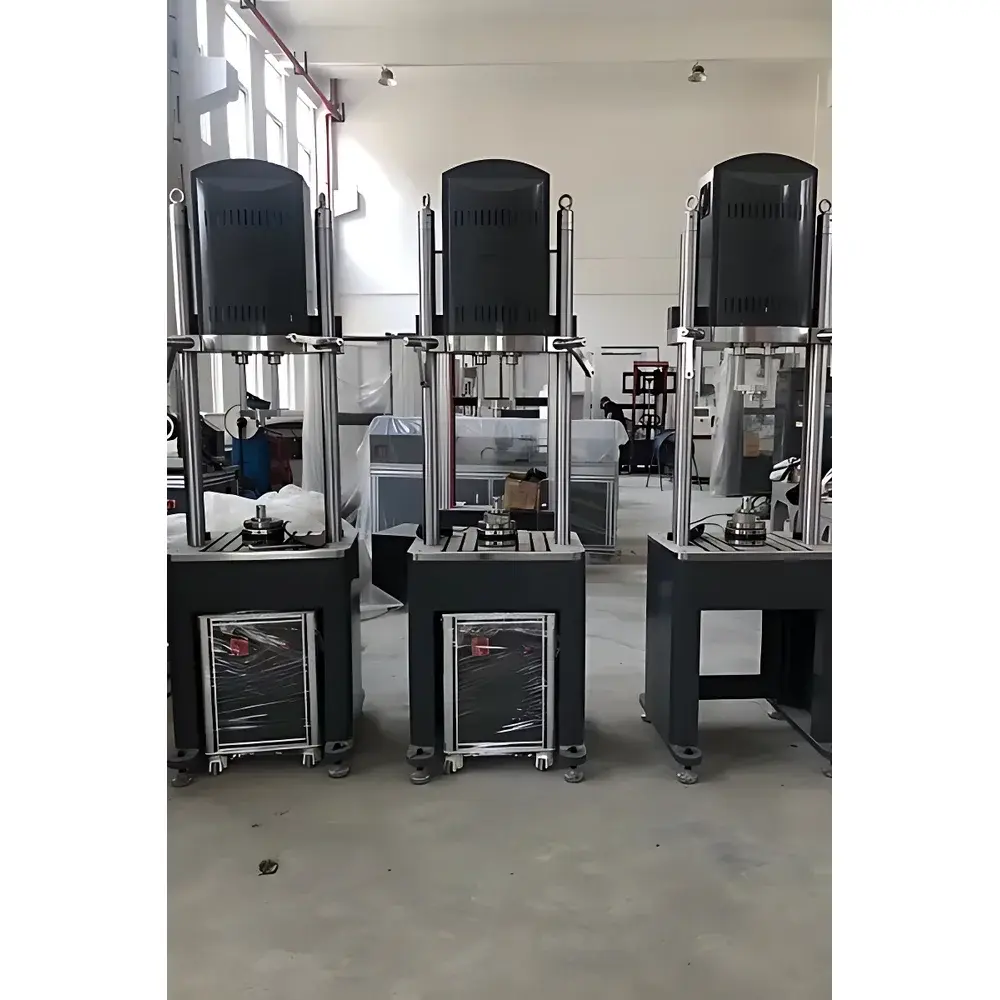
Hengyi HY(DP)5020050 Microcomputer-Controlled Electromechanical Tension-Compression-Torsion Fatigue Testing Machine for Orthopedic Implants
| Brand | Hengyi |
|---|---|
| Origin | Shanghai, China |
| Manufacturer Type | Direct Manufacturer |
| Country of Origin | China |
| Model | HY(DP)5020050 |
| Instrument Type | High-Frequency Fatigue Testing Machine |
| Maximum Test Load | ±5000 N |
| Torque Capacity | ±50 N·m |
| Force Resolution | 0.01 N / 0.01 N·m |
| Force Accuracy | Class 1 (±1% of reading) |
| Displacement Accuracy | Class 1 |
| Displacement Range | 0–200 mm (or ±100 mm), Angular Rotation: 0–1000° |
| Displacement Resolution | 0.01 mm |
| Frequency Range | 0–50 Hz |
| Waveform Options | Sine, Cosine, Square, Triangle, Sawtooth |
| Test Space (Tension/Compression) | 300 mm / 500 mm |
| Horizontal Clearance (Left–Right) | 450 mm |
| Vertical Test Height | 500 mm |
| Dimensions (L×W×H) | ≈680 × 700 × 2500 mm |
| Power Supply | 380 V AC, 8 kW |
| Weight | 850 kg |
Overview
The Hengyi HY(DP)5020050 is a microcomputer-controlled electromechanical fatigue testing system engineered specifically for the mechanical evaluation of orthopedic implants under dynamic loading conditions. It operates on a closed-loop servo-electric actuation principle, delivering precise, repeatable tension-compression-torsion waveforms to simulate in vivo physiological loading profiles—such as those experienced by hip stems, spinal rods, intramedullary nails, and bone plates during cyclic gait or spinal motion. Unlike hydraulic systems, this high-frequency electromechanical platform eliminates fluid contamination risks and enables stable low-load (<500 N) and mid-range load (up to ±5000 N) testing with minimal thermal drift and zero maintenance downtime associated with hydraulic oil management. Its modular architecture supports ASTM F2118, ISO 14801, ISO 7206-4, and FDA-recommended test protocols for implant durability assessment, making it suitable for R&D labs, regulatory submission support, and quality control environments operating under GLP or ISO 13485 frameworks.
Key Features
- Triple-axis dynamic capability: Simultaneous or independent control of axial force (±5000 N), torsional moment (±50 N·m), and linear displacement (±100 mm) or angular rotation (0–1000°)
- High-fidelity waveform generation: Programmable sine, cosine, square, triangle, and sawtooth profiles with user-defined phase offsets and dwell intervals
- Class 1 force and displacement accuracy per ISO 7500-1 and ISO 23718, verified across full operational range (50 N–5000 N; 0.5–50 N·m)
- Real-time closed-loop control with ±1% setpoint tracking tolerance and sub-millisecond response latency
- Modular fixture interface compliant with ISO 14801 mounting standards for femoral stem, acetabular cup, and interbody device fixtures
- Integrated safety interlocks including over-travel limit switches, emergency stop circuitry, and software-enforced load/displacement bounds
- Low-noise operation (<65 dB(A)) suitable for shared laboratory environments without dedicated acoustic enclosures
Sample Compatibility & Compliance
The HY(DP)5020050 accommodates standard orthopedic implant geometries—including solid and porous-coated metallic stems, polymer-based intervertebral spacers, resorbable fixation screws, and composite bone plates—via interchangeable grip systems (mechanical wedge, pneumatic, or custom-threaded adapters). Test space dimensions (450 mm lateral clearance, 500 mm vertical height, 300/500 mm tension/compression stroke) allow full-length testing of Class III devices up to 250 mm in length. All firmware and control logic comply with IEC 61508 functional safety requirements for laboratory equipment. Data acquisition meets ALCOA+ principles for audit readiness, supporting 21 CFR Part 11 compliance when deployed with validated software configurations and electronic signature modules.
Software & Data Management
The system runs on Hengyi’s proprietary FatigueTest Pro v4.2 software, a Windows-based application offering script-driven test sequencing, real-time FFT spectral analysis, cycle counting (Rainflow algorithm), and automated pass/fail reporting against user-defined thresholds (e.g., stiffness degradation >15%, displacement creep >0.1 mm/cycle). Raw data is stored in HDF5 format with embedded metadata (operator ID, calibration timestamp, environmental conditions), enabling traceability and interoperability with LIMS platforms via OPC UA or CSV export. Audit trails record all parameter changes, test starts/stops, and calibration events with immutable timestamps—fully aligned with GLP documentation requirements.
Applications
- ISO 14801-compliant fatigue testing of dental and orthopedic endosseous implants under combined bending-torsion loads
- ASTM F2118 evaluation of total hip replacement stem micromotion and subsidence behavior over 10⁷ cycles
- Dynamic compression testing of vertebral body replacement devices per ISO 12189
- Accelerated wear simulation of modular taper junctions using phase-shifted torque-axial coupling
- Material-level validation of additively manufactured Ti-6Al-4V lattice structures under variable amplitude loading
- Preclinical verification of bioresorbable polymer screw fatigue life in simulated cortical-cancellous bone composites
FAQ
What standards does this system support for regulatory submissions?
It natively supports test method execution per ISO 14801, ISO 7206-4, ASTM F2118, and ISO 12189, with documentation packages available for FDA 510(k) and CE Mark technical files.
Can the system perform push-in or pull-out testing of cemented implants?
Yes—using optional compression platens and self-aligning fixtures, it replicates ASTM F1800 shear and push-out protocols for cement-bone-implant interfaces.
Is remote monitoring and troubleshooting supported?
The controller includes Ethernet/IP connectivity and supports secure remote desktop access for engineering diagnostics, subject to customer network security policies.
What calibration intervals are recommended?
Annual force and displacement calibration is advised, traceable to NIM (China National Institute of Metrology) or equivalent national metrology institutes; onboard self-diagnostics run at startup and after every 500 hours of operation.
Does the system integrate with third-party DAQ or motion capture systems?
Yes—digital I/O ports and analog voltage outputs (±10 V) enable synchronization with high-speed cameras, strain gauge amplifiers, or optical motion tracking systems via TTL triggers or analog sync signals.



