
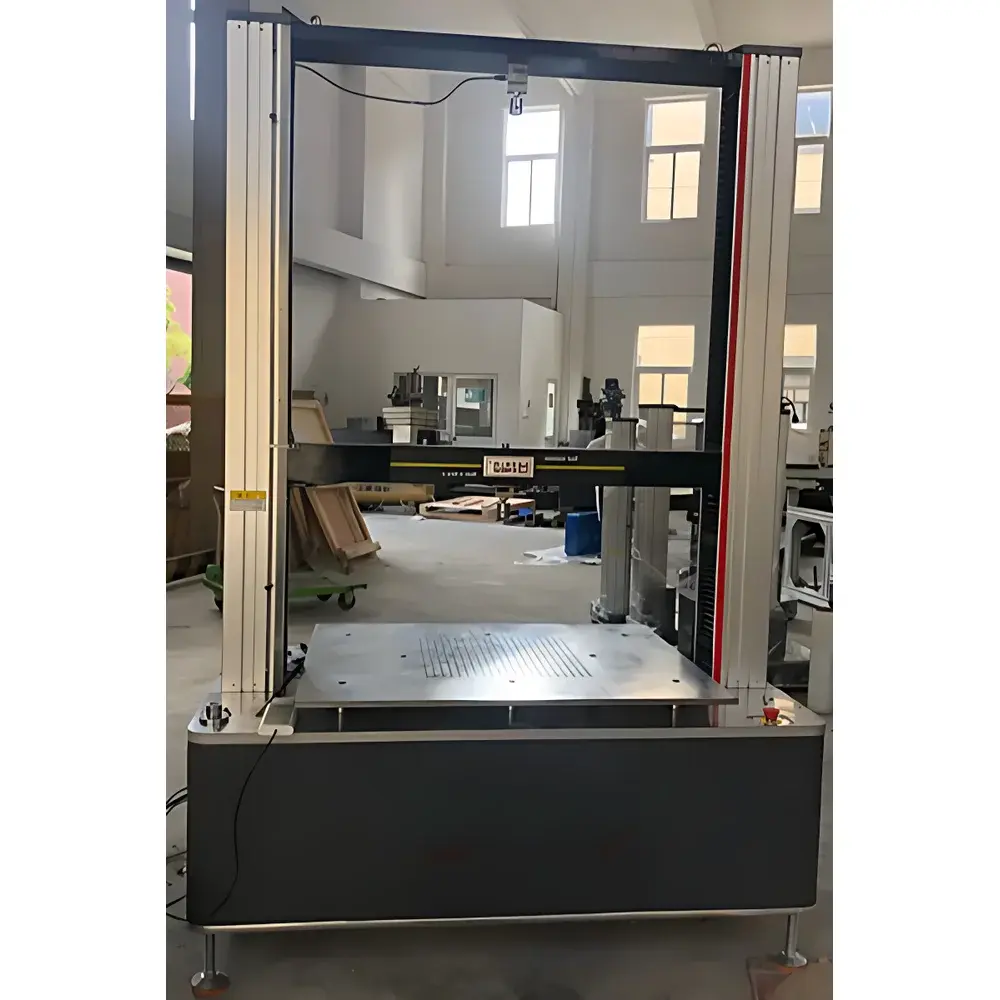
Hengyi HY-0580 Dual-Arm Automotive Door Glass Ejection Force Tester
| Brand | Hengyi / Hengyitest |
|---|---|
| Origin | Shanghai, China |
| Manufacturer Type | Direct Manufacturer |
| Regional Classification | Domestic (China) |
| Model | HY-0580 (Dual-Arm) |
| Instrument Type | Electromechanical Universal Testing Machine |
| Load Capacity | 5000 N |
| Accuracy Class | 0.5 |
| Effective Test Width | 1100 mm |
| Effective Test Height | 700 mm |
| Speed Range | 0.001–500 mm/min |
| Speed Accuracy | ±0.5% of indicated value |
| Displacement Measurement Accuracy | ±0.5% of indicated value |
| Strain Measurement Accuracy | ±0.5% of indicated value |
| Force Resolution | ±500000 counts (full-scale, no range switching) |
| Force Measurement Range | 0.1/100–99.9999% FS |
| Stress Control Rate Range | 0.005–6 %FS/S |
| Strain Control Rate Range | 0.002–6 %FS/S |
| Safety Protection | Electronic limit switch, overload protection (>110% FS), automatic fault diagnosis |
| Power Supply | 220 V AC, single-phase, 750 W |
| Dimensions (W×D×H) | 1400 × 800 × 1600 mm |
| Weight | 350 kg |
Overview
The Hengyi HY-0580 Dual-Arm Automotive Door Glass Ejection Force Tester is a precision electromechanical universal testing system engineered for standardized evaluation of adhesive bond integrity in automotive glass assemblies. It operates on the principle of controlled uniaxial force application in the vertical direction—specifically simulating real-world ejection loads during door closure or thermal cycling events—to quantify interfacial adhesion strength between laminated glass, polyurethane (PU) sealants, and metal substrates (e.g., door frames or mounting brackets). The instrument complies with critical OEM-specified performance thresholds, including the mandatory 1960 N static load requirement: under sustained vertical loading at this level, the glass assembly must exhibit zero delamination, edge lifting, or interfacial separation. Its dual-arm structural architecture ensures symmetrical load distribution across wide-format specimens (up to 1100 mm width), minimizing bending moments and enhancing measurement fidelity during high-force peel or shear-mode adhesion tests.
Key Features
- Dual-arm rigid frame design with reinforced crosshead and precision-ground guide columns, delivering exceptional lateral stability during off-center or asymmetric loading conditions typical of automotive glass module testing.
- High-resolution force measurement system (±500,000 internal counts, 0.5-class accuracy) with full-scale linearity maintained across the entire 0.1–5000 N operating range—no manual range switching required.
- Variable-speed actuation (0.001–500 mm/min) with closed-loop servo control and speed accuracy better than ±0.5% of setpoint, enabling both quasi-static bond strength evaluation and dynamic displacement-rate-sensitive failure mode analysis.
- Integrated electronic limit protection, real-time overload detection (>110% FS), and automated self-diagnostic routines for drive electronics, load cell excitation, and encoder feedback circuits.
- Motorized crosshead with dual-speed (fast/slow) positioning and jog functionality, supporting rapid specimen setup and precise zero-point alignment prior to test initiation.
- Comprehensive safety logic: programmable stop triggers based on elapsed time, achieved displacement, or target load; automatic return-to-initial-position post-test; emergency hardware-based cutoff.
Sample Compatibility & Compliance
The HY-0580 accommodates full-size automotive door glass modules—including curved, tempered, and laminated variants—as well as standardized coupons for PU-metal and PU-glass interface qualification. Its 1100 mm effective test width and 700 mm vertical stroke support OEM-relevant sample geometries without trimming or adaptation. The system satisfies mechanical testing requirements defined in ISO 6892-1 (tensile properties), ASTM D412/D638 (elastomer/plastic tensile behavior), ISO 11339 (adhesive peel strength), GB/T 228.1 (Chinese national standard for metallic materials), JIS Z 2241, and DIN 50125. It supports GLP-compliant data integrity through audit-trail-enabled software (optional FDA 21 CFR Part 11 add-on available), and its calibration traceability aligns with ISO/IEC 17025-accredited metrology practices.
Software & Data Management
Equipped with Hengyi’s proprietary TESTMaster v4.x control and analysis suite, the HY-0580 enables fully customizable test method definition—including multi-step stress/strain-controlled ramps, hold segments, and conditional branching logic. Real-time force-displacement curves are captured at ≥1 kHz sampling rate, with synchronized digital video triggering (via optional USB camera integration) for failure event correlation. All raw data is stored in vendor-neutral ASCII CSV format with embedded metadata (operator ID, timestamp, environmental conditions, calibration certificate ID). Automated report generation conforms to internal QA templates or external regulatory formats (e.g., AIAG CQI-9, IATF 16949 PPAP submissions), including statistical summaries (mean, SD, Cp/Cpk), pass/fail flagging against 1960 N threshold, and graphical overlays of historical lot comparisons.
Applications
- Quantitative validation of PU adhesive curing profiles and substrate surface preparation efficacy in Tier-1 automotive glazing supply chains.
- Comparative assessment of alternative sealant chemistries (e.g., silicone vs. hybrid polymer) under thermal aging (85°C/85% RH) or UV exposure preconditioning.
- Mechanical qualification of glass-to-frame bonding for electric vehicle (EV) door modules subject to increased vibration spectra and battery-cooling-induced thermal gradients.
- Root-cause analysis of field-reported glass detachment incidents via forensic replication of suspected load pathways (e.g., torsional twist + vertical ejection).
- Multi-material characterization beyond automotive use: tensile/compression/bend testing of composites, elastomers, thin metals, and biomedical polymers per ASTM D790, D695, and ISO 527.
FAQ
What standards does the HY-0580 specifically address for automotive glass adhesion verification?
It directly supports OEM engineering specifications requiring 1960 N minimum vertical ejection resistance, and maps to ISO 11339 (peel), ASTM D1876 (T-peel), and SAE J2527 (accelerated weathering + adhesion retention) test protocols.
Can the system be integrated into an Industry 4.0 production line environment?
Yes—via optional Ethernet/IP or Modbus TCP interface, allowing bidirectional communication with MES/SCADA systems for automated job dispatch, real-time SPC charting, and OEE calculation.
Is third-party calibration certification included with delivery?
A factory-issued calibration certificate traceable to NIM (National Institute of Metrology, China) is provided; ISO/IEC 17025-accredited field calibration services are available upon request.
Does the dual-arm configuration affect test speed or resolution compared to single-arm models?
No—the dual-arm architecture maintains identical dynamic performance specifications; the primary benefit is enhanced rigidity and reduced deflection error during wide-span testing, not speed or resolution trade-offs.
How is software validation handled for regulated industries?
TESTMaster v4.x includes IQ/OQ documentation packages and supports 21 CFR Part 11 compliance when configured with electronic signatures, audit trails, and role-based access control—validated per GAMP 5 guidelines.



