
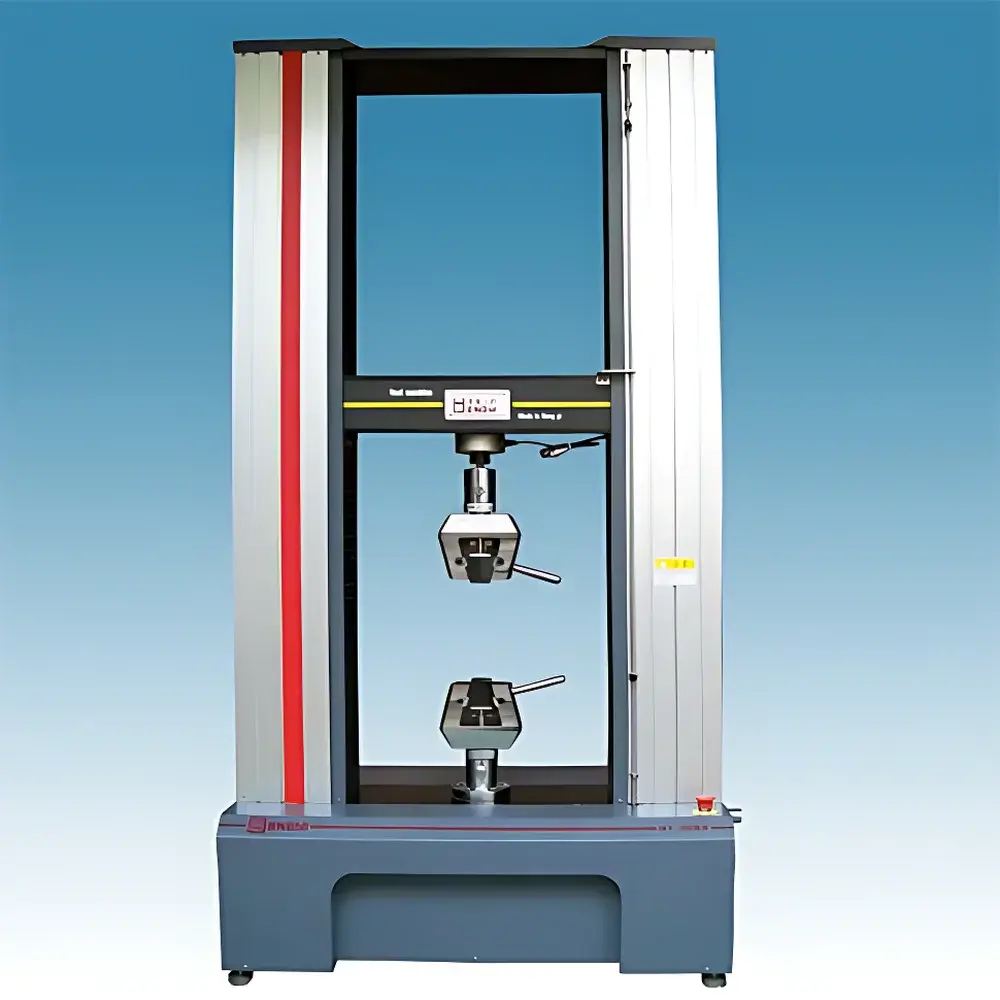
Hengyi HY-5080 (WJ) Microcomputer-Controlled Electromechanical Tensile Testing Machine
| Brand | Hengyi / Hengyitest |
|---|---|
| Origin | Shanghai, China |
| Manufacturer Type | Direct Manufacturer |
| Product Category | Domestic |
| Model | HY-5080 (WJ) |
| Instrument Type | Electromechanical Tensile Testing Machine |
| Accuracy Class | ≤0.5% |
| Load Capacity Options | 1N–5000N (multi-sensor configurable) |
| Effective Test Width | 120 mm |
| Effective Test Height | 800 mm |
| Speed Range | 0.001–500 mm/min |
| Speed Accuracy | ±0.5% of reading |
| Force Resolution | ±500,000 counts (full-scale, no range switching) |
| Displacement & Strain Measurement Accuracy | ±0.5% of reading |
| Stress/Strain Control Rate Range | 0.002–6% FS/S |
| Load Cell | Imported bidirectional high-precision load cell (USA-made) |
| Drive System | Panasonic servo motor & driver (Japan) |
| Lead Screw | Preloaded precision ball screw (imported) |
| Frame | Rigid single-column structural design |
| Safety Protection | Electronic limit switches, overload protection (110% FS), automatic fault diagnosis |
| Power Supply | 220 V AC, 750 W |
| Net Weight | 95 kg |
| Dimensions (W×D×H) | 470 × 400 × 1510 mm |
Overview
The Hengyi HY-5080 (WJ) Microcomputer-Controlled Electromechanical Tensile Testing Machine is a statically operated universal testing system engineered for high-reproducibility mechanical characterization of materials under uniaxial loading conditions. Based on electromechanical actuation principles—employing a precision preloaded ball screw driven by a closed-loop Panasonic servo motor—the system delivers controlled displacement or force profiles compliant with standardized static test methodologies defined in ISO 6892-1 (metallic materials), ISO 527-1/2 (plastics), ASTM D638/D3039/D790, and GB/T 228.1–2021. Its modular architecture supports both tension and compression modes within a single column frame, enabling full-cycle mechanical property derivation including ultimate tensile strength (UTS), yield strength (Rp0.2, Rp0.01), elastic modulus (E), elongation at break, Poisson’s ratio (via optional extensometry), and stress–strain curve generation. Designed for laboratory and QC environments where traceability and repeatability are critical, the HY-5080 (WJ) meets functional requirements for GLP-compliant data acquisition and supports audit-ready operation when integrated with validated software workflows.
Key Features
- Rigid single-column structural frame with high axial stiffness, minimizing deflection during high-load testing and ensuring geometric stability across full travel (800 mm).
- Imported bidirectional load cell (USA-manufactured) with automatic sensor recognition, calibrated to ≤0.5% accuracy class per ISO 376 and capable of seamless multi-range configuration (1 N to 5000 N).
- Panasonic AC servo motor and digital drive system (Japan), delivering precise speed control from 0.001 mm/min to 500 mm/min with ±0.5% speed fidelity across the entire range.
- High-precision preloaded recirculating ball screw with micron-level pitch accuracy, eliminating backlash and supporting long-term dimensional stability without maintenance.
- Dual-mode controller supporting both open-loop (position/speed) and closed-loop (force/stress/strain/displacement) control, with real-time PID parameter tuning and programmable ramp-hold-step profiles.
- Integrated safety architecture: electronic end-limit switches, hardware-based overload cutoff (110% FS), auto-diagnostic routines for drive, load cell, and encoder subsystems, and emergency stop compliance with IEC 60204-1.
- Ergonomic handheld remote control unit enabling rapid jog, start/stop, and manual return functions without requiring PC interaction.
Sample Compatibility & Compliance
The HY-5080 (WJ) accommodates a broad spectrum of specimen geometries and material classes—including thin films (e.g., PET, BOPP), elastomers (natural rubber, silicone), fine metallic wires (Cu, Al, NiTi), biomedical polymers (PLA, PCL), adhesives, foams, composites (CFRP, GFRP), pharmaceutical packaging films, and orthopedic implant components. Specimen widths up to 120 mm and thicknesses up to 25 mm are supported using interchangeable fixtures (tensile grips, compression platens, 3-/4-point bending assemblies, peel fixtures, shear adapters, and indentation modules). All mechanical test protocols align with internationally recognized standards: ISO 179 (impact-modified plastics), ISO 1183 (density), ASTM D882 (thin plastic sheeting), ASTM F2129 (corrosion resistance of implants), and USP (mechanical testing of medical devices). Optional calibration certificates traceable to Shanghai Institute of Measurement and Testing Technology (SIMT) satisfy metrological requirements under ISO/IEC 17025.
Software & Data Management
The system operates with Hengyi’s proprietary WinTest Pro v4.x software suite, a Windows-based platform compliant with FDA 21 CFR Part 11 for electronic records and signatures. It provides real-time plotting of force–displacement, stress–strain, and time-based curves; automated calculation of ASTM/ISO-defined parameters (modulus, yield offset, toughness, secant modulus); batch report generation in PDF/XLS formats; and user role-based access control (administrator, operator, reviewer). Raw data export is supported in CSV, TXT, and universal .UDF formats for third-party analysis (MATLAB, OriginLab, Python Pandas). Audit trails record all test modifications, calibration events, user logins, and instrument faults with timestamps and operator IDs—enabling full GMP/GLP traceability. Optional integration with LIMS via OPC UA or RESTful API allows centralized data ingestion into enterprise quality management systems.
Applications
- Quality assurance of polymer films and laminates in flexible packaging production lines.
- Mechanical validation of photovoltaic interconnect ribbons and solar cell substrates per IEC 61215.
- Tensile property benchmarking of biodegradable sutures, hydrogels, and tissue-engineered scaffolds per ISO 10993-12.
- Compression testing of pharmaceutical tablets and lyophilized cakes per USP .
- Peel strength evaluation of medical device adhesive tapes and wound dressings per ASTM D903.
- Shear and flexural characterization of composite laminates used in aerospace secondary structures.
- Calibration verification of strain gauges, load cells, and piezoresistive sensors in metrology labs.
FAQ
What standards does the HY-5080 (WJ) comply with for calibration and verification?
The system conforms to ISO 7500-1 (static calibration of force-proving instruments), ISO 4287 (surface roughness measurement for test fixtures), and JJG 139–2014 (Chinese national verification regulation for universal testing machines). Optional factory calibration includes NIST-traceable load cell certification.
Can the machine perform cyclic loading or fatigue tests?
No—the HY-5080 (WJ) is designed exclusively for static (quasi-static) mechanical testing. For dynamic or high-cycle fatigue applications, Hengyi offers the HY-FAT series electrodynamic fatigue testers.
Is the software compatible with Windows 11 and 64-bit architectures?
Yes—WinTest Pro v4.x supports Windows 10/11 (64-bit) and requires .NET Framework 4.8 and DirectX 12. Driver signing is WHQL-certified.
What is the recommended maintenance schedule?
Biannual inspection of ball screw lubrication, load cell zero drift verification, and encoder alignment check is advised. No scheduled replacement parts are required within the first 5 years under normal lab use.
Does the system support ASTM E4 calibration procedures?
Yes—calibration mode implements ASTM E4-compliant verification sequences, including linearity, hysteresis, and repeatability checks across ≥10 load points spanning 10–100% FS.



