
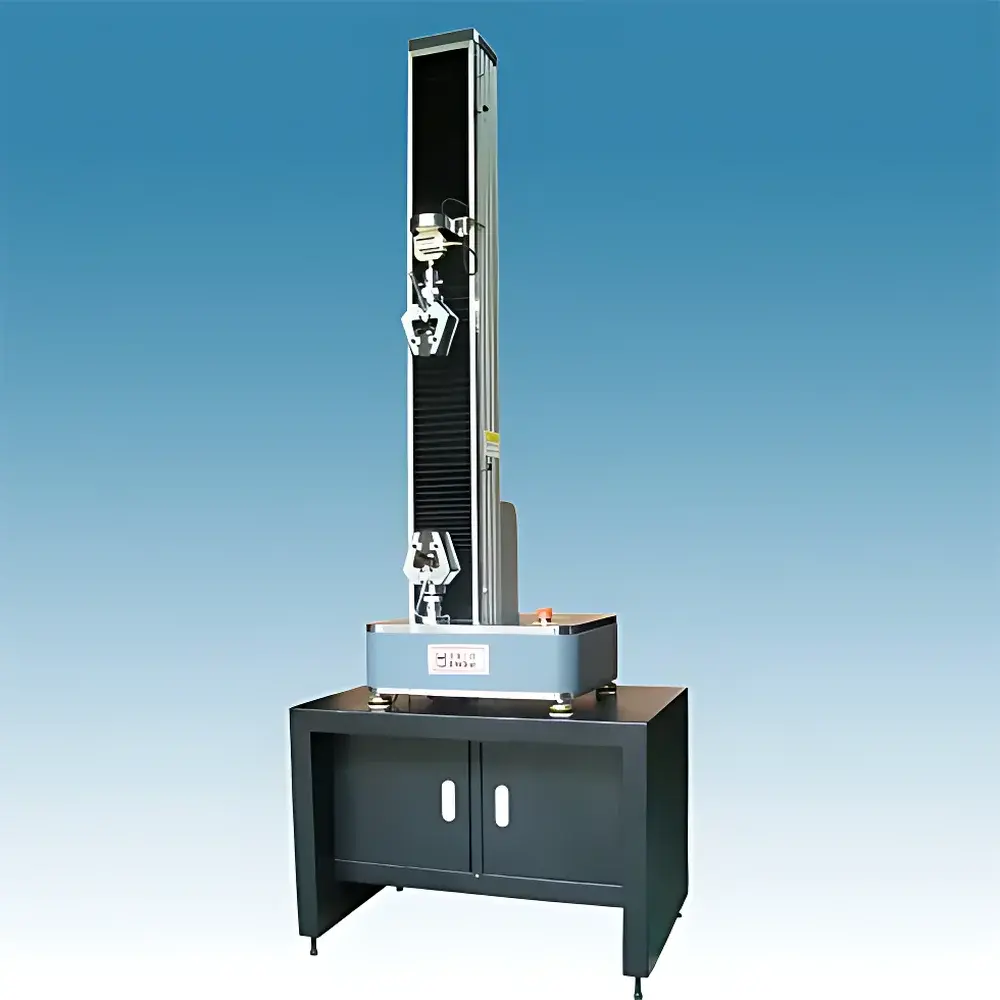
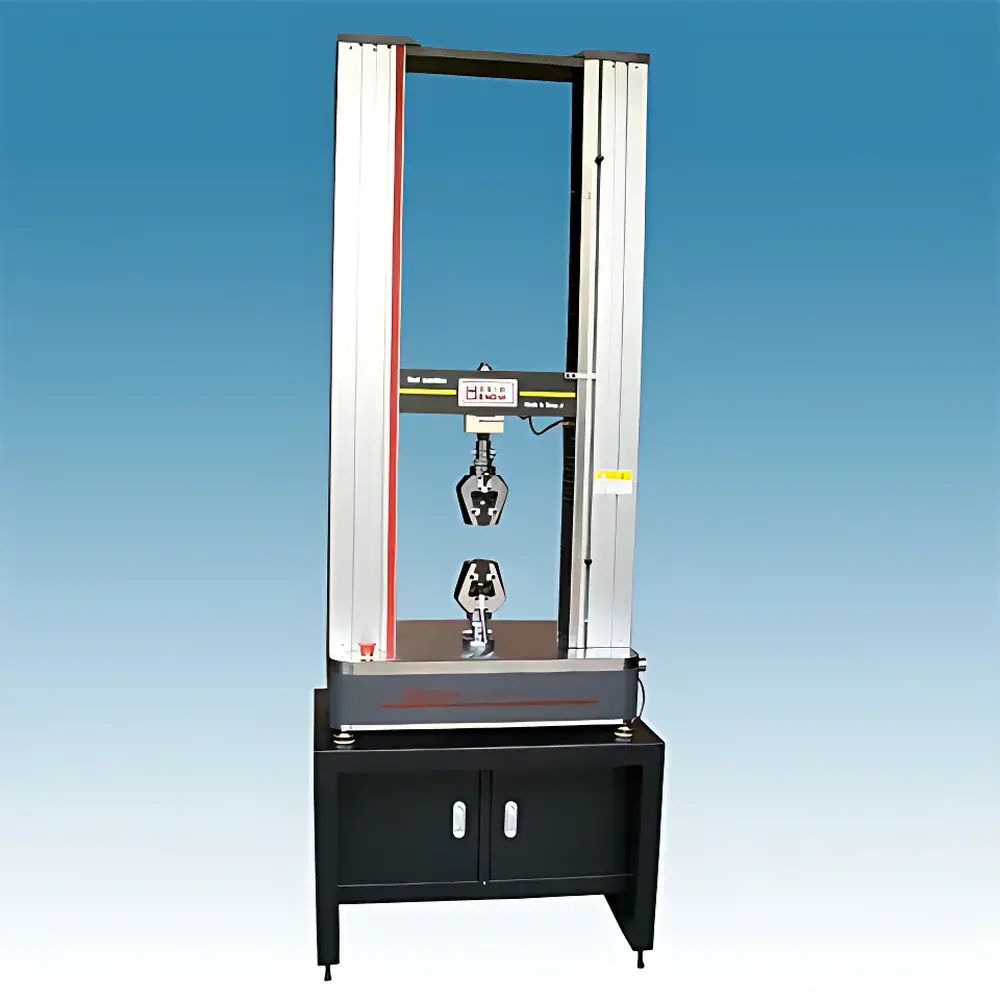
Hengyi HY-0580 Single-Column Universal Testing Machine for Seal Strip Pull-Out Force Measurement
| Brand | Hengyi |
|---|---|
| Origin | Shanghai, China |
| Manufacturer Type | Direct Manufacturer |
| Instrument Type | Electronic Universal Testing Machine |
| Load Capacity Options | 1N to 5000N (interchangeable load cells) |
| Force Accuracy | ≤0.5% of reading |
| Effective Test Width | 120 mm |
| Effective Stroke | 800 mm |
| Speed Range | 0.001–500 mm/min |
| Speed Accuracy | ±0.5% of set value |
| Displacement Accuracy | ±0.5% of reading |
| Force Resolution | ±500,000 counts (full-scale, no range switching) |
| Power Supply | 220 V AC, 750 W |
| Dimensions (W×D×H) | 470 × 400 × 1510 mm |
| Weight | 120 kg |
Overview
The Hengyi HY-0580 Single-Column Universal Testing Machine is an engineered solution for precise, repeatable measurement of pull-out force in automotive and architectural seal strips—specifically designed to quantify the interfacial adhesion strength between elastomeric sealing profiles and glass or metal substrates. Operating on the principle of controlled uniaxial tensile separation, the system applies a calibrated, motor-driven displacement at defined rates (e.g., 100 mm/min per GB/T 2611–2007) while continuously recording load vs. displacement data. Its single-column architecture provides rigidity and alignment stability essential for low-force (<5 kN), high-resolution mechanical testing of soft, viscoelastic components such as EPDM, TPE, and silicone-based gaskets. The machine complies with fundamental metrological requirements for static mechanical testing systems, including force transducer linearity, crosshead positioning repeatability, and system compliance correction protocols mandated by ISO 7500-1, ASTM E4, and JJG 475.
Key Features
- Modular load cell configuration supporting interchangeable sensors from 1 N to 5000 N—enabling traceable calibration across multiple force ranges without hardware modification.
- High-resolution force measurement system with 500,000-count A/D resolution, maintaining constant effective resolution throughout the full scale (no auto-ranging or digitization loss).
- Precise speed control over 0.001–500 mm/min with closed-loop servo feedback; speed accuracy maintained within ±0.5% of setpoint per ISO 5893.
- Dual-mode positioning: fine-adjustment “jog” control and rapid manual return, ensuring efficient specimen setup and post-test recovery.
- Integrated electronic limit switches and overload protection (110% FS cutoff) safeguard both operator safety and sensor integrity during unexpected load events.
- Real-time diagnostics monitor drive current, amplifier voltage, thermal load, and encoder feedback—triggering automatic shutdown upon deviation beyond preset thresholds.
- Compliance-ready mechanical design: column stiffness ≥ 200 kN/mm, frame deflection < 0.02 mm under 100% FS load, satisfying ISO 7500-1 Class 0.5 requirements.
Sample Compatibility & Compliance
The HY-0580 accommodates standardized seal strip specimens (e.g., 100 mm length, mounted per GB/T 16491–2008 Annex B) as well as diverse material forms—including polymer films, textile reinforcements, adhesive tapes, rubber compounds, and thermoplastic elastomers. Its 120 mm test width and 800 mm vertical travel support both standard and custom fixtures (e.g., pneumatic clamps, wedge grips, peel jigs). The system meets national and international standards including GB/T 2611–2007 (General Technical Requirements for Testing Machines), GB/T 16491–2008 (Electronic Universal Testing Machines), ISO 7500-1 (Static Calibration of Force Measuring Systems), ASTM D412/D638 (Rubber/Plastic Tensile Testing), and ISO 37 (Vulcanized Rubber – Tensile Stress–Strain Properties). Optional GLP-compliant audit trails and 21 CFR Part 11–ready software modules are available for regulated environments.
Software & Data Management
Bundled Hengyi TestMaster™ software provides real-time curve visualization, multi-channel synchronized acquisition (load, displacement, extensometer if equipped), and automated report generation compliant with ISO/IEC 17025 documentation requirements. Users may define custom test methods—including ramp-hold sequences, cyclic loading, and conditional termination (e.g., “stop at 50 N” or “stop after 2 mm extension”). Raw data exports to CSV, XML, or PDF formats include metadata (operator ID, timestamp, calibration certificate ID, environmental conditions). All test parameters, results, and system logs are stored with immutable timestamps and user-access controls—supporting traceability for internal audits or third-party accreditation reviews.
Applications
- Quantification of seal strip pull-out resistance from laminated automotive glass assemblies under ambient conditions.
- Evaluation of adhesive bond durability in HVAC duct seals subjected to thermal cycling and vibration pre-conditioning.
- Tensile property characterization of extruded elastomeric profiles per ASTM D412 and ISO 37.
- Peel strength assessment of pressure-sensitive tapes used in window glazing systems (ASTM D903).
- Compression-set and stress-relaxation analysis using optional environmental chambers and digital extensometers.
- Quality conformance testing for Tier-1 suppliers operating under IATF 16949 or ISO 9001 quality management systems.
FAQ
What is the maximum allowable crosshead speed for seal strip pull-out testing per GB/T 16491–2008?
Per Clause 6.3.2, the recommended rate for low-force adhesion tests is 100 mm/min—within the HY-0580’s validated operational envelope.
Can the system be integrated into a factory MES or LIMS environment?
Yes—via OPC UA or Modbus TCP interfaces; API documentation and SCADA integration support are provided under extended service contracts.
Is force calibration traceable to national metrology institutes?
All load cells ship with UKAS-accredited calibration certificates (ISO/IEC 17025), and in-house recalibration intervals follow ISO 9001-controlled procedures.
Does the machine support extensometer inputs for strain measurement?
Yes—standard RS-232 and analog voltage inputs accept contact and non-contact extensometers meeting ASTM E83 Class B-1 specifications.
How is system compliance compensated during low-load testing?
The firmware applies real-time frame compliance correction using pre-characterized column deflection coefficients, referenced against ISO 7500-1 Annex C methodology.



