
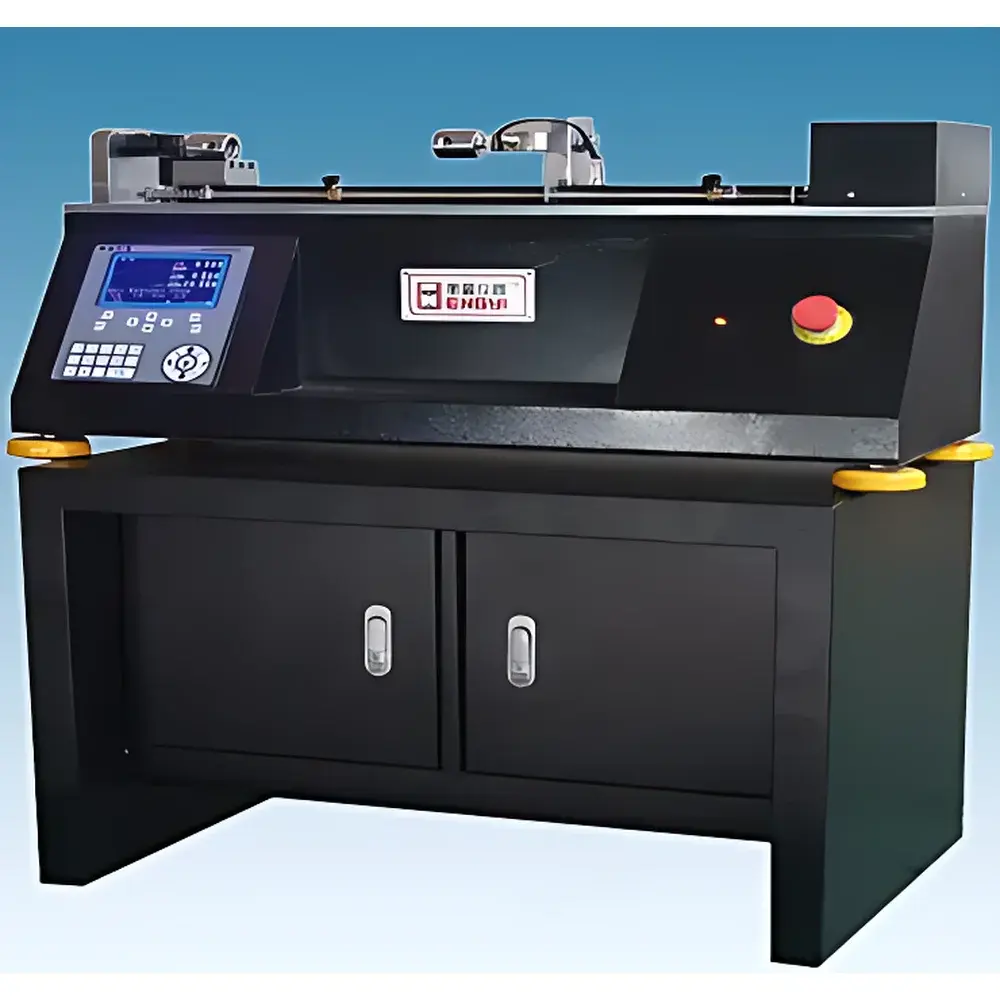
Hengyi HY-0530W Horizontal Benchtop Wire Harness Terminal Tensile Testing Machine
| Brand | Hengyi / Hengyitest |
|---|---|
| Origin | Shanghai, China |
| Manufacturer Type | Direct Manufacturer |
| Regional Category | Domestic (China) |
| Model | HY-0530W |
| Instrument Type | Electromechanical Tensile Testing Machine |
| Maximum Test Load | 5 kN |
| Load Measurement Range | 0.001–100% of Full Scale (FS) |
| Load Accuracy | ±0.5% FS |
| Test Stroke | 300 mm |
| Displacement Resolution | 0.001 mm |
| Load Cell | 5 kN High-Precision Load Cell (US-made, ±0.02% FS accuracy) |
| Drive System | Panasonic Full-Digital AC Servo Motor |
| Transmission | Precision Ball Screw + Taiwan-Made Reduction Assembly |
| Control Architecture | 32-bit ARM Microprocessor (56 MIPS), Embedded Real-Time OS |
| Data Acquisition Rate | Up to 100 Hz |
| Speed Range | 0.001–300 mm/min (adjustable in 0.001 mm/min increments) |
| Clamping Distance (center-to-center, excluding grips) | 500 mm |
| Display | Large Backlit LCD with Real-Time Curve Plotting, Load/Displacement Tracking, and Auto-Data Logging |
| Dimensions (W×D×H) | 560 × 470 × 490 mm |
| Weight | ≈85 kg |
Overview
The Hengyi HY-0530W is a horizontally configured, benchtop electromechanical tensile testing system engineered specifically for the mechanical validation of wire harness terminals, crimped connectors, solder joints, and related low-force electrical interconnects. It operates on the fundamental principle of uniaxial force application under controlled displacement or speed, measuring load response via a high-fidelity 5 kN load cell and resolving sub-micron displacement changes through precision ball-screw kinematics and optical encoder feedback. Designed for compliance with international mechanical testing workflows—including ISO 11337 (electrical connector pull-out), USCAR-21 (automotive terminal retention), and JASO D001—this system delivers traceable, repeatable data essential for quality assurance in automotive electronics, aerospace wiring assemblies, medical device cabling, and industrial control systems.
Key Features
- Horizontal architecture optimized for ergonomic handling and direct line-of-sight alignment during terminal pull tests—minimizing bending moments and ensuring pure axial loading.
- US-sourced 5 kN load cell with ±0.02% full-scale accuracy, calibrated to NIST-traceable standards and validated per ASTM E4 requirements for force verification.
- Panasonic digital AC servo drive delivering smooth, low-noise motion across the full speed range (0.001–300 mm/min), enabling both quasi-static creep evaluation and rapid release-cycle testing.
- Embedded 32-bit ARM processor with real-time operating system ensures deterministic data acquisition at up to 100 Hz, supporting synchronized load–displacement curve capture without PC dependency.
- Integrated backlit LCD interface provides live graphical plotting (force vs. displacement), numeric parameter readouts, and one-touch test initiation—ideal for production-floor environments with limited IT infrastructure.
- Modular grip system includes interchangeable jaw sets for flat-blade, cylindrical, and custom-profile terminals; accommodates AWG 30–8 conductors and ISO/IEC 7816-compliant smart card contacts.
Sample Compatibility & Compliance
The HY-0530W supports standardized test specimens defined in IEC 60512-2-1 (crimp joint pull strength), SAE J2241 (wire harness retention), and UL 486A-B (terminal mechanical performance). Its 500 mm center-to-center clamping distance allows full-length evaluation of multi-branch harnesses and daisy-chained connectors. All hardware components—including load train, frame, and sensor mounting—meet ISO 7500-1 Class 0.5 mechanical calibration requirements. The system’s mechanical design conforms to EN 61000-6-2 (EMC immunity) and EN 61000-6-4 (EMC emission) standards. Optional audit trail and electronic signature modules support GLP/GMP-aligned deployment where regulatory documentation integrity is required.
Software & Data Management
The embedded firmware supports automatic test sequence execution, pass/fail thresholding based on user-defined criteria (e.g., minimum pull force ≥ 80 N, maximum elongation ≤ 0.5 mm), and CSV-formatted export of raw time-stamped datasets. When connected to a host PC, optional Hengyi TestSuite™ software enables advanced analysis: statistical process control (SPC) charting, Weibull distribution fitting for failure mode assessment, batch report generation compliant with ISO/IEC 17025 documentation requirements, and PDF certificate output with embedded digital signatures. Data storage adheres to ALCOA+ principles (Attributable, Legible, Contemporaneous, Original, Accurate, Complete, Consistent, Enduring, Available) and supports 21 CFR Part 11-compliant user access control when deployed in regulated manufacturing settings.
Applications
- Validation of crimp integrity in automotive wiring harnesses prior to vehicle assembly.
- Quality screening of PCB-mounted terminals, IDC connectors, and FFC/FPC retention clips.
- Comparative evaluation of solder joint strength in medical sensor cables subjected to flex fatigue.
- R&D-level characterization of new contact materials (e.g., beryllium copper alloys) under variable temperature-humidity conditions (when integrated with environmental chamber).
- Failure analysis root cause determination—distinguishing between conductor pull-out, insulation slippage, and crimp barrel deformation via load plateau detection and slope analysis.
FAQ
What standards does the HY-0530W support out-of-the-box?
It natively supports test protocols aligned with ISO 11337, USCAR-21, IEC 60512-2-1, and SAE J2241. Calibration certificates include traceability to national metrology institutes.
Can the system be integrated into an automated production line?
Yes—RS-232 and Ethernet interfaces enable PLC-triggered test initiation, real-time pass/fail signal output, and MES data upload via Modbus TCP or custom REST API endpoints.
Is third-party calibration available?
Hengyi partners with A2LA-accredited laboratories for on-site or depot-based recalibration services, including full uncertainty budget reporting per ISO/IEC 17025.
Does the machine require compressed air or external cooling?
No—it is fully self-contained, fan-cooled, and operates on standard 100–240 VAC input with no auxiliary utilities required.
How is operator training delivered?
On-site or virtual instructor-led sessions cover mechanical setup, test method configuration, result interpretation, and preventive maintenance—certification documentation provided upon completion.



