
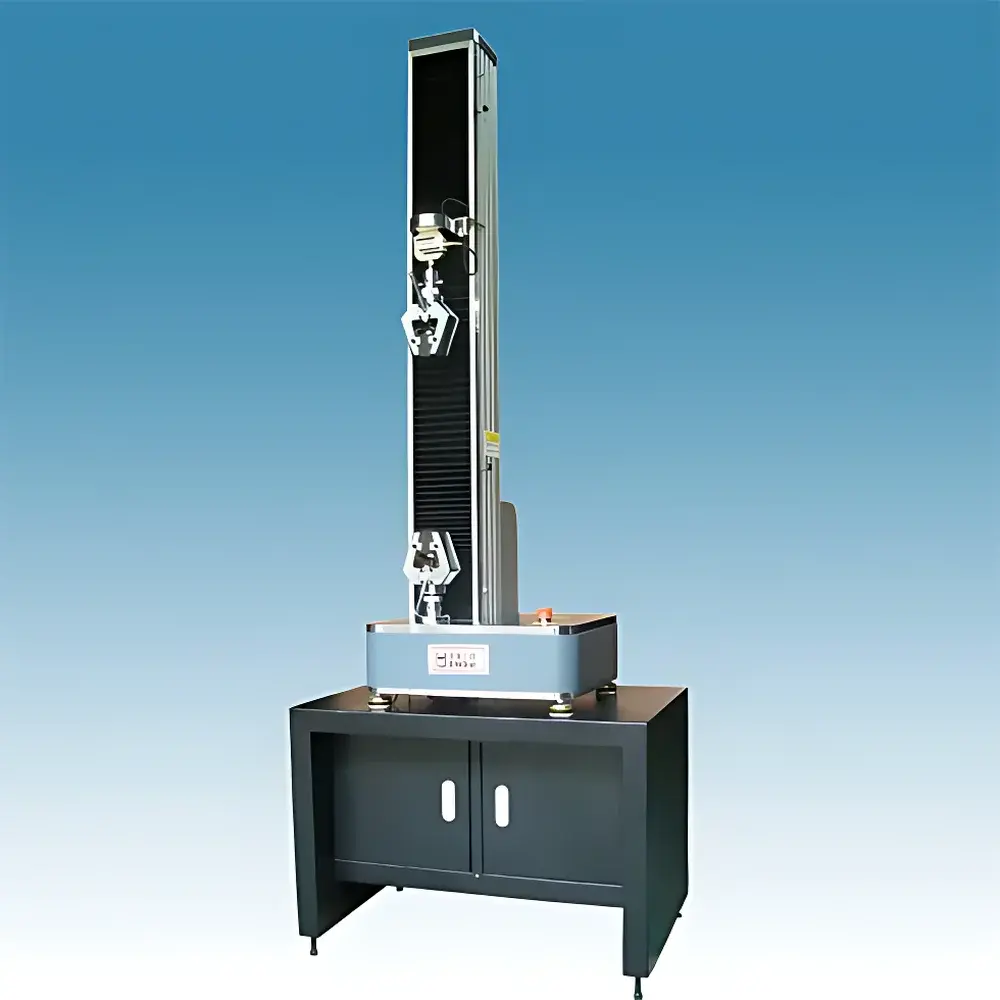
Hengyi HY-0580YSDE Creep Testing Machine for Compressed Straw Briquettes
| Brand | Hengyi |
|---|---|
| Origin | Shanghai, China |
| Manufacturer Type | Direct Manufacturer |
| Regional Classification | Domestic (China) |
| Model | HY-0580YSDE |
| Price Range | USD 1,400 – 7,000 (FOB Shanghai) |
| Max Test Load | 5 kN |
| Load Application Rate | 0.001–500 N/s |
| Platen Spacing | 80 mm |
| Platen Dimensions | 80 mm × 80 mm |
| Compression Cylinder ID | 60 mm |
| Cylinder Height | 140 mm |
| Test Speed Range | 0.001–500 mm/min |
| Force Resolution | ±500,000 counts (full-scale, no range switching) |
| Force Accuracy | ≤ ±0.5% of reading |
| Displacement & Strain Accuracy | ±0.5% of reading |
| Stress Control Rate Range | 0.005–6% FS/s |
| Strain Control Rate Range | 0.002–6% FS/s |
| Constant-Load/Displacement/Strain Holding Accuracy | ±0.1% FS (≥10% FS) |
| Safety Protection | Electronic over-travel limit, 10% overload auto-shutdown, real-time system diagnostics |
| Power Supply | 220 V AC, 50/60 Hz, 750 W |
| Net Weight | 95 kg |
| Overall Dimensions | 470 × 400 × 1510 mm (W×D×H) |
Overview
The Hengyi HY-0580YSDE Creep Testing Machine is a precision-engineered single-column electromechanical testing system designed specifically for time-dependent mechanical characterization of compressed agricultural biomass—primarily rice, wheat, and corn straw briquettes. It operates on the principle of controlled uniaxial compression under sustained or ramped load conditions, enabling quantitative evaluation of viscoelastic deformation behavior including creep compliance, stress relaxation, and long-term compressive stability. The system conforms to fundamental solid mechanics frameworks for quasi-static loading, with force application governed by a high-resolution servo-controlled actuator and displacement monitored via calibrated linear encoder feedback. Its modular architecture supports both static compression tests (e.g., density determination at 300 kg/m³ target) and dynamic time-dependent protocols (e.g., 50 mm/min consolidation followed by 24–72 h constant-load hold), making it suitable for R&D labs evaluating fuel pellet durability, storage integrity, and structural consistency in bioenergy supply chains.
Key Features
- Single-column rigid frame with integrated load cell (5 kN capacity, Class 0.5 accuracy per ISO 7500-1 and ASTM E4)
- Dual-mode control: precise force-rate (0.001–500 N/s) and displacement-rate (0.001–500 mm/min) programming, both with ≤±0.5% fidelity
- Standardized compression fixture: 60 mm inner-diameter cylindrical die with 140 mm height, compatible with ISO 17831-1 and EN 15210-1 sample geometry requirements
- Real-time synchronized acquisition of compressive force, axial displacement, time, and derived strain—sampled at ≥100 Hz
- Electronic safety interlocks including programmable travel limits, automatic emergency stop at >110% full scale, and continuous self-diagnostic monitoring of drive voltage, current, and thermal load
- Adjustable platen spacing (80 mm max) and square platens (80 mm × 80 mm) accommodate heterogeneous biomass specimens with minimal edge effects
- Integrated fast/slow manual positioning and programmable return-to-origin function for high-throughput batch testing
Sample Compatibility & Compliance
The HY-0580YSDE is validated for cylindrical straw briquettes (Ø60 mm × H≤140 mm) produced from air-dried, binder-free rice, wheat, and maize residues. Specimen moisture content should be maintained between 8–12% w.b. per ISO 18134-1 to ensure reproducible densification response. The system executes standardized test routines aligned with ASTM D1662 (compressive strength of solid biofuels), ISO 17831-2 (durability of wood pellets), and GB/T 21923-2008 (general technical requirements for straw-based solid fuels). All data acquisition, parameter calculation (e.g., ReH, Rp0.2, Rm, E, creep coefficient J(t)), and report generation comply with GLP documentation standards, supporting audit-ready traceability for internal QA and third-party certification workflows.
Software & Data Management
The machine operates with Hengyi’s proprietary TestMaster v4.2 software suite, a Windows-based platform supporting multilingual UI (English, German, Spanish, Chinese), configurable test templates, and automated pass/fail logic per user-defined thresholds. Raw data streams are saved in .csv and .tdms formats with embedded metadata (operator ID, calibration timestamp, environmental log). Software implements FDA 21 CFR Part 11-compliant electronic signatures, role-based access control, and immutable audit trails for all test modifications, calibration events, and result exports. Curve-fitting modules enable Burgers, Kelvin-Voigt, and Maxwell model regression for viscoelastic parameter extraction. Export options include PDF reports with embedded stress–strain–time plots, summary tables of ISO/ASTM-derived indices, and raw time-series datasets for post-processing in MATLAB or Python.
Applications
- Creep compliance quantification of densified straw under storage-relevant loads (e.g., 0.2–0.8 MPa for 72 h)
- Stress relaxation profiling during post-compaction stabilization phases
- Compression modulus (Ec) and yield stress (σy) determination per ASTM D695 methodology adapted for low-density biocomposites
- Inter-laboratory round-robin validation of briquette mechanical specifications for ENplus® or Pellet Fuels Institute (PFI) certification
- Formulation screening of lignin, starch, or clay binders via comparative creep resistance metrics
- Educational use in materials science curricula for introducing time-dependent deformation concepts in natural fiber composites
FAQ
What standards does the HY-0580YSDE support for biomass compression testing?
It natively executes test sequences compliant with ASTM D1662, ISO 17831-1/-2, EN 15210-1, and GB/T 21923-2008, with software-calculated parameters mapped directly to standard-defined nomenclature.
Can the system perform both creep and stress relaxation tests?
Yes—via programmable load-hold (creep) and displacement-hold (relaxation) modes, with automatic derivation of J(t) and G(t) functions using built-in curve-fitting algorithms.
Is calibration traceable to national metrology institutes?
Force calibration is performed using NIST-traceable deadweight standards; displacement calibration uses laser interferometry. Certificate of Conformance includes uncertainty budgets per ISO/IEC 17025.
What sample preparation guidelines are recommended?
Specimens must be conditioned at 23 ± 2°C and 50 ± 5% RH for ≥48 h prior to testing. Diameter tolerance: ±0.2 mm; height tolerance: ±1 mm; surface parallelism: <0.05 mm.
Does the software support LIMS integration?
Yes—via HL7 and ASTM E1384-compliant API interface, enabling direct push of test IDs, results, and QC flags into laboratory information management systems.



