
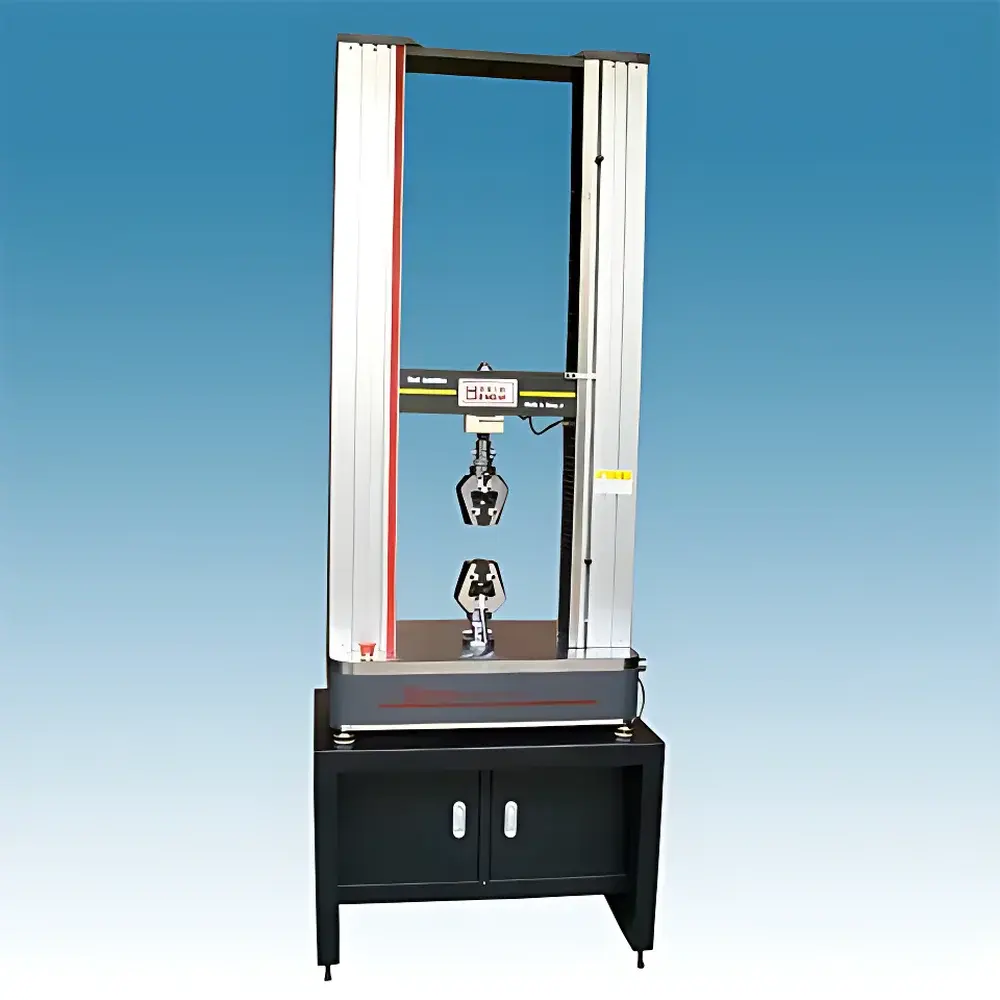
Hengyi HY-2080 Universal Tensile Testing Machine
| Brand | Hengyi / Hengyitest |
|---|---|
| Origin | Shanghai, China |
| Manufacturer Type | Direct Manufacturer |
| Country of Origin | China |
| Model | HY-2080 |
| Instrument Type | Electromechanical Universal Tensile Tester |
| Load Capacity Options | 1 N to 20 kN (multi-range selectable) |
| Accuracy Class | ≤0.5% of full scale |
| Effective Test Width | 380 mm (expandable) |
| Effective Test Height | 800 mm (extendable) |
| Speed Range | 0.001–500 mm/min (continuous, programmable) |
| Speed Accuracy | ±0.5% of set value |
| Force Resolution | ±500,000 counts (full-scale, no range switching) |
| Force Measurement Accuracy | ±0.5% of reading |
| Displacement & Strain Accuracy | ±0.5% of reading |
| Control System | High-speed DSP platform with USB 2.0 (full-speed, bulk-transfer mode) |
| Safety Features | Electronic limit switches, overload protection (110% FS), emergency stop, real-time self-diagnosis |
| Power Supply | 220 V AC, single-phase, 750 W |
| Dimensions (W×D×H) | 700 × 420 × 1510 mm |
| Weight | 180 kg |
Overview
The Hengyi HY-2080 Universal Tensile Testing Machine is a dual-column, electromechanical materials testing system engineered for high-precision static mechanical characterization under tension, compression, bending, shear, peel, tear, and cyclic loading conditions. Based on servo-controlled electromechanical actuation and closed-loop force/displacement/strain regulation, the HY-2080 implements standardized quasi-static test protocols in accordance with ISO 6892-1, ASTM E8/E9/E21, ISO 527, ISO 178, ISO 1133, USP , and relevant clauses of FDA 21 CFR Part 11 for audit-trail-capable data acquisition. Its rigid aluminum-alloy frame—designed for long-term dimensional stability and UV-resistant surface integrity—supports reproducible load train alignment critical for valid modulus and yield point determination across heterogeneous material classes.
Key Features
- High-stiffness dual-column structural frame with precision-ground, preloaded ball screws (dual-axis) ensuring minimal axial deflection and thermal drift during extended testing.
- Japan Panasonic AC servo motor and driver assembly delivering smooth, low-noise motion control with torque ripple <0.5% and position repeatability ≤±0.005 mm.
- U.S.-sourced bidirectional load cell with automatic transducer recognition, calibrated traceably to NIST-equivalent national standards; supports seamless interchange across 13 standard capacity ranges (1 N – 20 kN).
- DSP-based real-time controller featuring 500 kHz sampling rate, 24-bit A/D conversion, and embedded PID tuning for force, displacement, and strain control modes—including stress-rate (0.005–6 %FS/s) and strain-rate (0.002–6 %FS/s) ramping.
- USB 2.0 interface (12 Mb/s full-speed bulk transfer) enabling deterministic data streaming to host PC without packet loss; hot-pluggable, software-configurable I/O ports conforming to USB-IF compliance requirements.
- Comprehensive safety architecture: electronic upper/lower limit detection, hardware emergency stop circuit, 110% overload cut-off, real-time system diagnostics (overvoltage, overcurrent, motor stall, sensor fault), and auto-recovery from transient faults.
- Modular firmware architecture supporting user-defined test methods via VB.NET + SQL Server backend—enabling method validation, parameter templating, and GLP/GMP-compliant electronic signatures per Annex 11 requirements.
Sample Compatibility & Compliance
The HY-2080 accommodates specimens ranging from sub-millimeter filaments (e.g., suture threads, optical fibers, PV ribbon) to structural composites and biomedical implants. Validated applications include polymeric films (PET, PE, PP), elastomers (natural rubber, silicone), thin metals (Cu/Al foils, battery tabs), adhesives (PSA tapes, structural epoxies), pharmaceutical packaging (blister foil, pouch seals), medical devices (catheters, stent crimping fixtures), foam matrices (PU, PTFE), and fiber-reinforced laminates. All mechanical output parameters—including tensile strength, Young’s modulus (E), yield offset (0.2% proof stress), elongation at break, compressive yield, flexural modulus (3-point/4-point), and peel adhesion energy—are computed per ISO 527-2, ASTM D638, ISO 178, ASTM D903, and ISO 1133 protocols. Optional extensometry (video or clip-on) extends measurement validity to Poisson’s ratio and plastic strain localization analysis.
Software & Data Management
The HY-2080 operates with HengyiTest v5.x software—a Windows-based application compliant with 21 CFR Part 11 for electronic records and signatures. It provides role-based access control (administrator/operator/auditor), immutable audit trails (time-stamped, user-identified, tamper-evident), and automated report generation in PDF/A-1b format with embedded metadata (test method ID, calibration certificate ID, operator ID, environmental log). Raw data export supports CSV, Excel (.xlsx), and universal HDF5 formats for third-party statistical analysis (Minitab, JMP, Python pandas). The system logs all configuration changes, calibration events, and maintenance interventions—fulfilling ALCOA+ principles (Attributable, Legible, Contemporaneous, Original, Accurate, Complete, Consistent, Enduring, Available) required by ISO/IEC 17025-accredited laboratories.
Applications
This instrument serves as a primary mechanical characterization tool in R&D, QC, and regulatory submission workflows across regulated and non-regulated sectors. In polymer science, it quantifies melt strength, film toughness, and thermoforming behavior. In electronics manufacturing, it validates wire bond pull strength and solder joint shear integrity per IPC-J-STD-001. In medical device development, it supports ISO 10993-12 extractables testing and ASTM F2193 suture tensile performance evaluation. Automotive Tier-1 suppliers use it for composite crash-energy absorption profiling, while packaging engineers rely on it for seal strength validation against ASTM F88 and ASTM F904. Universities deploy it for undergraduate mechanics labs and graduate-level fracture mechanics research—particularly when coupled with digital image correlation (DIC) add-ons.
FAQ
What international standards does the HY-2080 support out-of-the-box?
It natively implements test sequences aligned with ISO 6892-1 (metals), ISO 527-2 (plastics), ISO 178 (flexural), ASTM D638, ASTM D790, and ASTM D1876 (peel)—with method templates preloaded and editable via GUI.
Can the system be validated for GMP environments?
Yes. Full IQ/OQ/PQ documentation packages are available, including URS mapping, risk assessment (FMEA), calibration traceability to CNAS-accredited labs, and 21 CFR Part 11 configuration reports.
Is third-party calibration certification included?
Standard delivery includes factory calibration with uncertainty budget; optional Shanghai Institute of Measurement & Testing (SIMT) certificate (CNAS ISO/IEC 17025 accredited) is available upon request.
What clamping solutions are recommended for brittle ceramics or soft hydrogels?
Pneumatic side-action grips with serrated tungsten-carbide faces are advised for ceramics; low-pressure pneumatic rubber-faced grips or custom vacuum chucks are recommended for hydrogels and biological tissues.
Does the controller support real-time analog output for external DAQ integration?
Yes—two isolated 0–10 V analog outputs (force and displacement) are provided with configurable scaling, enabling synchronization with high-speed cameras or thermal imaging systems.



