
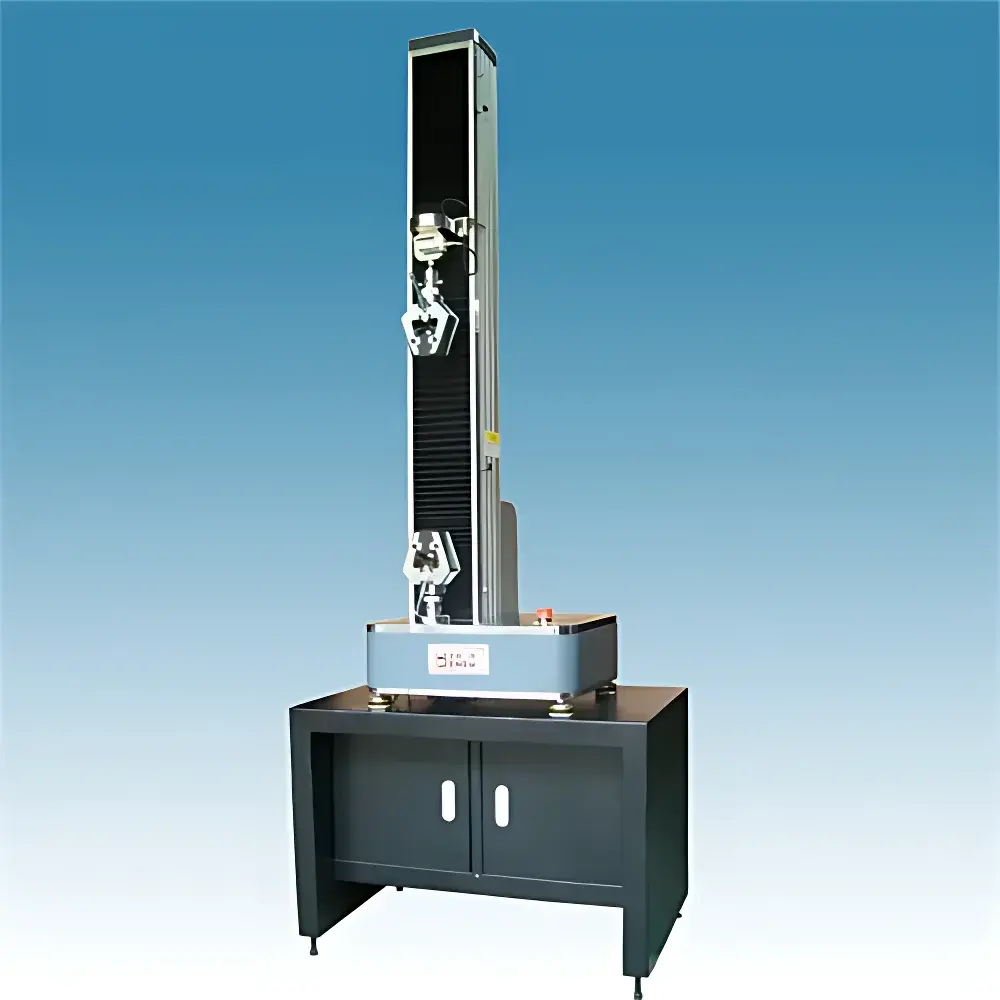
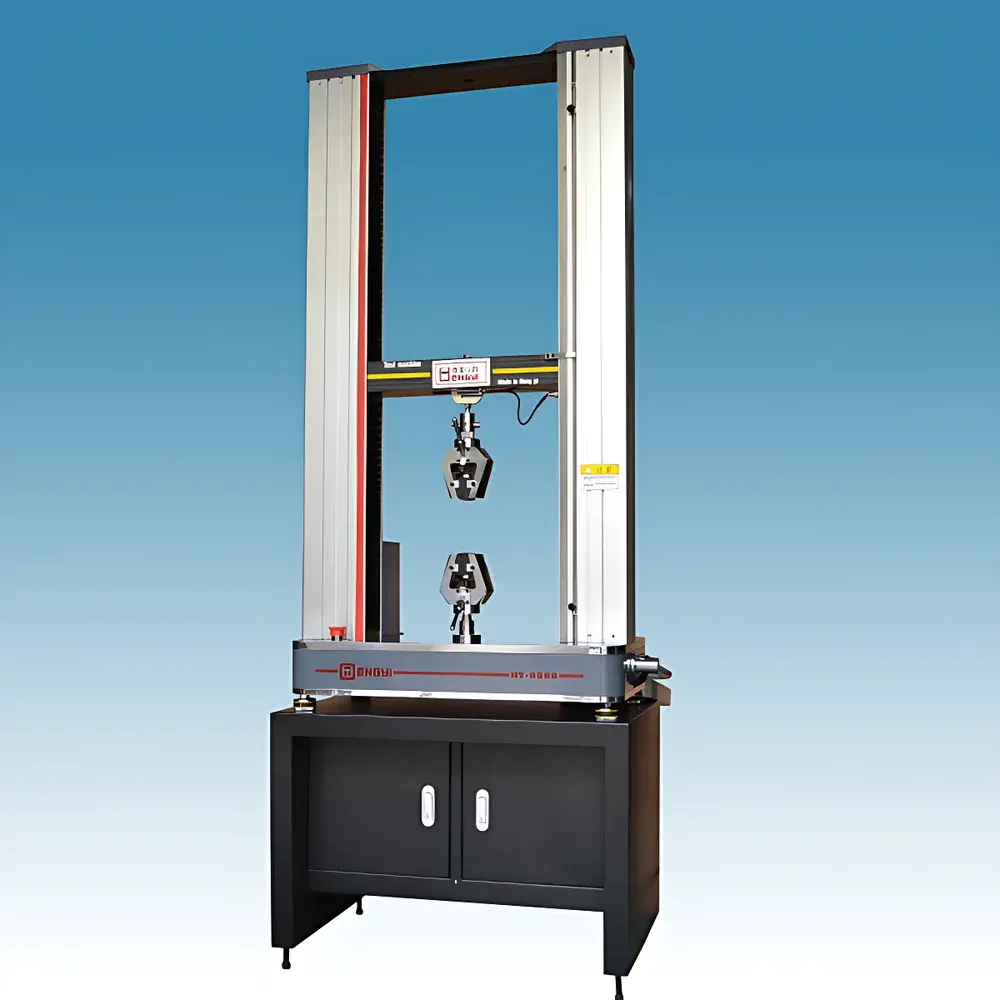
Hengyi HY-0580 Orthopedic Biomaterials Universal Testing Machine
| Brand | Hengyi |
|---|---|
| Origin | Shanghai, China |
| Manufacturer Type | Direct Manufacturer |
| Product Category | Domestic |
| Model | HY-0580HYJJ |
| Instrument Type | Electromechanical Universal Testing Machine |
| Load Capacity Options | 1 N to 5000 N (multi-sensor configurable) |
| Accuracy Class | ≤0.5 |
| Effective Test Width | 120 mm |
| Effective Vertical Travel | 800 mm |
| Speed Range | 0.001–500 mm/min |
| Speed Accuracy | ±0.5% of indicated value |
| Force Resolution | ±500,000 counts at full scale (no range switching) |
| Displacement & Strain Measurement Accuracy | ±0.5% of indicated value |
| Stress/Strain Control Rate Range | 0.002–6% FS/s |
| Constant-Load/Displacement/Deformation Control Range | 0.5–100% FS |
| Protection Features | Electronic limit switches, overload protection (>110% FS), real-time system diagnostics |
| Power Supply | 220 V AC, 50 Hz, 750 W |
| Dimensions (W×D×H) | 470 × 400 × 1510 mm |
| Weight | 95 kg |
| Operating Environment | 20–40 °C, 20–80% RH |
Overview
The Hengyi HY-0580 Orthopedic Biomaterials Universal Testing Machine is a high-precision electromechanical testing system engineered for static and quasi-static mechanical characterization of orthopedic implants, biomaterials, and load-bearing medical devices. Based on servo-controlled closed-loop force and displacement actuation, the system applies controlled uniaxial tensile, compressive, flexural, shear, peel, puncture, and pull-out loads in accordance with standardized biomechanical test protocols. Its architecture complies with ISO 7500-1 (static calibration of force-measuring systems), ASTM E4 (load verification), and ISO 5893 (tensile testing machines), ensuring metrological traceability and repeatability essential for regulatory submissions and preclinical validation.
Key Features
- Modular load cell configuration supporting selectable capacities from 1 N to 5000 N — enabling high-resolution testing of delicate soft-tissue scaffolds and high-strength metallic implants within a single platform.
- Force measurement resolution of ±500,000 digital counts at full scale, with no internal range switching — maintaining consistent resolution across the entire dynamic range.
- High-fidelity closed-loop control with independent stress, strain, and displacement rate modes — compliant with ISO 6892-1, ASTM F2118, and YY/T 1504 for axial pull-out of bone screws.
- Dual-speed motorized crosshead (fast jog + fine positioning) with electronic end-stop protection and automatic return-to-start functionality post-test.
- Real-time self-diagnostic subsystem monitoring drive current, voltage, thermal load, and sensor integrity — triggering immediate fault isolation and safe shutdown upon anomaly detection.
- Robust structural frame (95 kg mass, rigid aluminum-steel composite construction) minimizing resonance and deflection during high-force cyclic loading up to 5 kN.
Sample Compatibility & Compliance
The HY-0580 accommodates diverse specimen geometries and material classes relevant to orthopedic device development and quality assurance: cortical/cancellous bone analogs, titanium and stainless-steel fixation hardware (plates, screws, intramedullary nails), PEEK and UHMWPE joint components, bioresorbable polymers (PLLA, Mg alloys), spinal fusion cages, vascular grafts, tendon/ligament constructs, and ceramic-coated surfaces. It satisfies mandatory test standards including GB/T 228.1–2010 (metal tensile testing), YY/T 0342–2002 (bone plate bending stiffness), YY/T 0662–2008 (asymmetric screw mechanics), YY/T 1504–2016 (screw pull-out), and YY 0017–2008 (plate flexural strength). All test routines are structured to support GLP-compliant documentation and FDA 21 CFR Part 11 audit readiness when paired with validated software.
Software & Data Management
Bundled with Hengyi TestMaster v4.x — a Windows-based, multi-language testing suite certified for ISO/IEC 17025 laboratory environments. The software provides programmable test sequences (e.g., ramp-hold-relax, cyclic fatigue, creep), real-time curve overlay, automatic yield point detection per ASTM E8/E21, and export of raw data in CSV, XML, and PDF formats. Built-in report templates align with ISO 14801 (dental implant fatigue) and ISO 1798 (flexural properties of foams), while audit trails log user actions, parameter changes, calibration events, and instrument status — fulfilling requirements for GMP and regulatory inspection.
Applications
- Mechanical validation of spinal instrumentation under ASTM F1717 (spinal implant static bending).
- Static pull-out strength assessment of cortical and cancellous bone screws per YY/T 1504 and ISO 5835.
- Three-point bending tests of osteosynthesis plates per YY/T 0342 and ISO 9585.
- Tensile modulus and ultimate strength evaluation of biodegradable polymer sutures and meshes.
- Cyclic fatigue life determination of hip/knee prostheses under ISO 7206-4 and ISO 14242-1.
- Compression testing of vertebral body replacement devices and interbody fusion cages.
- Peel adhesion quantification of hydrogel-coated implants and tissue-engineered constructs.
FAQ
Does the HY-0580 support ASTM F2193-compliant testing for bone cement interfaces?
Yes — with optional compression platens and environmental chamber integration, it meets displacement rate and load resolution requirements specified in ASTM F2193 for push-out testing of cement-bone or cement-implant interfaces.
Can test methods be exported and re-imported between instruments for lab-wide standardization?
Yes — TestMaster supports .tmx method files containing all control parameters, limits, and reporting configurations, enabling seamless method transfer across HY-0580 units in multi-site QA labs.
Is the system compatible with third-party extensometers for high-accuracy strain measurement?
Yes — the controller features dual analog inputs (±10 V) and TTL synchronization ports for integration with contact or non-contact extensometers meeting ISO 9513 Class 0.5 or better.
What calibration documentation is provided with shipment?
Each unit ships with a factory calibration certificate traceable to CNAS-accredited national standards, covering force (per ISO 376), displacement (per ISO 9513), and speed verification — valid for 12 months under normal use conditions.
How is data integrity ensured during long-duration fatigue testing (e.g., >1 million cycles)?
The embedded controller logs every cycle event with microsecond timestamping; data buffering persists through brief power interruptions, and checksum-verified file writes prevent corruption during extended runs.



