
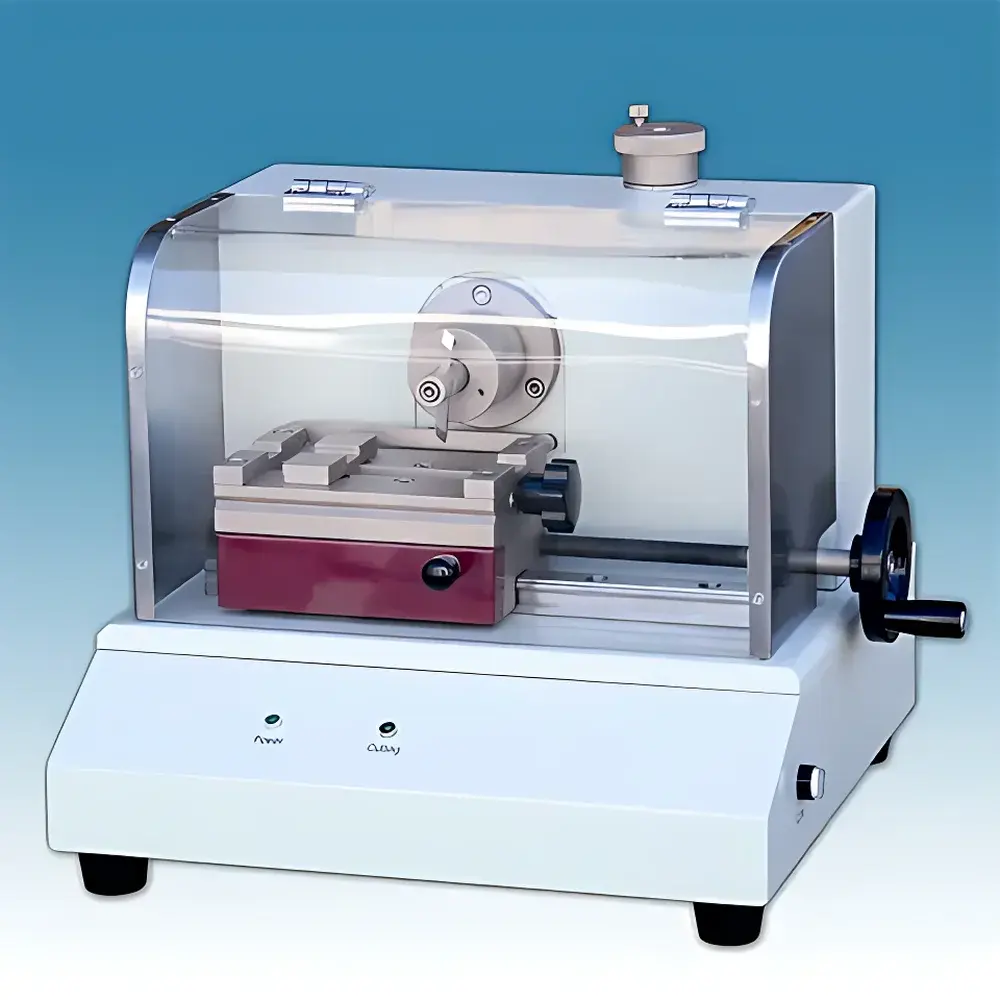
Hengyi HY-QK Electric Notching Machine
| Brand | Hengyi |
|---|---|
| Origin | Shanghai, China |
| Manufacturer Type | Manufacturer |
| Country of Origin | Domestic (China) |
| Model | HY-QKTYY |
| Quotation | Upon Request |
| Worktable Travel | >90 mm |
| Feed Rate | 30 mm/min |
| Sample Dimensions | 80 mm × 10 mm × 4 mm (customizable) |
| Notch Types | Type A (45°±0.2°, r = 0.25±0.05 mm), Type B (45°±0.2°, r = 1.0±0.05 mm), Type C (45°±0.2°, r = 0.1±0.02 mm) |
| Feed Depth Adjustment | 0–2.5 mm (adjustable) |
| Feed Stroke | 10 mm |
| Overall Dimensions (L×W×H) | 400 × 270 × 300 mm |
| Power Supply | 220 VAC ±10%/−15%, 50 Hz, Single-phase Three-wire |
| Tool Material | Imported European High-Speed Alloy Steel, Hardness > HRC60, Surface Roughness Ra < 0.4 µm |
| Throughput | ≥60 notched specimens per 10 minutes (20 specimens clamped simultaneously) |
| Compliance | ISO 179:2000, ISO 180:2001, GB/T 1043–2008, GB/T 1843–2008 |
Overview
The Hengyi HY-QK Electric Notching Machine is a precision-engineered benchtop instrument designed for the reproducible preparation of standardized notches in rigid plastic and non-metallic test specimens prior to Charpy (impact pendulum) and Izod impact testing. It operates on a controlled linear feed principle, utilizing motor-driven carriage motion and fixed-angle, radius-calibrated cutting tools to generate geometrically accurate V-notches—critical for achieving high inter-laboratory reproducibility in impact energy measurements. The machine is optimized for compliance with international standardization requirements for notch geometry tolerance, particularly in relation to notch angle (45° ± 0.2°), root radius (r = 0.1–1.0 mm, depending on tool type), and surface finish (Ra < 0.4 µm). Its fully electric actuation eliminates manual variability, ensuring consistent feed speed (30 mm/min), repeatable depth control (0–2.5 mm adjustable), and minimal operator-induced error across large batch processing.
Key Features
- High-throughput specimen preparation: Simultaneous clamping of up to 20 specimens; capable of producing ≥60 notched samples per 10-minute cycle.
- Three interchangeable, pre-calibrated notching tools (Type A, B, and C) manufactured from imported European high-speed alloy steel, hardness > HRC60, surface roughness Ra < 0.4 µm—ensuring long service life and regrindability without loss of dimensional fidelity.
- Precision linear motion system with >90 mm worktable travel and 10 mm programmable feed stroke, enabling full-depth notch formation under repeatable mechanical conditions.
- Tool-independent angular and radius tolerances: All notch types maintain 45° ± 0.2° included angle and root radius within ±0.02–0.05 mm tolerance bands—directly traceable to ISO/GB reference standards.
- Robust cast-iron frame and vibration-damped base structure minimize positional drift during multi-specimen runs, preserving notch alignment and edge integrity.
- Single-phase 220 VAC power interface with wide-input voltage tolerance (±10%/−15%), suitable for stable operation in industrial and accredited laboratory environments without external regulators.
Sample Compatibility & Compliance
The HY-QK accommodates standard rectangular test bars measuring 80 mm × 10 mm × 4 mm, as specified in ISO 179, ISO 180, GB/T 1043, and GB/T 1843. Custom specimen dimensions can be supported upon request, subject to fixture adaptation. Each notch type serves a defined material classification: Type A (r = 0.25 mm) for general-purpose rigid thermoplastics; Type B (r = 1.0 mm) for ductile or fiber-reinforced composites requiring reduced stress concentration; and Type C (r = 0.1 mm) for highly brittle materials where maximum notch acuity is required. All generated notches meet the dimensional verification criteria outlined in Annex B of ISO 179–2000 and Clause 6.2 of GB/T 1043–2008, including optical measurement of root radius using calibrated profile projectors or scanning electron microscopy (SEM)-based metrology.
Software & Data Management
The HY-QK is a standalone electromechanical device with no embedded microprocessor or digital interface. However, its operational repeatability supports full integration into GLP/GMP-compliant quality systems through documented procedural controls. Users are advised to maintain logbooks recording tool installation date, cumulative notch count per tool, recalibration intervals (recommended every 500 notches or quarterly), and verification results using certified gauge blocks (L63.5, L80, L120 mm) supplied with each unit. While no proprietary software is provided, the machine’s deterministic mechanical behavior enables traceable audit trails compatible with FDA 21 CFR Part 11–aligned electronic record systems when paired with external data capture protocols (e.g., time-stamped digital photography of notched edges, automated image-based radius measurement via third-party metrology software).
Applications
- Preparation of notched specimens for ISO 179 (Charpy impact) and ISO 180 (Izod impact) testing of thermoplastics, thermosets, and polymer composites.
- Quality control laboratories performing routine impact testing per ASTM D6110, ASTM D256, or EN ISO 180 in automotive, aerospace, and electrical insulation material certification.
- Research institutions conducting fracture mechanics studies requiring tightly controlled notch geometry for KIC or GIC determination in polymeric systems.
- Third-party testing labs accredited to ISO/IEC 17025, where demonstrable measurement traceability and process consistency are mandatory for reporting impact energy values.
- Manufacturers validating batch-to-batch consistency of impact resistance in injection-molded components prior to release.
FAQ
What standards does the HY-QK comply with?
The HY-QK conforms to ISO 179:2000 (Charpy impact), ISO 180:2001 (Izod impact), GB/T 1043–2008, and GB/T 1843–2008 for notch geometry, dimensional tolerances, and procedural repeatability.
Can the machine accommodate specimens other than 80 × 10 × 4 mm?
Yes—custom fixtures and clamping adjustments are available for alternative dimensions; contact technical support with detailed specimen specifications for feasibility assessment.
How often should the notching tools be recalibrated or replaced?
Tools should be verified for root radius and angle accuracy after every 500 notches or at least once per quarter. Regrinding is possible due to the high hardness (>HRC60) and low surface roughness (Ra < 0.4 µm) of the imported alloy steel.
Is the HY-QK compatible with ISO/IEC 17025 accreditation requirements?
Yes—its mechanical determinism, supplied calibration artifacts (gauge blocks), and documented maintenance procedures enable full traceability and compliance with clause 6.4 (equipment) and clause 7.7 (results reporting) of ISO/IEC 17025:2017.
Does the machine include validation documentation?
Each unit ships with a factory inspection report listing measured notch geometry on reference specimens, tool certification data, and conformity statements against ISO and GB standards.



