
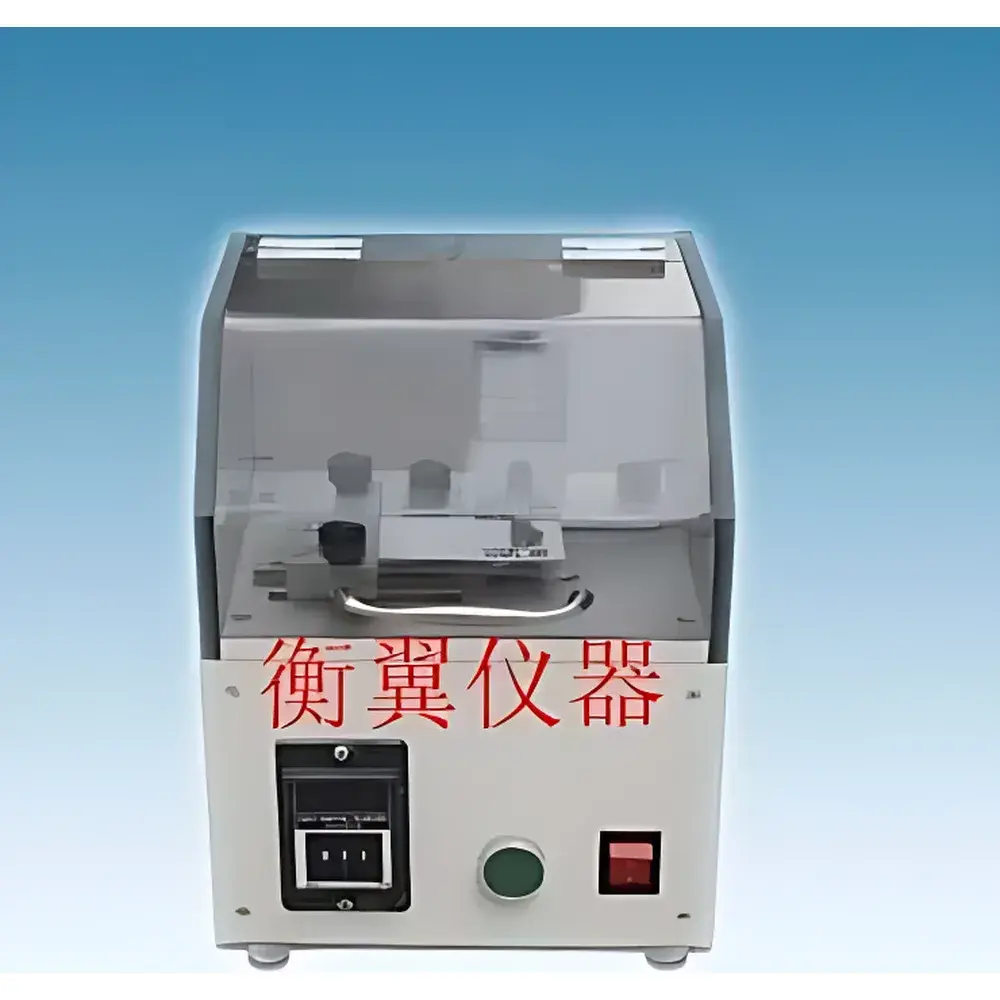
Hengyi HY(SL) Smart Card Triple-Roll Durability Tester
| Brand | Hengyi |
|---|---|
| Origin | Shanghai, China |
| Manufacturer Type | Direct Manufacturer |
| Country of Origin | China |
| Model | HY(SL) |
| Power Supply | AC 220 V |
| Cycle Count | 50 forward + 50 backward rolls (100 total) |
| Roll Frequency | 0.5 Hz |
| Applied Load | 8 N (standard), optional 15 N weight included for CQM-compliant testing |
| Dimensions (L×W×H) | 255 × 235 × 285 mm |
| Weight | 12 kg |
Overview
The Hengyi HY(SL) Smart Card Triple-Roll Durability Tester is an electromechanical test instrument engineered to evaluate the mechanical robustness of contact-type integrated circuit (IC) cards—commonly referred to as smart cards—under standardized cyclic mechanical stress. It operates on the principle of controlled, repetitive rolling indentation across the card surface, simulating real-world wear conditions encountered during insertion, ejection, and repeated use in card readers. The device implements the mechanical test protocol defined in ISO/IEC 10373-3:2001, specifically addressing Clause 6.3 “Triple-roll test” for identification cards with embedded contacts. Designed for laboratories conducting conformance testing per MasterCard’s Card Quality Management (CQM) program, the tester applies a precisely regulated downward force while executing two distinct 50-cycle phases: first over the chip’s front edge (contact pad side), then over its rear edge (substrate side), ensuring symmetrical mechanical loading relevant to terminal interface durability.
Key Features
- Compliance-driven mechanical actuation: Dual-phase roll sequence (50 cycles per zone) executed at a fixed frequency of 0.5 Hz, ensuring repeatability and alignment with ISO/IEC 10373-3 timing requirements.
- Calibrated load application: Standard 8 N nominal force applied via precision-machined roller assembly; includes a certified 15 N auxiliary weight for extended CQM validation scenarios requiring higher stress levels.
- Fixed-geometry test platform: Rigid aluminum frame with CNC-machined guide rails ensures consistent roller trajectory, minimizing lateral deviation and maintaining orthogonal contact angle relative to the card surface.
- Dedicated card fixture: Adjustable clamping mechanism accommodates standard ID-1 format cards (85.6 × 53.98 mm) while securing positional stability throughout all 100 roll cycles.
- Manual start/stop control with cycle counter: Integrated digital display logs completed cycles in real time; operator-initiated termination enables mid-test inspection without system reset.
- Low-noise, brushless DC motor drive: Ensures smooth acceleration/deceleration profiles and eliminates torque ripple that could introduce non-uniform stress distribution.
Sample Compatibility & Compliance
The HY(SL) tester accepts ISO/IEC 7810-compliant ID-1 plastic cards (PVC, PET, or composite substrates) with embedded contact chips meeting ISO/IEC 7816-2 physical interface specifications. It supports both single-layer and laminated card constructions, provided thickness remains within 0.76 ± 0.08 mm. All test procedures align with the normative annexes of ISO/IEC 10373-3:2001 and satisfy MasterCard CQM documentation requirements for mechanical endurance verification. While not a certified calibration instrument, the system’s mechanical design—including load transmission path, roller surface finish (Ra ≤ 0.4 µm), and dimensional repeatability—is traceable to national metrological standards through factory verification reports supplied with each unit. No software-based compliance certification (e.g., FDA 21 CFR Part 11) applies, as the device performs purely deterministic mechanical operations without data storage or user-modifiable parameters.
Software & Data Management
The HY(SL) Triple-Roll Tester operates as a standalone electromechanical system with no embedded firmware, network interface, or proprietary software. Cycle counting and power control are managed via discrete logic circuitry and an LED-based digital display. Test records—including date, operator ID, card batch number, applied load configuration (8 N or 15 N), and pass/fail outcome—are manually documented by laboratory personnel in accordance with GLP-compliant test logbooks. For integration into LIMS or QA reporting workflows, users may export handwritten or scanned test records as PDF or CSV files. No audit trail, electronic signature, or data encryption capabilities are present, consistent with its classification as a Class I mechanical test apparatus under ISO/IEC 17025 clause 5.5.2.
Applications
- Pre-certification screening of smart cards prior to submission for ISO/IEC 10373-3 conformance testing.
- Routine quality assurance checks in IC card manufacturing facilities performing incoming material verification on substrate batches.
- Failure mode analysis of contact degradation, solder joint fatigue, or delamination under repeated flexural stress at chip edges.
- Comparative evaluation of adhesive bond strength between chip module and card body across different lamination processes.
- Supporting root cause investigations during field return analysis when contact failure correlates with mechanical handling history.
FAQ
Does the HY(SL) tester meet ISO/IEC 10373-3:2001 Clause 6.3 requirements?
Yes—the mechanical sequence, load magnitude, roll frequency, and card positioning geometry conform to the normative test method specified in that clause.
Can the device test dual-interface (contact + contactless) cards?
Yes, provided the contact chip region complies with ISO/IEC 7816-2 dimensions and the antenna layer does not interfere with roller travel path or clamping.
Is calibration required before each test run?
No—load calibration is performed at the factory using traceable deadweight standards; users verify roller alignment and clamp function visually prior to each session.
What maintenance intervals are recommended?
Lubrication of linear guide rails every 500 test cycles; visual inspection of roller surface integrity and belt tension every 1,000 cycles.
Is technical support available outside China?
Yes—Hengyi provides remote troubleshooting, English-language operation manuals, and third-party calibration service coordination through authorized regional partners.



