
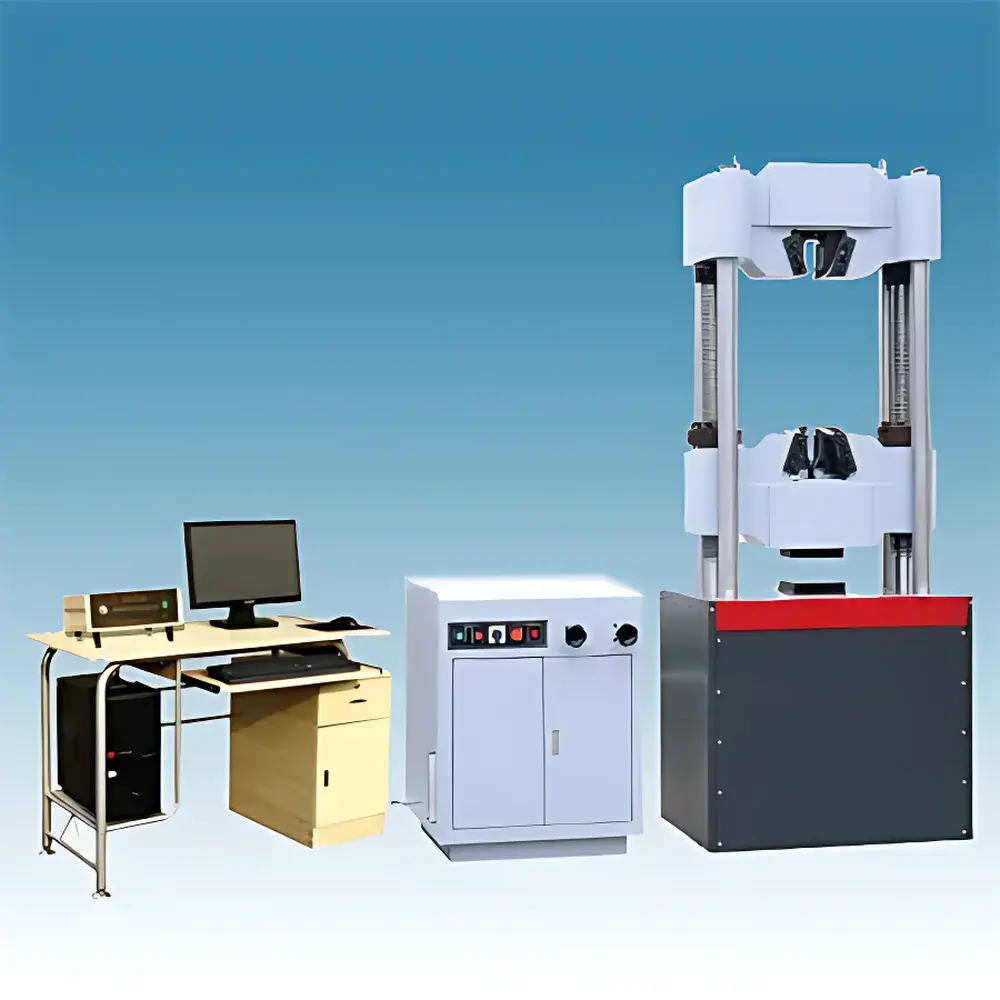
Hengyi HY(WE)100060TYHH Hydraulic Universal Testing Machine
| Brand | Hengyi / Hengyitest |
|---|---|
| Origin | Shanghai, China |
| Manufacturer Type | Direct Manufacturer |
| Regional Classification | Domestic (China) |
| Model | HY(WE)100060TYHH |
| Instrument Type | Hydraulic Universal Testing Machine |
| Max Load Capacity | 1000 kN |
| Force Accuracy | ±0.5% of reading |
| Resolution | ≤0.5% of full scale |
| Compression Space | 600 mm |
| Tension Space | 600 mm |
| Round Specimen Grip Range | Φ20–Φ60 mm |
| Flat Specimen Thickness Capacity | 0–40 mm |
| Piston Stroke | 150 mm |
| Bend Support Span Adjustment | 100–600 mm |
| Shear Specimen Diameter | Φ10 mm |
| Deformation Measurement Accuracy | ±0.5% of reading |
| Displacement Measurement Error | ±0.5% of reading |
| Stress Rate Control Range | 1–60 N/mm²/s |
| Strain Rate Control Range | 0.00025–0.0025 s⁻¹ |
| Closed-Loop Control Accuracy (Constant Load/Displacement/Strain) | ±1% of setpoint |
| Dimensions (W×D×H) | 880 × 580 × 2260 mm |
| Motor Power | 1.5 kW, 3-phase |
| Weight | 3500 kg |
Overview
The Hengyi HY(WE)100060TYHH Hydraulic Universal Testing Machine is a high-capacity, electro-hydraulic servo-controlled system engineered for precision mechanical property evaluation of metallic and non-metallic materials under tension, compression, bending, and shear loading conditions. Designed in accordance with fundamental principles of static mechanical testing—governed by ISO 6892-1 (metallic tensile testing), ASTM E4 (force verification), ASTM E8/E8M (tensile testing of metals), and ISO 7500-1 (calibration of force-proving instruments)—this machine delivers traceable, repeatable, and compliant test data across R&D, QA/QC, and certification workflows. Its oil-cylinder-underneath configuration enables vertical space optimization and enhanced rigidity, while the hydraulic wedge-type grips ensure uniform stress distribution during high-force fastener testing—particularly critical for bolt tensile strength assessment per ISO 898-1, ASTM F606, and GB/T 3098.1.
Key Features
- 1000 kN maximum load capacity with dual-range force transducers calibrated to ±0.5% accuracy per ISO 7500-1 Class 1 requirements
- Adjustable test zones: 600 mm usable tension and compression height, configurable via motorized crosshead positioning
- Hydraulic wedge-action grips with automatic self-aligning jaw geometry for consistent clamping pressure on round (Φ20–Φ60 mm) and flat (0–40 mm thick) specimens
- Electro-hydraulic proportional control system enabling precise stress rate (1–60 N/mm²/s) and strain rate (0.00025–0.0025 s⁻¹) regulation under closed-loop feedback
- High-resolution displacement measurement via linear variable differential transformer (LVDT), with ±0.5% relative error over full stroke (150 mm)
- Integrated digital controller supporting constant-load, constant-displacement, and constant-strain modes—all with ±1% setpoint fidelity
- Rigid C-frame architecture (880 × 580 × 2260 mm footprint) and 3500 kg mass minimize dynamic deflection and improve low-noise signal integrity
- 1.5 kW three-phase hydraulic power unit optimized for stable pressure delivery and thermal consistency during extended test cycles
Sample Compatibility & Compliance
This testing machine accommodates a broad spectrum of standardized and non-standard specimens—including structural bolts, anchor rods, threaded fasteners, welded joints, cast/forged components, rebar, wire rope, concrete prisms, ceramic tiles, and asphalt cores. It supports compliance-driven testing protocols required by ISO 376 (verification of force-measuring instruments), ISO 527 (plastics tensile), ISO 178 (flexural), and ASTM C39/C469 (concrete compression and modulus). For aerospace-grade fasteners, it satisfies Boeing BAC 5125 and Airbus AITM 1-0003 mechanical validation criteria. All hardware and software configurations adhere to GLP and GMP documentation standards, with audit-ready calibration logs, operator authentication, and electronic signature support aligned with FDA 21 CFR Part 11 requirements.
Software & Data Management
The system operates with a Windows-based, real-time control and analysis platform compliant with IEC 61508 functional safety guidelines for industrial automation. Test sequences are programmable using step-based scripting—enabling multi-stage load-hold-unload profiles, cyclic fatigue pre-conditioning, and fracture toughness initiation protocols. Raw force, displacement, and extensometer data are acquired at ≥1 kHz sampling rate and stored in vendor-neutral .csv and .tdms formats. Curve overlay, modulus calculation (ISO 527-2 secant method), yield point detection (0.2% offset), and ultimate tensile strength derivation are automated. Reports conform to ISO/IEC 17025 clause 7.8.2, including metadata on environmental conditions, calibration status, operator ID, and uncertainty budgets. Data export supports LIMS integration via OPC UA or RESTful API endpoints.
Applications
- Mechanical property validation of high-strength bolts (grade 8.8 through 12.9) per ISO 898-1 and DIN EN 20898
- Quality assurance of cold-formed fasteners in automotive chassis and EV battery mounting systems
- Structural integrity assessment of offshore wind turbine foundation bolts and flange connections
- Research into creep behavior of high-temperature alloy fasteners under sustained load
- Compression testing of precast concrete segments and geopolymer composites
- Shear resistance evaluation of riveted and bolted lap joints in aerospace sheet metal assemblies
- Educational laboratories conducting ASTM E8-compliant tensile labs for materials science curricula
- Third-party certification bodies performing accredited mechanical testing per CNAS-CL01:2018
FAQ
What standards does this machine support for bolt tensile testing?
It fully complies with ISO 898-1, ASTM F606, GB/T 3098.1, and DIN 267-4 for mechanical property testing of carbon steel and alloy steel bolts, screws, and studs.
Can the system perform cyclic loading or fatigue pre-tests?
Yes—the electro-hydraulic proportional valve and digital controller support programmable load cycling up to 5 Hz, suitable for pre-fatigue conditioning prior to static rupture testing.
Is extensometer integration supported for strain measurement?
The system provides analog and digital inputs for clip-on, video, or laser extensometers; strain measurement accuracy meets ISO 9513 Class 1 (±0.5% of reading) when calibrated.
How is traceability maintained for calibration and maintenance records?
All calibrations are logged with timestamps, technician IDs, reference standard IDs, and as-found/as-left data; records are encrypted and retained for ≥10 years per ISO/IEC 17025.
Does the software meet regulatory requirements for auditable electronic records?
Yes—audit trail functionality captures all user actions, parameter changes, and report generations with immutable timestamps, satisfying FDA 21 CFR Part 11 and EU Annex 11 requirements.
Related Products



