
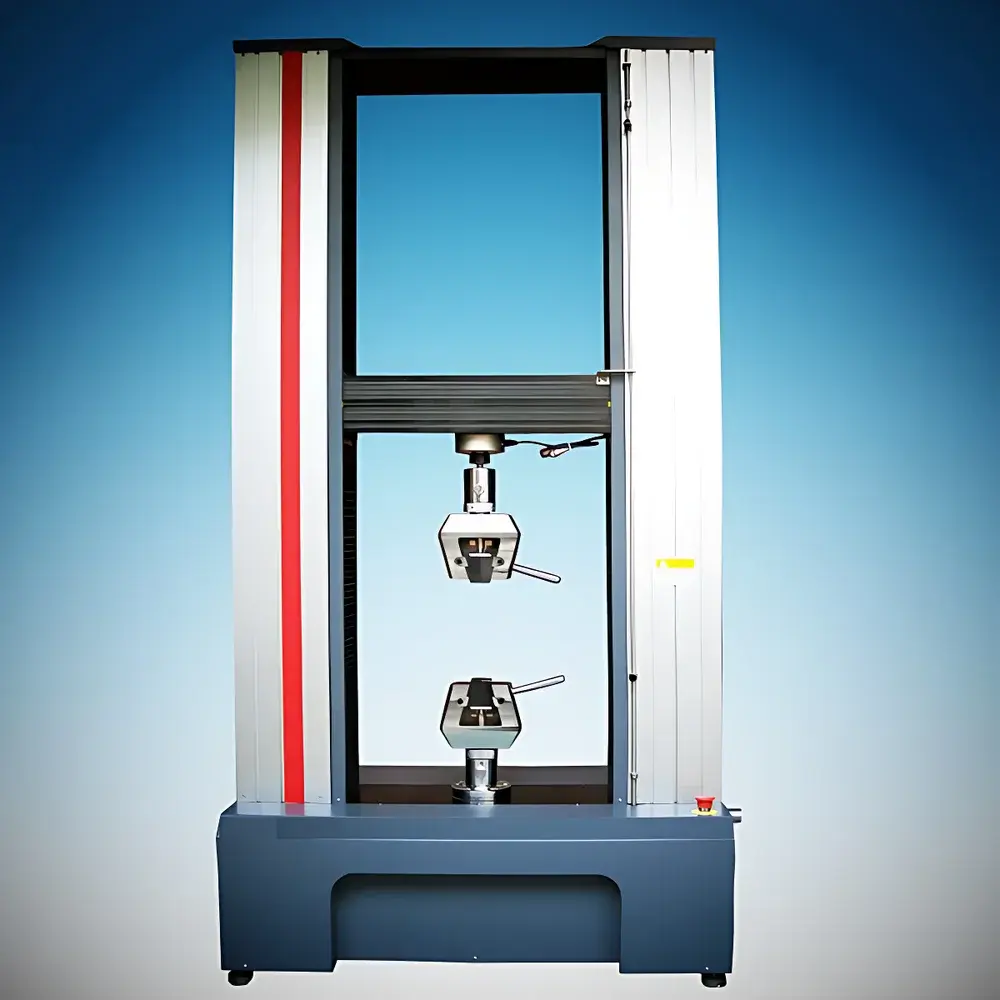
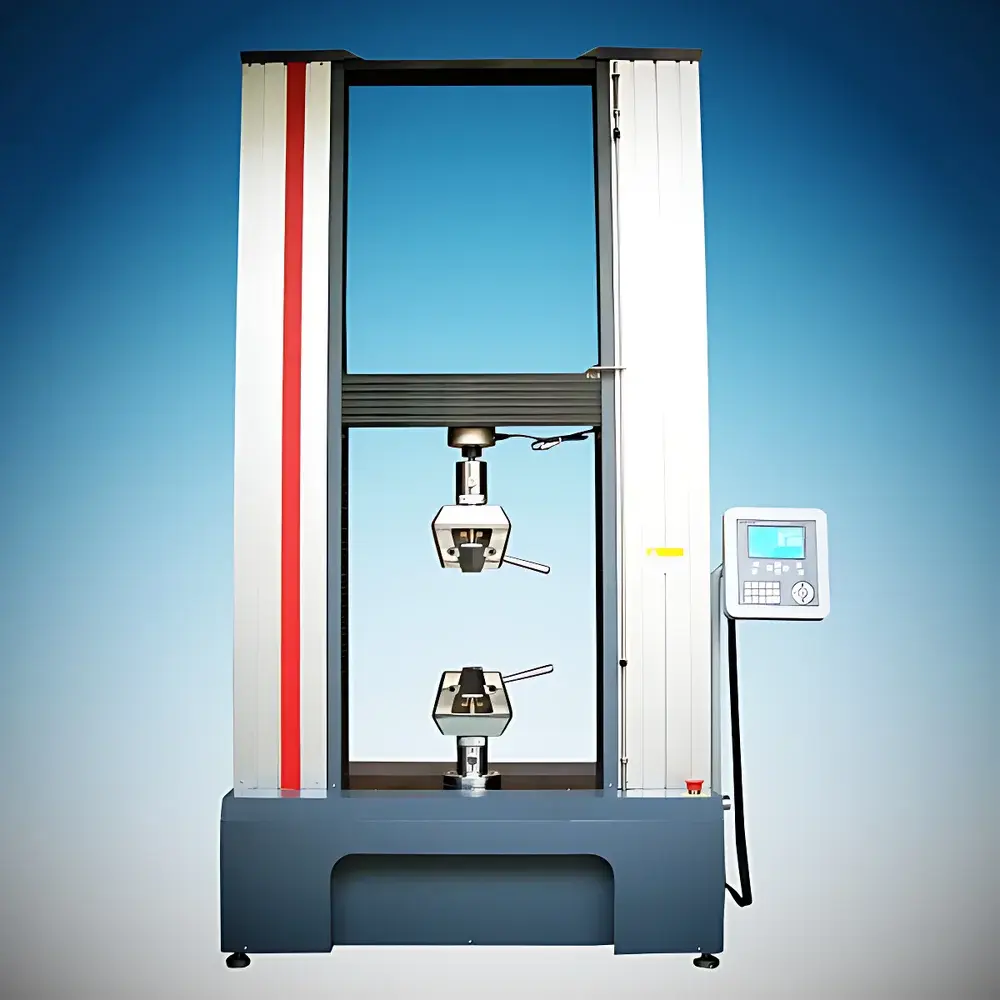
Hengyi HY-30080 Universal Electromechanical Tensile Testing Machine
| Key | Brand: Hengyi |
|---|---|
| Origin | Shanghai, China |
| Manufacturer Type | Direct Manufacturer |
| Country of Origin | China |
| Model | HY-30080YUIOP |
| Max Test Load | 300 kN |
| Force Measurement Range | 0.001–100% FS |
| Force Accuracy | ±0.5% of reading |
| Crosshead Travel | 800 mm |
| Displacement Resolution | 0.001 mm |
| Speed Range | 0.001–500 mm/min |
| Speed Accuracy | ±0.5% of set value |
| Position Accuracy | ±0.5% of reading |
| Weight | 1650 kg |
| Dimensions (W×D×H) | 1000 × 680 × 2300 mm |
| Power Supply | 380 V AC, 3 kW |
Overview
The Hengyi HY-30080 Universal Electromechanical Tensile Testing Machine is a high-capacity, precision-engineered static mechanical testing system designed for rigorous evaluation of tensile, compressive, flexural, shear, peel, tear, creep, relaxation, and cyclic loading behavior across metallic, polymeric, composite, and ceramic materials. Built upon a robust dual-column龙门 (gantry) architecture with reinforced steel frame and precision-ground ball-screw actuation, the system delivers stable force transmission and minimal deflection under full-load conditions (up to 300 kN). Its measurement principle relies on closed-loop servo-controlled electromechanical actuation coupled with high-stability load cell transduction and real-time digital signal processing — enabling traceable, repeatable, and ISO/IEC 17025-aligned mechanical property quantification. The machine complies with fundamental metrological standards including GB/T 16491–1996 (Electronic Testing Machines), GB/T 2611 (General Technical Requirements for Testing Machines), and GB/T 6825.1–2002 (Calibration of Uniaxial Testing Machines), ensuring structural integrity and measurement validity throughout its operational lifecycle.
Key Features
- High-force capacity: 300 kN rated load with optional multi-range load cells (1 N to 300 kN) supporting seamless transition between micro- and macro-scale specimen testing.
- Full-range force resolution: ±500,000 counts at maximum capacity; no internal range switching required, maintaining constant resolution across 0.001–100% FS.
- Precision motion control: Adjustable crosshead speed from 0.001 to 500 mm/min with ±0.5% speed accuracy and programmable ramp-hold-step profiles.
- Advanced displacement sensing: Optical encoder-based position feedback with 0.001 mm resolution and ±0.5% linearity over 800 mm travel.
- Integrated safety architecture: Dual-mode electronic limit protection, overload cutoff (>110% FS), automatic return-to-start, and real-time diagnostic monitoring of drive voltage, current, and thermal load.
- Modular fixture interface: Standard T-slot test table (600 mm effective width, expandable) compatible with ASTM/ISO-compliant grips — including wedge-action tensile jaws, compression platens, three/four-point bend fixtures, shear adapters, peel tabs, and tear dies.
- Extensible measurement capability: Optional high-accuracy extensometers (e.g., clip-on or video-based) and large-strain transducers (for elastomers/rubbers) support strain-controlled protocols per ISO 527, ASTM D638, and GB/T 228.1.
Sample Compatibility & Compliance
The HY-30080 accommodates specimens ranging from fine-diameter metal wires (≥0.1 mm) and threaded rebars to structural steel plates, aluminum extrusions, FRP laminates, and polymer rods. Its open-test-zone geometry supports custom environmental chambers (temperature: –70°C to +300°C; humidity: 10–95% RH) for in-situ thermomechanical characterization. All mechanical outputs — including yield strength (ReH, ReL), proof stress (Rp0.2), ultimate tensile strength (Rm), Young’s modulus (E), elongation at break (A), and reduction of area (Z) — are computed per internationally harmonized methods: GB/T 228.1–2021, ISO 6892–1:2019, ASTM E8/E8M–23, DIN EN 10002–1, and JIS Z 2241. Calibration traceability is maintained to national standards via accredited third-party verification (CNAS-certified laboratories), satisfying GLP and GMP audit requirements for quality control laboratories in metallurgy, aerospace, construction, and R&D institutions.
Software & Data Management
Equipped with Hengyi TestMaster™ v5.2 software (Windows-based), the system provides real-time force-displacement-strain curve acquisition, multi-channel synchronized data logging (up to 10 kHz sampling), and automated parameter extraction per user-defined test templates. The software supports audit trail functionality compliant with FDA 21 CFR Part 11 (electronic signatures, change history, role-based access control), raw data export in CSV, XML, and universal .UDF formats, and integration with LIMS platforms via OPC UA or TCP/IP protocols. All test reports include metadata (operator ID, timestamp, calibration certificate ID, environmental conditions) and can be preconfigured to generate bilingual (English/Chinese) PDFs with institutional branding and regulatory footers.
Applications
- Metallic material qualification: Yield strength verification of rebar (GB/T 1499.2), stainless steel sheets (ASTM A240), and titanium alloys (AMS 4911) under ambient and elevated temperatures.
- Fastener and weld joint assessment: Tensile rupture analysis of bolts, rivets, and resistance spot welds per ISO 14272 and AWS D1.1.
- Composite laminate certification: Interlaminar shear strength (ILSS) and flexural modulus determination per ASTM D2344 and ISO 14125.
- Wire and cable R&D: Elongation-to-failure and modulus profiling of copper-clad aluminum conductors (IEC 60228) and stainless steel surgical sutures (ISO 11402).
- Quality assurance in foundries and rolling mills: Batch-level tensile repeatability validation with statistical process control (SPC) charting and CPK calculation.
FAQ
What standards does the HY-30080 comply with for force calibration?
It conforms to GB/T 6825.1–2002, ISO 7500–1:2018, and ASTM E4–22 for static force calibration, with traceability to NIM (National Institute of Metrology, China) or equivalent national metrology institutes.
Can the system perform strain-controlled tests?
Yes — when equipped with an ISO 9513-compliant extensometer (e.g., 10/50 mm gauge length, Class 1), it supports strain-rate-controlled protocols per ISO 6892–1 Annex C and ASTM E2624.
Is remote operation supported?
Standard Ethernet connectivity enables remote monitoring and basic test initiation; full remote control requires optional VNC-enabled industrial PC configuration and site-specific firewall policy alignment.
What maintenance intervals are recommended?
Load cell recalibration every 12 months; ball screw lubrication every 6 months; annual verification of encoder linearity, crosshead parallelism, and grip alignment per GB/T 12160–2002.
Does the system meet CE or UKCA requirements?
As supplied for domestic Chinese use, it meets GB standards; CE/UKCA compliance requires additional EMC testing (EN 61326–1), safety assessment (EN 61000–6–2/3), and technical file compilation by an EU/UK Notified Body — available as a customization option.
Related Products



