
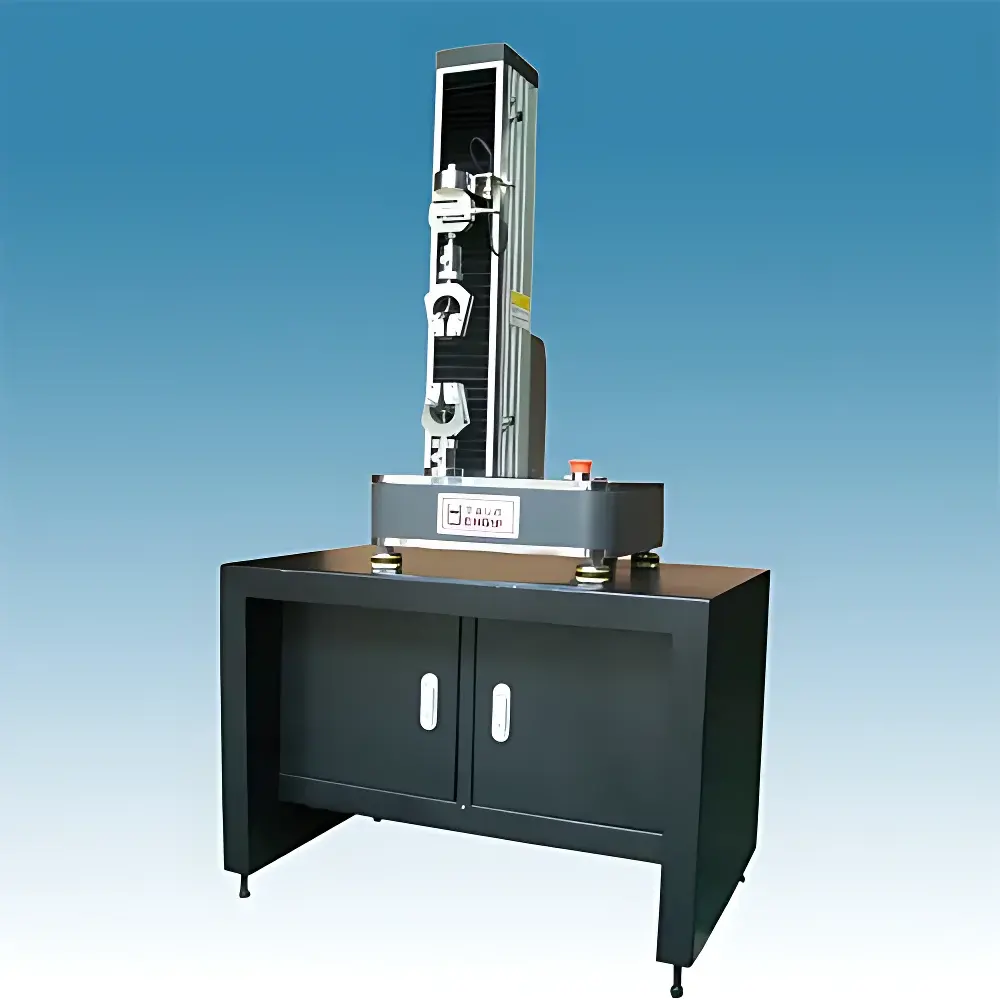
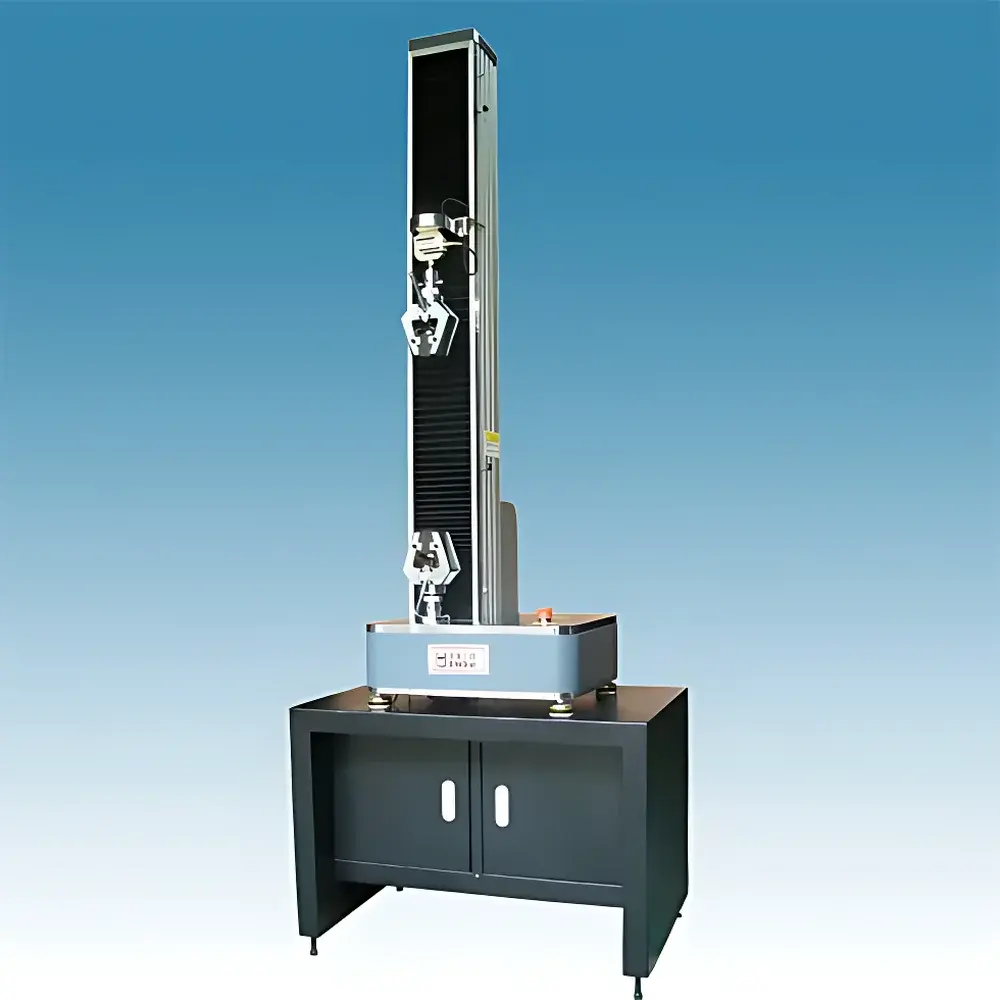
Hengyi HY-0580TUNPO Single-Column Microforce Tensile Testing Machine
| Brand | Hengyi |
|---|---|
| Origin | Shanghai, China |
| Manufacturer Type | Direct Manufacturer |
| Product Category | Domestic |
| Model | HY-0580TUNPO |
| Instrument Type | Electromechanical Tensile Tester |
| Maximum Test Load | 1 N (0.001 kN) |
| Force Measurement Range | 0.1–100% of Full Scale (FS) |
| Force Accuracy Class | 0.5 |
| Test Stroke | 800 mm |
| Displacement Resolution | 0.001 mm |
| Speed Range | 0.001–500 mm/min |
| Speed Accuracy | ±0.5% of indicated value |
| Displacement Measurement Accuracy | ±0.5% of indicated value |
| Effective Test Width | 120 mm |
| Load Cell Resolution | ±500,000 counts (single-range, no auto-ranging) |
| Stress Control Rate Range | 0.005–6 %FS/s |
| Strain Control Rate Range | 0.002–6 %FS/s |
| Constant-Load/Displacement/Strain Accuracy | ±1% (for setpoints <10%FS), ±0.1% (for setpoints ≥10%FS) |
| Safety Protection | Electronic limit switch, overload protection (>110% FS), real-time system diagnostics |
| Power Supply | 220 V AC, 50 Hz, 750 W |
| Dimensions (W×D×H) | 470 × 400 × 1510 mm |
| Net Weight | 100 kg |
Overview
The Hengyi HY-0580TUNPO is a single-column electromechanical tensile testing machine engineered for high-precision microforce mechanical characterization of low-strength, fine-diameter, and highly deformable materials—including mulberry silk fibers, nanofibers, biomedical sutures, ultra-thin films, hydrogels, and electrospun polymers. It operates on the principle of controlled uniaxial force application with real-time load-displacement feedback, utilizing a high-resolution load cell (1 N full scale, 0.5-class accuracy per ISO 7500-1) and precision ball-screw actuation. Its design adheres to fundamental metrological requirements for static mechanical testing, enabling traceable force measurement across the full dynamic range—from sub-millinewton initiation loads to 1 N maximum capacity—without range switching or resolution degradation. The system is fully compliant with international standard test methodologies including ISO 527-3 (plastics—tensile properties of films), ISO 20795-1 (denture base polymers), ASTM D882 (tensile properties of thin plastic sheeting), ASTM D3822 (tensile properties of yarns and fibers), and GB/T 1040.3 (Chinese national standard for plastics tensile testing). It is calibrated and validated in accordance with ISO/IEC 17025 principles and supports GLP-compliant audit trails when integrated with certified software configurations.
Key Features
- Single-column rigid frame architecture with optimized stiffness-to-weight ratio, minimizing parasitic bending moments during microforce testing
- High-resolution displacement encoder (0.001 mm resolution) synchronized with closed-loop motion control for precise strain-rate execution
- Wide-speed actuation (0.001–500 mm/min) with ±0.5% speed fidelity—critical for quasi-static fiber elongation and viscoelastic relaxation protocols
- Full-scale, single-range load measurement (±500,000 digital counts) ensuring consistent resolution from 0.1% to 100% FS without recalibration or range switching
- Dual-mode control architecture supporting stress-controlled, strain-controlled, and displacement-controlled test profiles per ISO 6892-1 Annex C
- Integrated electronic safety limits, overload cutoff (>110% FS), and real-time diagnostic monitoring of drive voltage, current, and thermal load
- Modular fixture interface (M6 threaded mounting) compatible with custom grips for silk filament clamping, loop tensile, knot strength, and micro-bending fixtures
Sample Compatibility & Compliance
The HY-0580TUNPO accommodates specimens ranging from monofilament silk fibers (diameters <20 µm) to woven textile swatches (max. 120 mm wide), elastomeric hydrogels, biodegradable polymer films, and composite laminates up to 800 mm effective travel length. Its low-inertia crosshead and low-friction grip design minimize axial misalignment and slippage—essential for reproducible failure mode analysis in brittle or low-modulus samples. The instrument satisfies mechanical testing requirements under ISO 13934-1 (tensile properties of textiles), ISO 13935-1 (seam tensile strength), and USP (mechanical testing of pharmaceutical packaging films). All hardware and firmware comply with CE machinery directive 2006/42/EC and electromagnetic compatibility standards EN 61326-1. Optional calibration certificates are available with NIST-traceable reference standards.
Software & Data Management
The system ships with Hengyi TestMaster v3.x—a Windows-based, FDA 21 CFR Part 11-ready software platform supporting user-defined test methods, multi-step loading sequences, and automated pass/fail evaluation against configurable acceptance criteria. Raw data streams (load, displacement, time) are captured at ≥1 kHz sampling rate and stored in ASCII-compatible .csv and proprietary .hdt binary formats. Curve analysis tools include Young’s modulus calculation (tangent/secant method), yield point detection (0.2% offset), elongation-at-break, and energy-to-break integration. Audit trail functionality logs all user actions, parameter changes, and calibration events with timestamped, non-erasable entries. Export modules support direct integration with LIMS environments via ODBC and generate PDF reports compliant with ISO/IEC 17025 reporting clauses.
Applications
- Mechanical profiling of natural protein fibers (e.g., Bombyx mori silk, spider dragline analogs) for biomaterial development
- Quality control of medical-grade suture threads and absorbable mesh implants per ISO 10993-12
- Tensile validation of printed electronics substrates, conductive nanocomposite films, and flexible OLED encapsulation layers
- Research-grade deformation mapping of hydrogel scaffolds under physiological strain rates (0.01–1 mm/min)
- Adhesion strength quantification of pressure-sensitive adhesives using 90° and 180° peel protocols (ASTM D6252, D903)
- Evaluation of interfacial shear strength in fiber-reinforced composites via microbond or fragmentation tests
FAQ
What is the minimum measurable force resolution of the HY-0580TUNPO?
The system achieves a force resolution of 0.00002 N (20 µN) at full 1 N capacity, derived from its 500,000-count A/D conversion and 0.5-class transducer linearity.
Can the machine perform cyclic loading or fatigue tests?
Yes—TestMaster software supports programmable load/displacement waveforms (sine, triangle, ramp) with dwell periods; however, dedicated high-cycle fatigue testing requires optional servo-hydraulic add-ons not included in the base configuration.
Is GLP/GMP validation documentation available?
Yes—IQ/OQ/PQ protocols, installation qualification checklists, and electronic signature-enabled audit trail reports are provided upon request for regulated laboratory deployment.
What environmental conditions are required for optimal performance?
Ambient temperature must be maintained between 10–35 °C (±2 °C/h drift), relative humidity <80%, and minimal electromagnetic interference; vibration isolation tables are recommended for sub-100 µN measurements.
Are third-party calibration services supported?
Yes—the load cell and displacement encoder are designed to accept accredited external calibration per ISO/IEC 17025, with documented traceability to national metrology institutes (e.g., NIM, NIST, PTB).



