
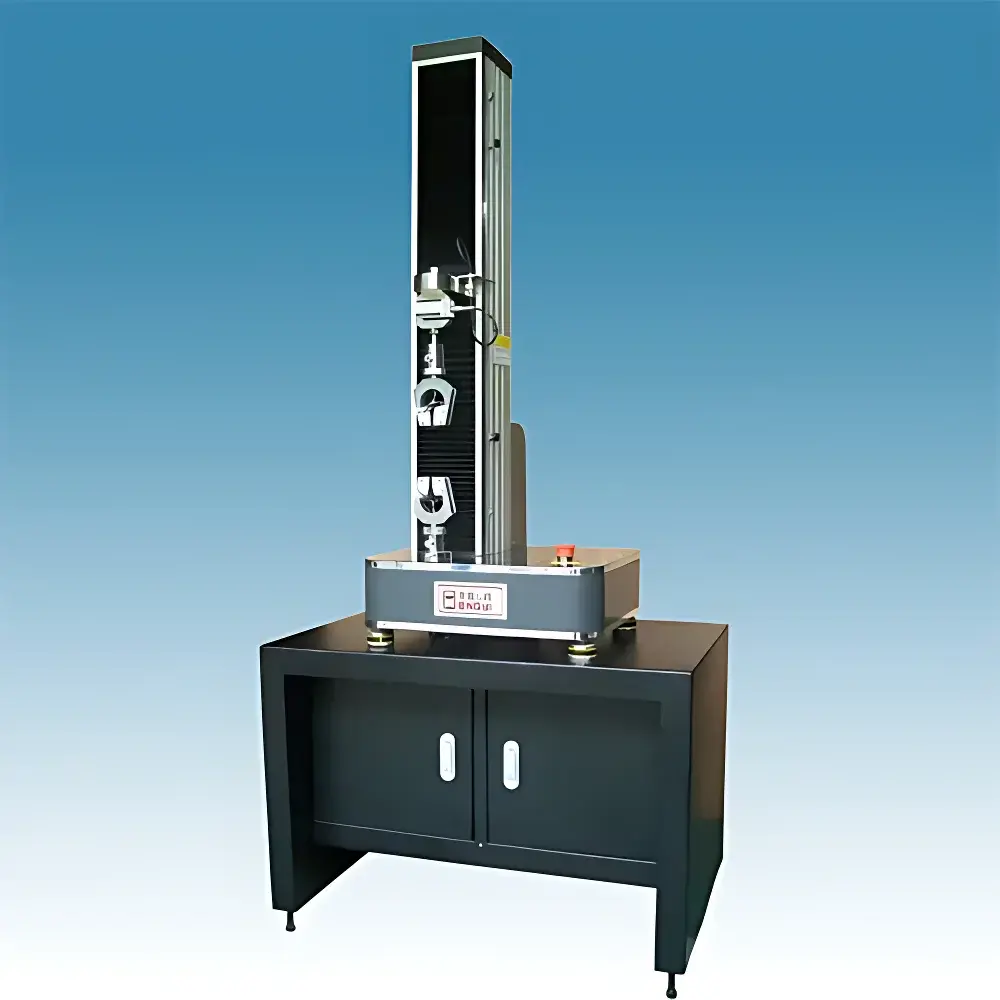
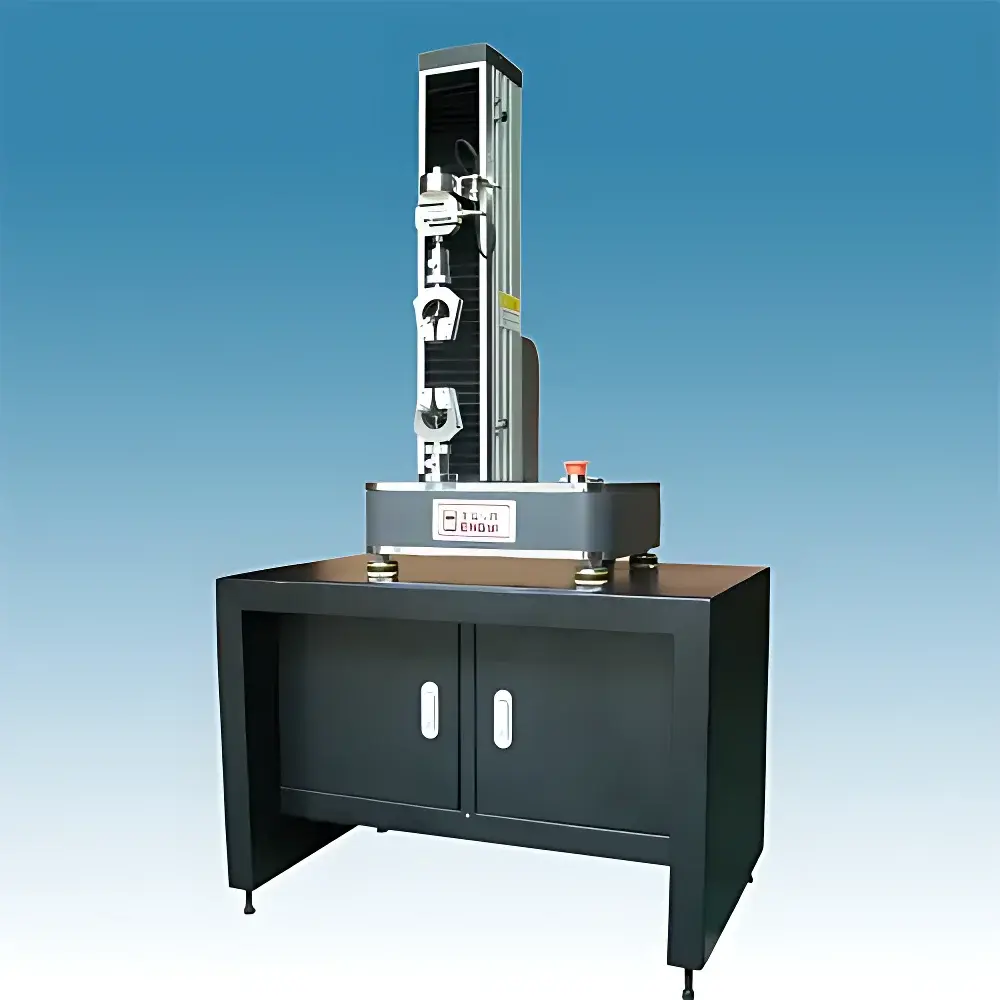
Hengyi HY-0580 Battery Electrode Peel Strength Tester
| Brand | Hengyi / Hengyitest |
|---|---|
| Origin | Shanghai, China |
| Manufacturer Type | Direct Manufacturer |
| Product Category | Domestic |
| Model | HY-0580RYVVF |
| Instrument Type | Electromechanical Universal Testing Machine |
| Load Capacity Options | 1 N to 5000 N (multi-sensor configurable) |
| Force Accuracy | ≤ ±0.5% of reading |
| Effective Test Width | 120 mm |
| Effective Stroke | 800 mm |
| Speed Range | 0.001–500 mm/min (adjustable) |
| Position Resolution | ±0.5% of reading |
| Data Acquisition Rate | 500,000 counts full scale (no range switching) |
| Power Supply | 220 V AC, 750 W |
| Net Weight | 95 kg |
Overview
The Hengyi HY-0580 Battery Electrode Peel Strength Tester is an electromechanical universal testing machine engineered for high-precision mechanical characterization of thin-film battery components and related advanced materials. It operates on the principle of controlled uniaxial force application—via servo-controlled motor-driven crosshead displacement—to quantify interfacial adhesion, cohesive integrity, and tensile deformation behavior under standardized loading conditions. Designed specifically for lithium-ion battery R&D and quality control laboratories, the system meets the mechanical testing requirements defined in ISO 11339 (adhesion testing of coated films), ASTM D903 (peel resistance of adhesive bonds), and GB/T 2792 (180° peel strength for pressure-sensitive tapes). Its architecture supports both static and dynamic load regimes, enabling compliance with GLP-aligned test protocols across electrode calendering validation, separator lamination integrity assessment, and current collector–active material bond evaluation.
Key Features
- Modular load cell configuration: Interchangeable transducers from 1 N to 5000 N enable seamless transition between micro-scale foil peel testing and macro-scale composite electrode tensile evaluation.
- High-resolution motion control: Closed-loop servo system delivers speed accuracy of ±0.5% over a 0.001–500 mm/min range, critical for low-velocity peel initiation and stable delamination propagation analysis.
- True dual-range displacement sensing: Optical encoder-based position feedback ensures ±0.5% linearity across full 800 mm stroke—eliminating step-change errors during multi-stage tests (e.g., pre-load → dwell → peel → post-fracture recovery).
- Digital safety architecture: Dual-layer protection includes programmable electronic limit switches, real-time overload monitoring (>110% FS), and autonomous diagnostic routines for drive system voltage/current/temperature anomalies.
- Ergonomic operator interface: Manual jog controls with fast/slow dual-speed actuation and one-touch return-to-origin functionality streamline routine sample setup and alignment verification.
- Compliance-ready data traceability: All test parameters—including load, displacement, time, and calculated metrics—are timestamped and stored with audit trail metadata, supporting FDA 21 CFR Part 11–aligned electronic records when paired with validated software modules.
Sample Compatibility & Compliance
The HY-0580 accommodates a broad spectrum of planar and quasi-ductile specimens relevant to electrochemical energy storage manufacturing. Validated test geometries include copper/aluminum foil–coated cathode/anode laminates (thickness: 6–20 µm active layer), microporous polyolefin separators (12–25 µm), dry-electrode free-standing films, and ultrathin solid-state electrolyte membranes. Fixture compatibility extends to standard 180° peel grips (ASTM D3330), T-peel fixtures (ISO 11339), tensile dog-bone holders (ASTM D882), and compression platens per ISO 604. All mechanical test methods executed on this platform are traceable to national metrology standards via factory calibration certificates (NIST-traceable reference loads), and instrument performance verification follows ISO/IEC 17025–compliant procedures documented in the user manual.
Software & Data Management
The system integrates with Hengyi’s proprietary TestMaster Pro software—a Windows-based application compliant with ISO/IEC 17025 documentation requirements. The software provides real-time graphical display of force–displacement curves, automated calculation of peel strength (N/mm), tensile modulus (MPa), elongation at break (%), and yield offset points (0.2% strain method). Raw data export is supported in CSV, Excel (.xlsx), and XML formats; all files include embedded metadata (operator ID, environmental temperature/humidity logs if sensor-equipped, calibration expiry date). Optional 21 CFR Part 11 add-on enables electronic signatures, role-based access control, and immutable audit trails for regulated environments. Data archiving conforms to ICH M7 and USP guidance for material testing records retention.
Applications
- Quantification of cathode–current collector adhesion loss after thermal cycling or electrolyte immersion (accelerated aging studies)
- Comparative evaluation of binder formulations (e.g., SBR vs. CMC vs. PVDF) via 180° peel energy dissipation metrics
- Mechanical screening of dry-process electrodes versus slurry-cast counterparts under identical calendering pressures
- Interfacial shear strength measurement of multilayer separator–electrode stacks using modified T-peel configurations
- Compression resilience testing of silicon-anode composite foils under stack pressure simulating pouch cell assembly
- Quality gate testing for incoming copper foil suppliers—verifying surface treatment efficacy through peel initiation force thresholds
- Supporting DOE-defined failure mode analysis (FMEA) for electrode delamination root cause identification
FAQ
What standards does the HY-0580 comply with for battery electrode testing?
It supports test execution aligned with ASTM D903, ISO 11339, GB/T 2792, and internal OEM specifications for peel, tensile, and compression testing of battery components.
Can the system be integrated into a laboratory LIMS or MES environment?
Yes—via TCP/IP or RS232 communication protocols, raw data streams and pass/fail status outputs can be directed to third-party systems using configurable ASCII or JSON payloads.
Is calibration certification included with delivery?
Each unit ships with a factory calibration report traceable to CNAS-accredited reference standards; annual recalibration services are available under service contract.
Does the tester support high-humidity or inert-atmosphere testing?
The base configuration operates in ambient lab conditions (23 ± 2°C, 40–60% RH); optional glovebox-integrated enclosures and environmental chambers are available as accessories.
How is data integrity ensured during long-duration creep or relaxation tests?
Continuous sampling at ≥100 Hz, non-volatile memory buffering, and power-fail resume capability prevent data loss during extended experiments exceeding 72 hours.



