
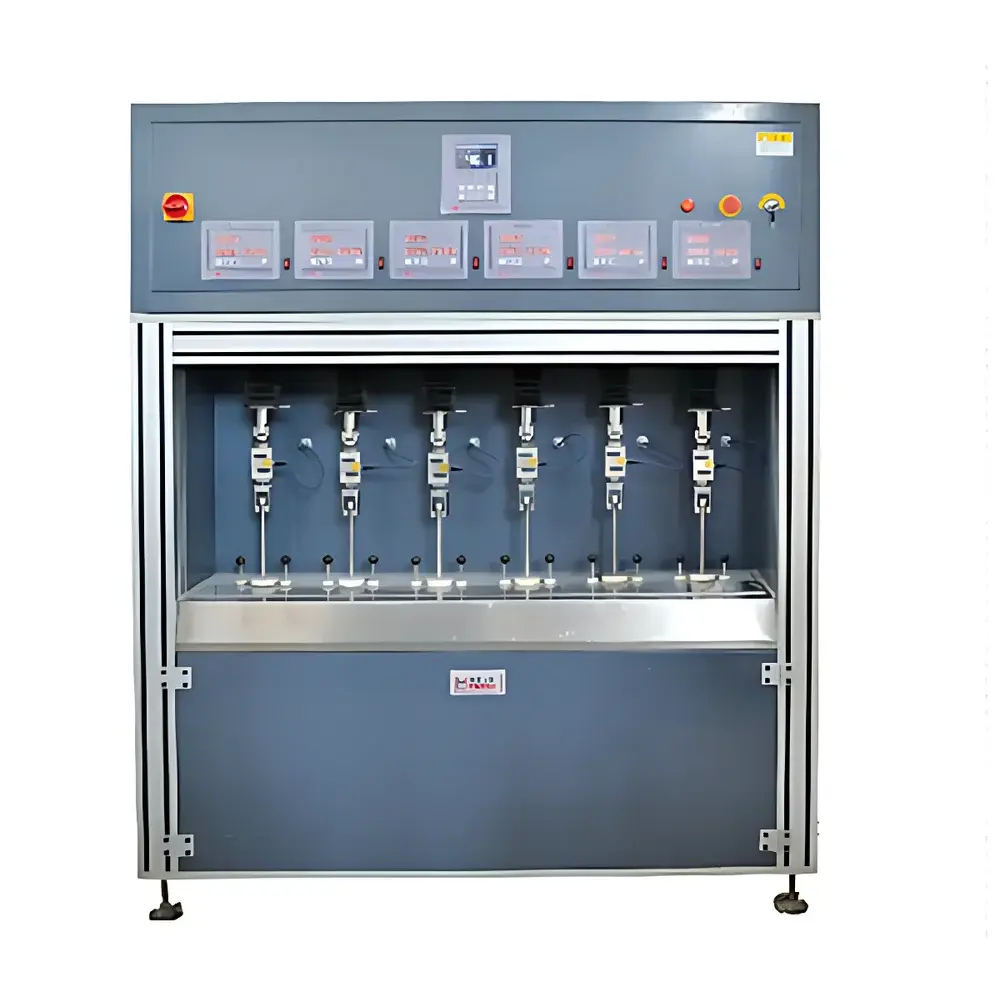
Hengyi HY-QKRB Plastic Pipe Creep and Pull-Out Tester
| Brand | Hengyi / Hengyitest |
|---|---|
| Origin | Shanghai, China |
| Manufacturer Type | Direct Manufacturer |
| Origin Category | Domestic (China) |
| Model | HY-QKRB-YUJ |
| Quotation | Upon Request |
| Load Capacity | 2000 N (interchangeable load cells available below 2000 N |
| Force Measurement Range | 0.4–99.999% of full scale |
| Effective Test Width | 120 mm |
| Effective Test Stroke | 200 mm |
| Test Speed | 0.001–100 mm/min (adjustable in real time) |
| Speed Accuracy | ±1% of indicated value |
| Displacement Accuracy | ±1% of indicated value |
| Strain/Deformation Accuracy | ±1% of indicated value |
| Test Stations | 12 independent stations |
| Temperature Control Bath Range | Ambient to 95 °C |
| Temperature Stability | ±0.5 °C |
| Control System | PC-based closed-loop control |
| Power Requirement | 10 kW |
| Unit Weight | 850 kg |
| Dimensions (W×D×H) | 1620 × 850 × 1750 mm |
| Compliance Standards | GB/T 15820–1995, GB/T 11546, GB/T 32682–2016, ISO 899-1, ISO 16770, ISO 3501 |
Overview
The Hengyi HY-QKRB Plastic Pipe Creep and Pull-Out Tester is a purpose-built, multi-station mechanical testing system engineered for long-term static loading evaluation of thermoplastic piping materials—particularly polyethylene (PE), cross-linked polyethylene (PEX), and PE-based composites—under controlled thermal and chemical environments. It operates on the fundamental principles of time-dependent viscoelastic deformation under constant axial tensile load, enabling precise quantification of creep rupture time, environmental stress cracking (ESC) resistance, and joint integrity via pull-out force measurement. Unlike general-purpose universal testers, the HY-QKRB integrates twelve independently actuated test stations with synchronized temperature-controlled bath immersion, allowing parallel execution of standardized creep, full-notch creep (FNCT), and pipe-to-fitting pull-out tests per ASTM D2990, ISO 899-1, ISO 16770, and GB/T 32682–2016. Its rigid 850 kg structural frame, high-resolution displacement feedback, and sub-1% measurement uncertainty across force, speed, and position ensure metrological traceability suitable for accredited third-party laboratories and R&D centers operating under GLP or ISO/IEC 17025 requirements.
Key Features
- Twelve independent test stations with individual load cell mounting and real-time force monitoring—enabling high-throughput comparative assessment of material batches or joint configurations.
- Integrated thermostatic bath with PID-controlled heating and circulation, maintaining uniform ±0.5 °C stability from ambient to 95 °C—critical for simulating service conditions in buried PE water mains or geothermal applications.
- Modular load cell architecture supporting interchangeable sensors (rated ≤2000 N), permitting optimization for low-force FNCT specimen geometries or high-load pipe anchorage testing.
- Precision electromechanical drive system delivering programmable crosshead speeds from 0.001 to 100 mm/min with closed-loop velocity feedback and ±1% speed fidelity across the full range.
- PC-based control interface with automated test sequencing, real-time curve plotting (force vs. time, displacement vs. time), and event-triggered data logging at user-defined intervals (e.g., every 10 seconds during early-stage creep).
- Structural design compliant with ISO 7500-1 Class 0.5 accuracy requirements for force measurement systems, validated per national metrological standards prior to shipment.
Sample Compatibility & Compliance
The HY-QKRB accommodates standard cylindrical, notched, and assembled pipe-fitting specimens per ISO 16770 (FNCT), ISO 899-1 (tensile creep), and GB/T 15820 (pull-out of PE pipe joints). Specimen clamping fixtures are designed for minimal stress concentration and axial alignment reproducibility. The system fully supports regulatory and quality assurance frameworks including ISO/IEC 17025 accreditation, FDA-relevant GMP documentation practices (via optional audit trail module), and GLP-compliant electronic records per 21 CFR Part 11 when paired with validated software. All mechanical and thermal subsystems undergo factory calibration against NIST-traceable reference standards, with calibration certificates supplied.
Software & Data Management
The proprietary Hengyi TestMaster™ software provides intuitive workflow-driven test setup—including preloaded templates for GB/T 11546, ISO 899-1, and ISO 16770 protocols—with configurable pass/fail criteria based on rupture time thresholds or strain rate limits. Raw data export is supported in CSV, Excel (.xlsx), and XML formats compatible with LIMS integration. Audit trails record operator ID, timestamp, parameter changes, and calibration events. Optional 21 CFR Part 11 compliance package includes electronic signatures, role-based access control, and immutable data archiving.
Applications
- Environmental stress cracking (ESC) resistance evaluation of PE100 and PE100-RC pipes in surfactant-containing aqueous media.
- Long-term joint performance validation for electrofusion and butt-fusion connections per GB/T 15820 and ISO 4427.
- Creep rupture life prediction for pressure pipe design under ISO 9080 extrapolation methodology.
- Material qualification for gas distribution networks per EN 1555 and ASTM F714.
- R&D screening of novel PE blends, nanocomposites, or recycled-content formulations under accelerated thermal aging.
FAQ
What standards does the HY-QKRB directly support out-of-the-box?
It natively implements test sequences and reporting formats for GB/T 15820–1995, GB/T 11546, GB/T 32682–2016, ISO 899-1, ISO 16770, and ISO 3501.
Can the system perform simultaneous tests at different temperatures?
No—the single integrated bath maintains uniform temperature across all 12 stations. Multi-temperature studies require sequential runs or optional auxiliary bath modules.
Is remote monitoring or unattended operation possible?
Yes. With network-enabled PC control and email/SNMP alerting, users can monitor test progress and receive rupture notifications without physical presence.
What maintenance is required for long-term reliability?
Annual verification of load cell linearity, bath temperature uniformity mapping, and lead screw lubrication per included maintenance schedule—no proprietary tools required.
Does the system include validation documentation for laboratory accreditation?
Yes. Factory calibration certificates, IQ/OQ documentation templates, and uncertainty budgets are provided as part of standard delivery.



