
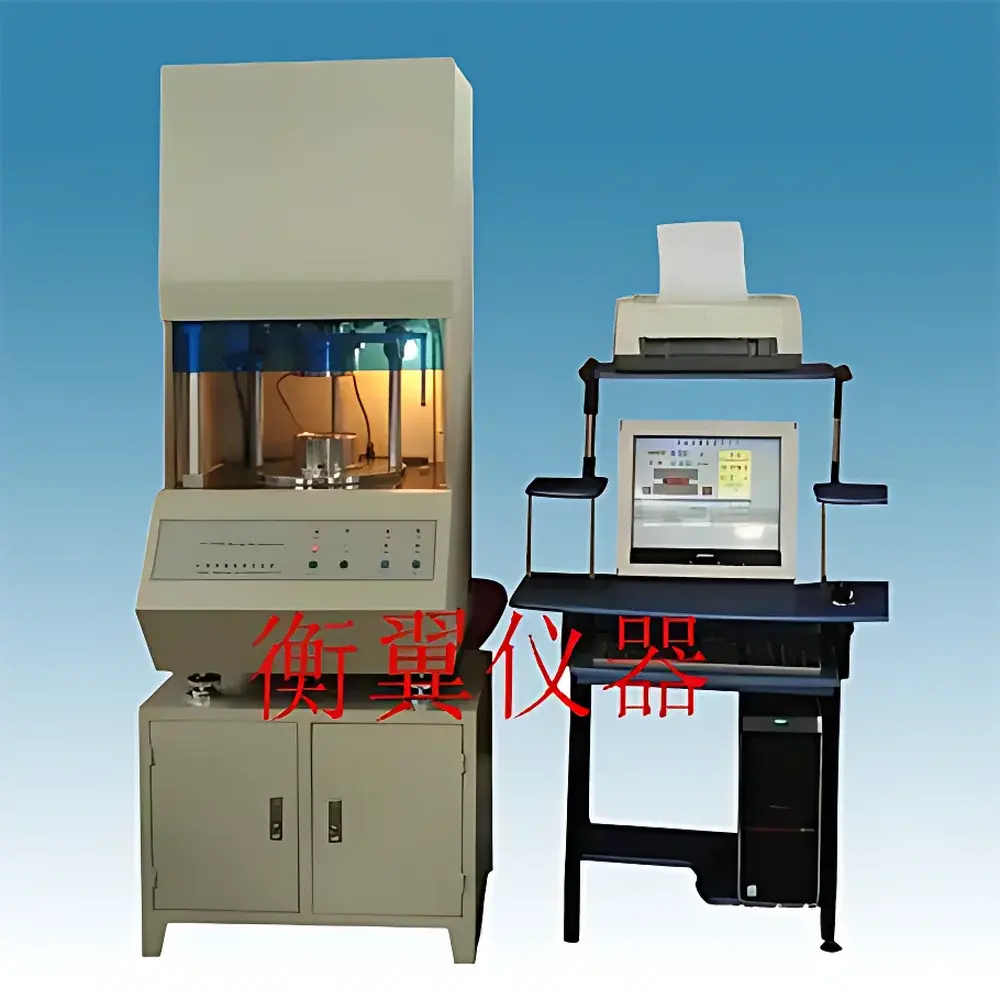
Hengyi HY(LH)-DN Computer-Controlled Rotorless Curemeter
| Brand | Hengyi / Hengyitest |
|---|---|
| Origin | Shanghai, China |
| Manufacturer Type | Direct Manufacturer |
| Product Origin | Domestic (China) |
| Model | HY(LH)-DN |
| Pricing | Upon Request |
Overview
The Hengyi HY(LH)-DN Computer-Controlled Rotorless Curemeter is an ASTM D5289-, ISO 6502:1991-, and GB/T 16584-compliant instrument engineered for precise vulcanization characterization of raw and compounded rubber materials. It operates on the principle of oscillating die rheometry—applying a small-amplitude sinusoidal torsional strain (±1° ±0.5° at 1.67 Hz) to uncured rubber within a fully sealed, temperature-controlled cavity—and measures the resulting torque response as crosslink density evolves during thermal curing. Unlike rotor-based systems, its rotorless design eliminates mechanical wear, reduces sample preparation variability, and enhances long-term calibration stability. The instrument delivers time-resolved viscoelastic data critical for determining scorch safety (ts1, ts2), optimal cure state (t₁₀, t₅₀, t₉₀), vulcanization rate (Vc₁, Vc₂), and rheological endpoints (ML, MH). Its high-fidelity measurement architecture supports both QC laboratories requiring rapid batch verification and R&D teams conducting fundamental polymer network formation studies.
Key Features
- Fully sealed cavity with dual independent temperature control channels and advanced variable-structure predictive algorithm—achieving cavity temperature stability ≤ ±0.02 °C post-closure, with overshoot < 0.3 °C and heating time < 10 min (0–200 °C)
- 24-bit high-resolution A/D converter with programmable gain amplifier: temperature display resolution 0.01 °C; torque resolution 0.001 N·m across selectable ranges (0–5, 0–10, or 0–20 N·m)
- Integrated Fourier-transform-based torque signal processing to suppress mechanical vibration and external electromagnetic interference—ensuring smooth, reproducible cure curves with inter-run CV < 1.2% under GLP conditions
- Panasonic stepper motor-driven oscillation system with amplitude regulator; fixed frequency 100 rpm (1.67 Hz), angular displacement ±1° ±0.5°
- Real-time dual-curve visualization (torque vs. time + cavity temperature vs. time) on Windows-based host PC; synchronized data logging at ≥10 Hz sampling rate
- Unified dual-control interface: full parameter setup, start/stop, and manual override available via both software GUI and front-panel hardware buttons
Sample Compatibility & Compliance
The HY(LH)-DN accommodates standard 4.5 g rubber specimens in accordance with ISO 6502 Annex A and ASTM D5289 Section 7. It supports natural rubber (NR), SBR, BR, EPDM, NBR, CR, and thermoplastic elastomers (TPEs) with fillers including carbon black, silica, and calcium carbonate. All thermal and mechanical calibrations are traceable to NIST-certified reference standards. The system complies with ISO/IEC 17025:2017 requirements for testing laboratory competence and supports audit-ready documentation for FDA 21 CFR Part 11 (when paired with validated electronic signature modules), EU GMP Annex 11, and ISO 9001 quality management systems.
Software & Data Management
The embedded Windows application provides ISO 17025-aligned data integrity features: user-level access control (admin/operator/guest), full audit trail (timestamped parameter changes, test starts/stops, file exports), and automatic metadata tagging (date, operator ID, sample ID, instrument serial number). Raw torque and temperature streams are saved in binary .DAT format with ASCII export capability (.CSV, .TXT). Curve overlay functionality enables side-by-side comparison of up to eight historical tests using color-coded traces. Post-test analysis includes automatic calculation of ML, MH, ts1, ts2, t₁₀, t₅₀, t₉₀, Vc₁, Vc₂, and ΔTorque; all results conform to reporting templates specified in ASTM D5289 Annex B.
Applications
- Formulation optimization: screening accelerator packages, sulfur levels, and co-agents to balance scorch delay and cure rate
- Batch-to-batch consistency verification in tire tread, conveyor belt, and automotive sealing compound production
- Thermal aging studies: quantifying reversion behavior via extended-time isothermal cures at elevated temperatures
- Quality assurance for incoming raw rubber lots—detecting pre-vulcanization or storage-induced degradation
- Correlation with Mooney viscosity (ASTM D1646) and tensile property development (ASTM D412) for predictive modeling
FAQ
Does the HY(LH)-DN require external compressed air for operation?
Yes—it operates with regulated compressed air supply at 0.35–0.40 MPa to actuate the pneumatic clamping mechanism and ensure consistent cavity closure pressure.
Is the system compatible with LIMS integration?
Yes—the software supports ODBC-compliant database export and can be configured for automated result push to enterprise LIMS platforms via configurable API endpoints.
What calibration standards are recommended for routine verification?
NIST-traceable torque calibration kits (e.g., TQ-STD-5N from Torque Solutions Inc.) and certified RTD reference probes (e.g., Fluke 724 with 0.005 °C uncertainty) are recommended quarterly per ISO/IEC 17025 Clause 6.5.
Can test parameters be modified mid-run?
Yes—the software allows real-time adjustment of cure duration during active testing, enabling adaptive experimental protocols without interrupting data acquisition.
Is GLP-compliant electronic signature support included?
Electronic signature functionality is available as an optional validation package compliant with 21 CFR Part 11 Annex A requirements, including biometric login, digital certificate binding, and immutable audit log generation.



