
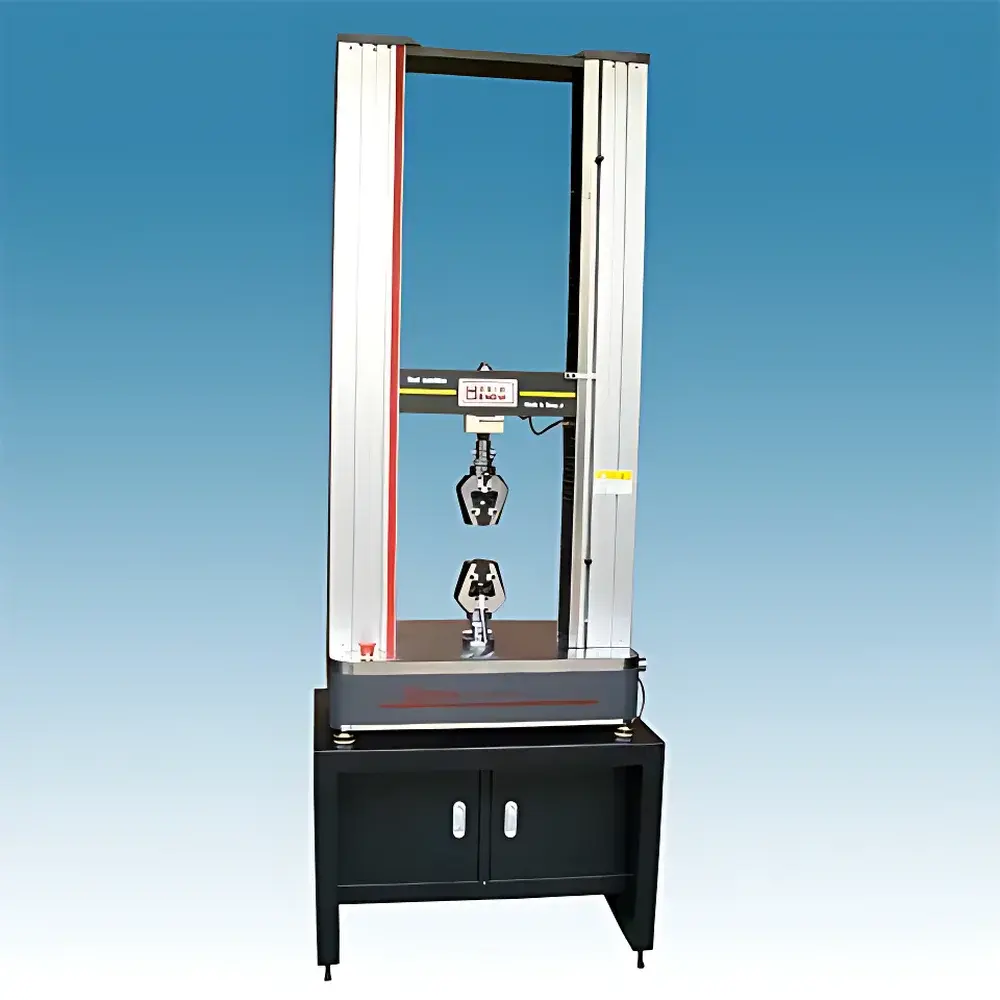
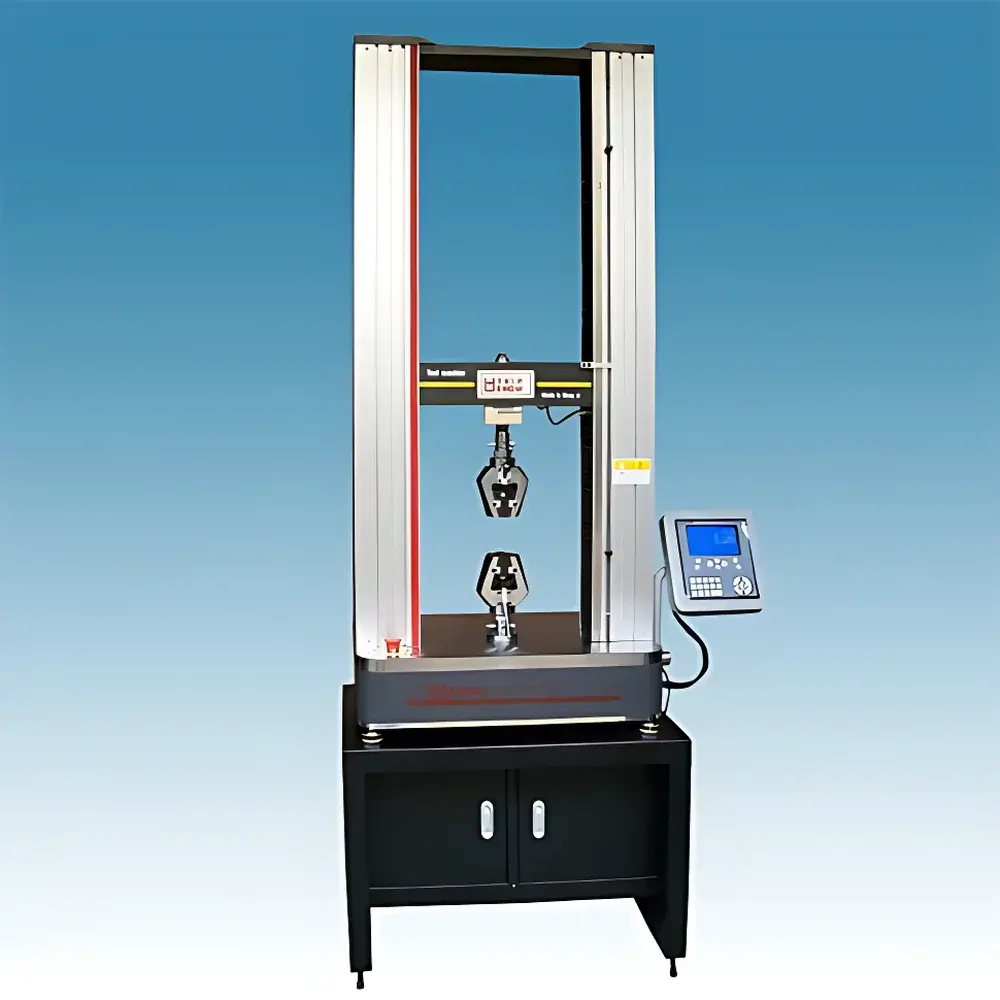
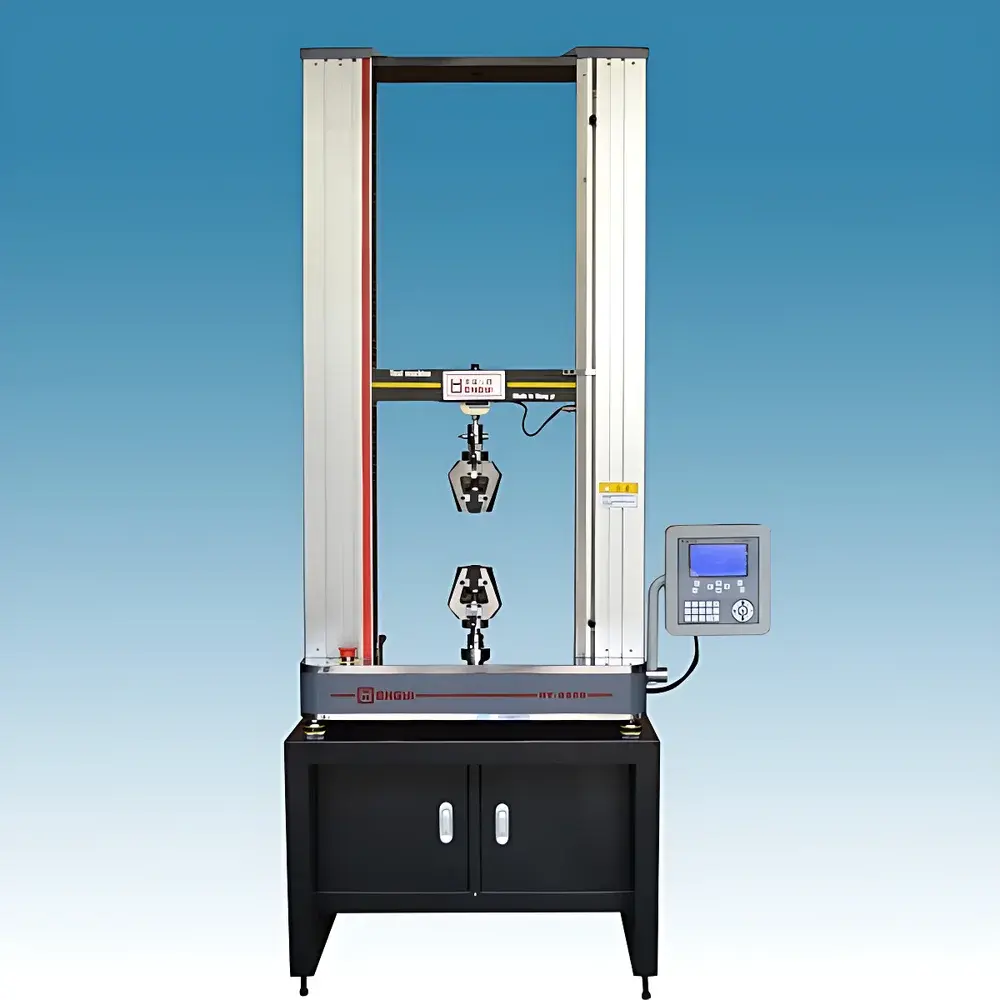
Hengyi HY-3080JX Precision Ceramic Flexural Strength Testing Machine
| Brand | Hengyi / Hengyitest |
|---|---|
| Origin | Shanghai, China |
| Manufacturer Type | Direct Manufacturer |
| Regional Category | Domestic (China) |
| Model | HY-3080JX |
| Instrument Type | Electromechanical Universal Testing Machine |
| Load Capacity Options | 1 N to 30 kN (configurable) |
| Accuracy Class | ≤0.5% |
| Effective Test Width | 380 mm (expandable) |
| Effective Test Height | 800 mm (extendable) |
| Speed Range | 0.001–500 mm/min |
| Speed Accuracy | ±0.5% of indicated value |
| Force Resolution | ±500,000 counts full scale, no range switching |
| Displacement & Strain Measurement Accuracy | ±0.5% of indicated value |
| Control Modes | Stress, strain, and displacement control with closed-loop feedback |
| Safety Features | Electronic limit protection, overload auto-stop (>110% FS), real-time system diagnostics |
| Power Supply | 220 V AC, single-phase, 750 W |
| Dimensions (W×D×H) | 700 × 420 × 1510 mm |
| Weight | 180 kg |
Overview
The Hengyi HY-3080JX Precision Ceramic Flexural Strength Testing Machine is a high-stiffness, dual-column electromechanical universal testing system engineered for accurate and repeatable flexural strength evaluation of advanced brittle materials—particularly fine ceramics, technical ceramics, and ceramic composites. It operates on the principles of three-point and four-point bending per ASTM C1161, ISO 14704, and GB/T 6569, delivering controlled static loading under displacement or load-rate regulation. Designed for R&D laboratories, quality control departments, and materials certification bodies, the HY-3080JX integrates precision mechanical architecture with digital closed-loop control to ensure traceable, GLP-compliant mechanical property characterization—including modulus of rupture (MOR), flexural strength, elastic modulus (E), and stress–strain response up to fracture.
Key Features
- Robust dual-column frame with preloaded high-precision ball screws (imported) and optimized structural rigidity to minimize deflection during high-load flexural testing.
- High-resolution bidirectional load cell (U.S.-sourced, calibrated to ±0.5% accuracy) with automatic transducer recognition and seamless integration into the control loop.
- Panasonic servo motor and drive system (Japan) — maintenance-free, low-noise, and thermally stable for long-term repeatability across extended test sequences.
- Digital controller supporting multi-language UI (English, Chinese, German, French, Spanish), unit conversion (N, kN, lbf, kgf), and configurable control modes: load, stress, strain, and displacement control.
- Integrated handheld remote control for rapid jog operation, emergency stop, and intuitive test initiation—optimized for operator safety and workflow efficiency.
- Comprehensive hardware-based safety architecture: electronic travel limits, over-travel cutoff, 110% overload shutdown, real-time system diagnostics (drive voltage, current, temperature, sensor integrity), and programmable auto-return.
Sample Compatibility & Compliance
The HY-3080JX accommodates standardized ceramic beam specimens per ASTM C1161 (rectangular cross-section, typically 3×4×45 mm or 3×3.5×50 mm) as well as non-standard geometries via customizable support span and loading nose fixtures. Its modular fixture platform supports three-point and four-point bending configurations, compression platens, tensile grips, peel fixtures, and shear adapters—enabling cross-material validation per ISO 527 (plastics), ISO 6892-1 (metals), ISO 179 (impact-flexural), and ISO 11357 (thermal-mechanical). All force and displacement measurements comply with ISO 7500-1 Class 0.5 requirements. Optional metrological certification (Shanghai Institute of Measurement and Testing Technology) ensures traceability to national standards, meeting internal audit and external accreditation needs (e.g., CNAS, ILAC-MRA).
Software & Data Management
The system operates with Hengyi’s proprietary TESTMaster v5.x software, a Windows-based platform compliant with FDA 21 CFR Part 11 for electronic records and signatures (audit trail enabled, user role management, password-protected method templates). Real-time data acquisition at ≥1 kHz sampling rate captures full load–displacement curves, with post-test calculation of flexural strength (σf = 3PL/2bd² for 3-pt; σf = PL/bd² for 4-pt), elastic modulus from initial linear slope, and fracture energy integration. Export formats include CSV, XLSX, PDF reports (customizable headers, logos, pass/fail thresholds), and XML for LIMS integration. Raw data files retain full metadata: timestamp, operator ID, calibration certificate ID, environmental conditions (optional sensor input), and test sequence logs.
Applications
- Flexural strength qualification of sintered alumina (Al2O3), silicon carbide (SiC), zirconia (ZrO2), and silicon nitride (Si3N4) components used in semiconductor substrates, biomedical implants, and aerospace thermal barriers.
- Quality assurance of ceramic coatings, laminated ceramic-metal composites, and porous ceramics where bending stiffness and crack-initiation resistance are critical design parameters.
- Comparative mechanical screening of green-state vs. fully densified ceramics during process development.
- Standardized testing of ceramic matrix composites (CMCs) per ASTM D7264 for flexural performance under ambient and elevated temperature (with optional environmental chamber).
- Supporting failure analysis workflows through synchronized video capture (via USB camera module) and load-synchronized acoustic emission triggering (with optional AE interface).
FAQ
What bending standards does the HY-3080JX support out-of-the-box?
ASTM C1161, ISO 14704, GB/T 6569, and EN 843-1 are preconfigured in TESTMaster software with automated calculation templates and report formatting.
Can the system perform both three-point and four-point bending without hardware reconfiguration?
Yes—interchangeable bending fixtures (including adjustable span rods and interchangeable loading noses) allow rapid transition between configurations; all are recognized automatically by the controller.
Is the load cell calibrated and certified prior to shipment?
Each unit ships with a factory calibration certificate traceable to NIM (National Institute of Metrology, China); optional third-party verification (e.g., Shanghai IMT) is available upon request.
Does the software support automated batch testing for production QA?
Yes—batch mode enables unattended sequential testing of up to 99 specimens with pass/fail logic based on user-defined limits for peak load, deflection at break, or modulus deviation.
What environmental conditions are recommended for optimal ceramic flexural testing?
Testing should be conducted in a temperature-controlled lab (23 ± 2°C) with <50% RH to minimize hygroscopic effects on surface flaws; optional humidity monitoring integration is supported.
Related Products



