
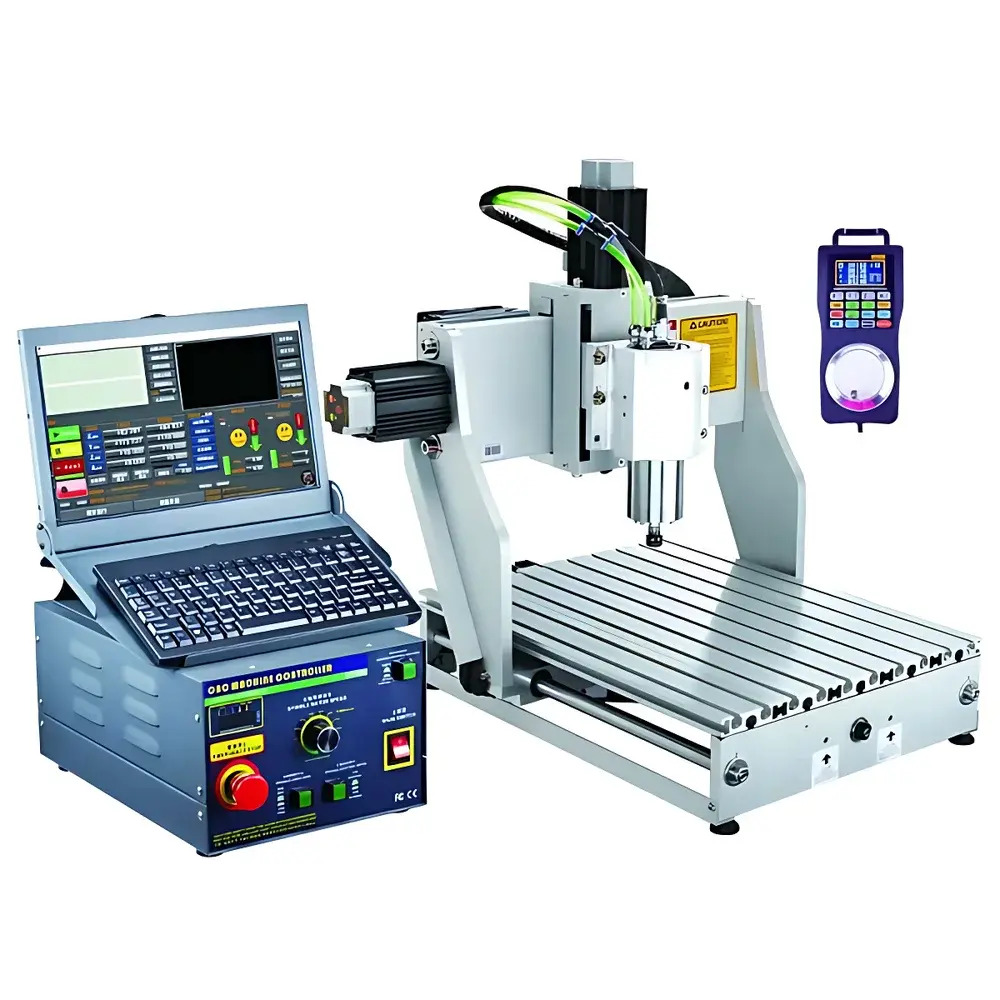
Hengyi HY(DK)TB Impact Notch Specimen Milling Machine
| Brand | Hengyi |
|---|---|
| Origin | Shanghai, China |
| Manufacturer Type | Direct Manufacturer |
| Country of Origin | China |
| Model | HY(DK)TB |
| Price | Upon Request |
| Spindle Speed | 24,000 rpm |
| Feed Rate | 0–500 mm/min |
| Cut Depth Adjustment Range | 2–20 mm |
| Compatible Pipe Diameter Range | 50–250 mm |
| Max Workpiece Length (Pipe/Sheet) | 260 mm |
| X-Axis Travel | 280 mm |
| Y-Axis Travel | 310 mm |
| Z-Axis Travel | 70 mm |
| Frame Material | Aluminum Alloy |
| Drive System | Three Stepper Motor + Driver Sets |
| Spindle Motor | High-Speed Variable-Frequency Motor |
| Linear Guidance | Six Precision Ground Linear Shafts |
| Motion Transmission | Three Precision Ball Screws |
| Standard Vise | Included |
| Dimensional Accuracy | Compliant with GB/T 1043, GB/T 1843, GB/T 1040, GB/T 8804.2, ISO 8004-2, and ISO 179 |
| Tooling Options | Cylindrical End Mills, 20° Flat-Bottom Cutters, Parting Cutters, 45° Chamfer Cutters |
| Tool Diameters | Φ3 mm, Φ4 mm, Φ6 mm |
| Max Machining Envelope | 300 × 150 × 100 mm |
| Power Supply | 220 V AC |
| Total Power Consumption | 1500 W |
| Net Weight | 45 kg |
Overview
The Hengyi HY(DK)TB Impact Notch Specimen Milling Machine is a precision CNC-based specimen preparation system engineered for the standardized machining of polymeric, composite, and non-metallic test specimens—specifically designed to meet the stringent dimensional and surface finish requirements of international mechanical testing standards. Unlike manual or semi-automatic notching tools, this machine employs a closed-loop motion control architecture with high-rigidity aluminum alloy frame construction, ensuring thermal stability and long-term repeatability across production batches. Its core function is the deterministic generation of notched bars for Charpy and Izod impact testing (per ISO 179, ISO 8004-2, GB/T 1843), dumbbell-shaped tensile specimens (per ISO 527, GB/T 1040), and rectangular flexural specimens (per ISO 178, GB/T 9341). The integrated high-speed spindle (24,000 rpm) and synchronized XYZ-axis positioning enable consistent material removal rates and controlled chip formation—critical for minimizing micro-cracking, heat-affected zones, and edge burrs that compromise fracture behavior in subsequent impact evaluations.
Key Features
- Precision CNC architecture with three independently controlled stepper motor axes (X/Y/Z), each driven by high-resolution ball screws and supported by six hardened linear guide shafts for minimal backlash and positional deviation ≤ ±5 µm.
- Dedicated tooling set including ISO-standardized cylindrical end mills (Φ3/Φ4/Φ6 mm), 20° flat-bottom cutters for precise notch root geometry, 45° chamfer tools for ASTM-compliant edge conditioning, and parting cutters for specimen separation—all mounted via ER11 collet chucks.
- Programmable feed rate (0–500 mm/min) and adjustable cut depth (2–20 mm) allow optimization for brittle thermoplastics (e.g., PMMA, PC), semi-crystalline polymers (e.g., PP, PE), fiber-reinforced composites, and rigid PVC sheets without delamination or matrix pull-out.
- Integrated vise with T-slot base and adjustable clamping force ensures secure fixation of pipes (50–250 mm Ø) and flat plates (up to 260 mm length) while maintaining parallelism within 0.02 mm/m across the full Y-axis travel (310 mm).
- Compact footprint (approx. 800 × 700 × 1100 mm) and 220 V / 1500 W single-phase power requirement enable seamless integration into QC laboratories, metrology rooms, and accredited testing facilities compliant with ISO/IEC 17025.
Sample Compatibility & Compliance
The HY(DK)TB accommodates a broad spectrum of standard-compliant geometries defined in major materials testing protocols. It consistently produces specimens meeting the dimensional tolerances specified in ISO 179-1 (notched Izod bars: 80 × 10 × 4 mm), ISO 8004-2 (notched Charpy bars: 80 × 10 × 4 mm), GB/T 1043 (Chinese national standard for impact testing), and GB/T 8804.2 (polyethylene and polypropylene tensile specimens). For pipe-derived samples, the machine supports circumferential milling to extract representative longitudinal or hoop-direction test coupons from pressure-rated PE, PPR, and PVC-U piping systems. All machined surfaces exhibit Ra ≤ 0.8 µm as verified by contact profilometry—ensuring compliance with surface roughness clauses in ASTM D6110 and ISO 13479. Traceable calibration documentation and tool wear logs support GLP/GMP audit readiness.
Software & Data Management
The HY(DK)TB operates via an embedded industrial controller with intuitive touch-interface HMI, supporting G-code import (ISO 6983-1 compliant) and on-device parameter programming. Preloaded machining templates include ISO 179 notch profiles (A-type, B-type), ISO 527 Type 1B dumbbells, and custom user-defined paths. Each machining cycle automatically records timestamp, tool ID, spindle load profile, and axis position feedback—exportable as CSV for integration into LIMS or QMS platforms. While no proprietary software suite is bundled, the controller outputs standard RS-232/USB-C serial logs compatible with third-party SPC tools. Audit trails comply with data integrity principles outlined in FDA 21 CFR Part 11 when paired with validated network logging infrastructure.
Applications
This system serves as a primary specimen preparation platform in polymer R&D labs, pipe manufacturing QA departments, national building materials inspection institutes (e.g., CNAS-accredited centers), and independent certification bodies performing EN 1452, ASTM F714, or ISO 4427 conformance testing. Typical use cases include: generating notched impact bars from extruded HDPE pipe sections for qualification under ISO 4437; preparing tensile specimens from FRP laminates per ISO 527-4; machining compression test cubes from cellular PVC boards per ISO 844; and producing standardized flexural beams from recycled PET sheets for mechanical recycling validation studies. Its ability to maintain geometric fidelity across heterogeneous materials—including filled thermoplastics, biodegradable PLA, and glass-fiber composites—makes it indispensable for comparative aging, weathering, and creep studies requiring strict inter-laboratory reproducibility.
FAQ
Does the HY(DK)TB support automated tool change?
No—it uses manual tool loading via ER11 collets; however, tool offsets are stored per program to minimize setup time between specimen types.
Can it process metallic specimens?
Not recommended—the spindle and structural design are optimized for non-ferrous and polymeric materials; aluminum or brass may be machined at reduced speeds but void warranty coverage.
Is ISO/IEC 17025 calibration documentation provided?
Yes—factory calibration certificates for linear axis positioning accuracy and spindle speed verification are included; periodic recalibration services are available through authorized Hengyi service partners.
What maintenance intervals are recommended?
Lubrication of ball screws and linear guides every 500 operating hours; spindle bearing inspection every 2,000 hours; collet chuck torque verification before each shift.
Are spare parts and tooling kits available internationally?
Yes—standard ER11 collets, carbide-tipped cutters, and aluminum vise components are stocked in EU and North American distribution hubs with lead times under 10 business days.



