
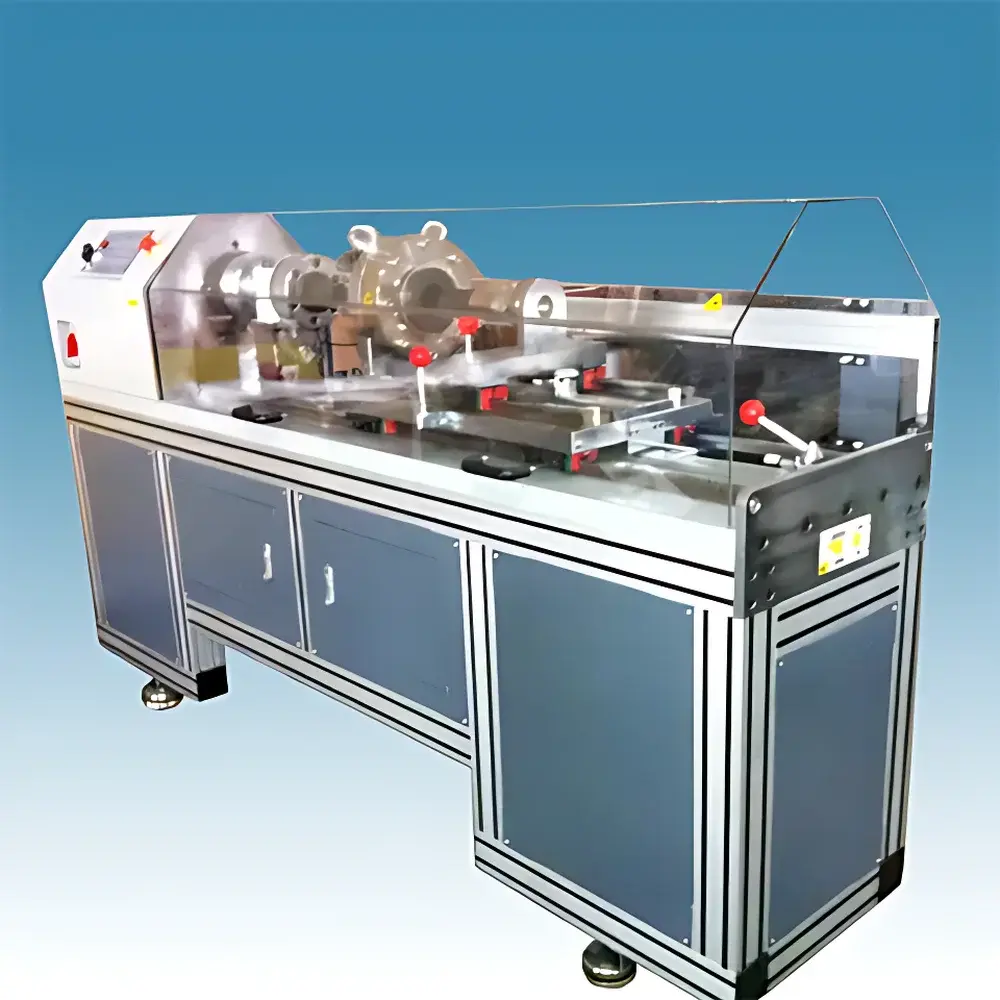
Hengyi HY-2000N·m Servo Motor-Controlled High-Strength Bolt Axial Force and Torque Coefficient Testing Machine
| Brand | Hengyi (Hengyitest) |
|---|---|
| Origin | Shanghai, China |
| Manufacturer Type | Direct Producer |
| Regional Classification | Domestic |
| Model | HY-2000N·mIUIMM |
| Max Torque | 2000 N·m |
| Torque Measurement Range | 2–2000 N·m |
| Torque Resolution | 0.001 N·m |
| Torsion Angle Range | 0–100,000° (or continuous) |
| Motor Power | 5 kW |
Overview
The Hengyi HY-2000N·m Servo Motor-Controlled High-Strength Bolt Axial Force and Torque Coefficient Testing Machine is a precision-engineered torsion testing system designed for quantitative mechanical characterization of threaded fasteners under controlled tightening conditions. It operates on the principle of simultaneous, synchronized measurement of axial clamping force (tensile load) and rotational torque components—total torque (MA), thread torque (MG), bearing surface torque (MB), and breakaway torque (ML)—enabling full decomposition of frictional contributions in bolted joints. The system integrates a proprietary dual-sensor architecture: a high-stiffness axial load cell co-located with a compound “clamping force–thread torque” transducer compliant with ISO 16047 and GB/T 3098.9–2010. This architecture ensures traceable, repeatable acquisition of torque coefficient (K), total friction coefficient (μtot), thread friction coefficient (μth), and bearing surface friction coefficient (μb). Designed for R&D laboratories, quality control departments, and certification bodies in aerospace, automotive, rail, wind energy, and structural steel fabrication, the machine supports both static and dynamic tightening protocols—including constant-torque, torque-angle (M–φ), yield-point detection, and ultimate failure analysis—under fully programmable speed and load profiles.
Key Features
- Servo motor-driven actuation with closed-loop speed control (5–40 rpm standard; up to 200 rpm optional), delivering smooth, non-cogging rotation and eliminating stick-slip artifacts during low-speed tightening.
- Dual-axis synchronized acquisition: real-time, time-aligned sampling of axial force (5–500 kN range) and three torque components (total, thread, bearing surface) at ≥1 kHz sampling rate.
- Modular gripping system accommodating M10–M30 fasteners (customizable up to M42); parallel jaw design ensures uniform stress distribution and minimizes bending moments.
- Hybrid controller architecture: Hengyi HYtest digital controller with FPGA-based signal conditioning, supporting ASTM E4, ISO 7500-1 Class 0.5 accuracy compliance for force and torque channels.
- Integrated angular encoder with 0.01° resolution and ±0.5% linearity over 0–100,000° range, enabling precise tracking of yield transition, plastic deformation, and thread stripping events.
- Robust mechanical frame (1800 kg mass, 2200 × 540 × 1250 mm footprint) with reinforced crosshead guidance and zero-backlash gear train for long-term metrological stability.
Sample Compatibility & Compliance
The HY-2000N·m system is validated for testing hex bolts, studs, screws, and flange bolts per international fastener standards. It supports full mechanical property evaluation of carbon steel, alloy steel, stainless steel, and titanium fasteners per ISO 898-1, ISO 3506-1, EN 14399-1/3/6, and DIN 267-11. Test methods align with ISO 16047 (determination of torque coefficient and friction coefficients), GB/T 16823.3–2010 (mechanical properties of fasteners — part 3: torque/clamp force testing), and Volkswagen PV 3227:2010-03 (tightening behavior of bolted joints). All torque and force data paths are calibrated traceable to national metrology institutes (e.g., NIM China, PTB Germany), and system validation reports include uncertainty budgets per GUM (JCGM 100:2008). The machine meets CE machinery directive 2006/42/EC and electromagnetic compatibility (EMC) requirements per EN 61326-1.
Software & Data Management
HYtest v5.2 software provides ISO/IEC 17025-compliant test sequencing, real-time curve overlay (M–F, M–φ, F–φ), and automated calculation of K-factor, μth, μb, yield torque (My), yield clamping force (Fy), and ultimate tensile strength (UTS). Data export supports CSV, XML, and PDF report generation with embedded metadata (operator ID, calibration date, environmental conditions). Audit trail functionality complies with FDA 21 CFR Part 11 requirements, including electronic signatures, user-level access control, and immutable event logging. Raw data files are stored in HDF5 format for long-term archival integrity and third-party analysis interoperability (MATLAB, Python pandas).
Applications
- Quantitative friction coefficient mapping for lubricant development and surface treatment validation (e.g., phosphate, zinc flake, PTFE coatings).
- Production-line verification of torque specification compliance for critical joints in aircraft engine mounts and landing gear assemblies.
- Root-cause analysis of joint loosening in wind turbine tower flanges using post-torque relaxation and transverse vibration correlation.
- Calibration and verification of hand torque tools and electric pulse tools against reference standards.
- Research into preload scatter reduction strategies via statistical process control (SPC) of K-factor distributions across lot batches.
- Support for ISO/IEC 17025 accredited testing laboratories performing accredited torque coefficient certification per ISO/IEC 17025:2017 clause 7.7.
FAQ
What standards does this machine directly support?
ISO 16047, GB/T 3098.9–2010, GB/T 16823.3–2010, EN 14399-1/3/6, ISO 898-1, PV 3227:2010-03, and ASTM F2291 (for torque-tension relationships).
Can it measure yield point during tightening?
Yes—via real-time slope analysis of the torque-angle curve; automatic detection of the 0.2% offset yield torque and corresponding clamping force is enabled.
Is the system suitable for GLP/GMP environments?
Yes—software includes full 21 CFR Part 11 compliance, audit trail, role-based permissions, and electronic signature capability.
What is the maximum specimen length accommodated?
Standard grip spacing is 1000 mm; extended configurations up to 1500 mm are available upon request.
Does the system provide uncertainty statements for reported K-values?
Yes—uncertainty budgets are generated per test based on sensor calibration certificates, environmental monitoring, and repeatability studies conducted per ISO/IEC 17025 Annex A.



