
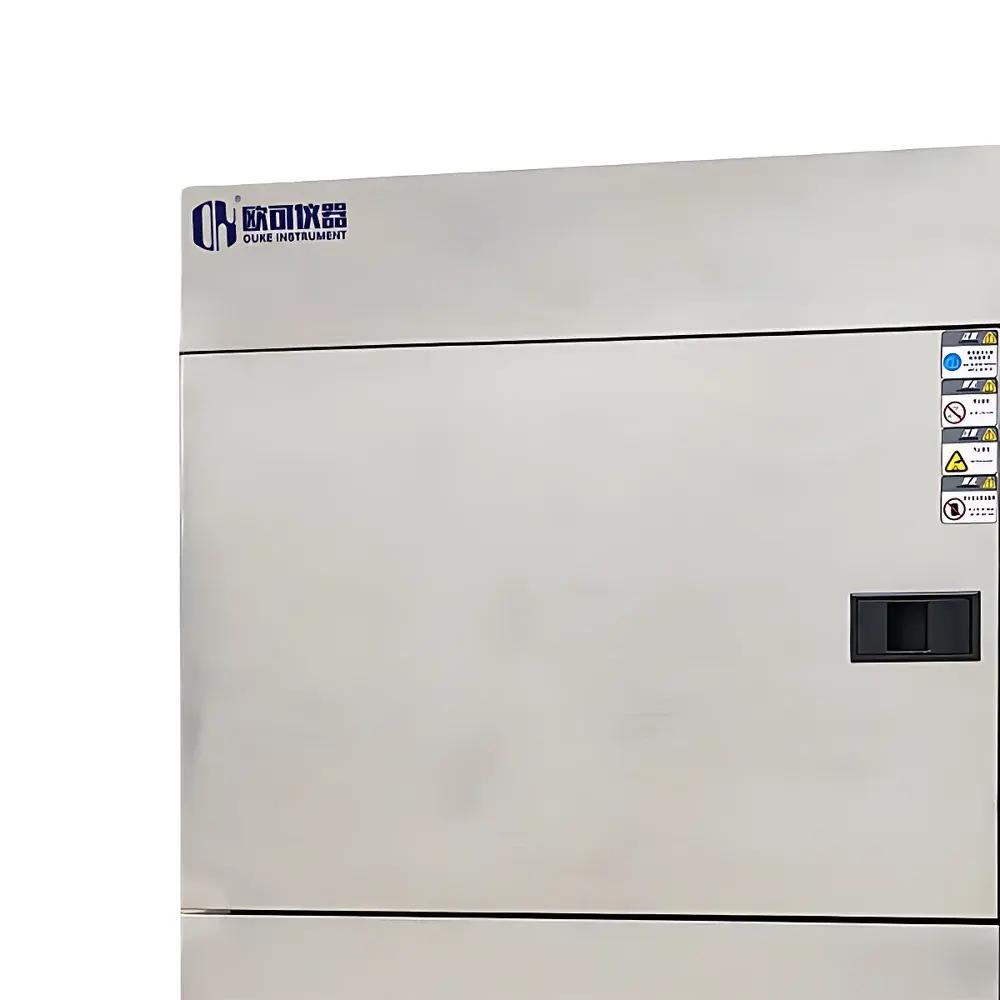
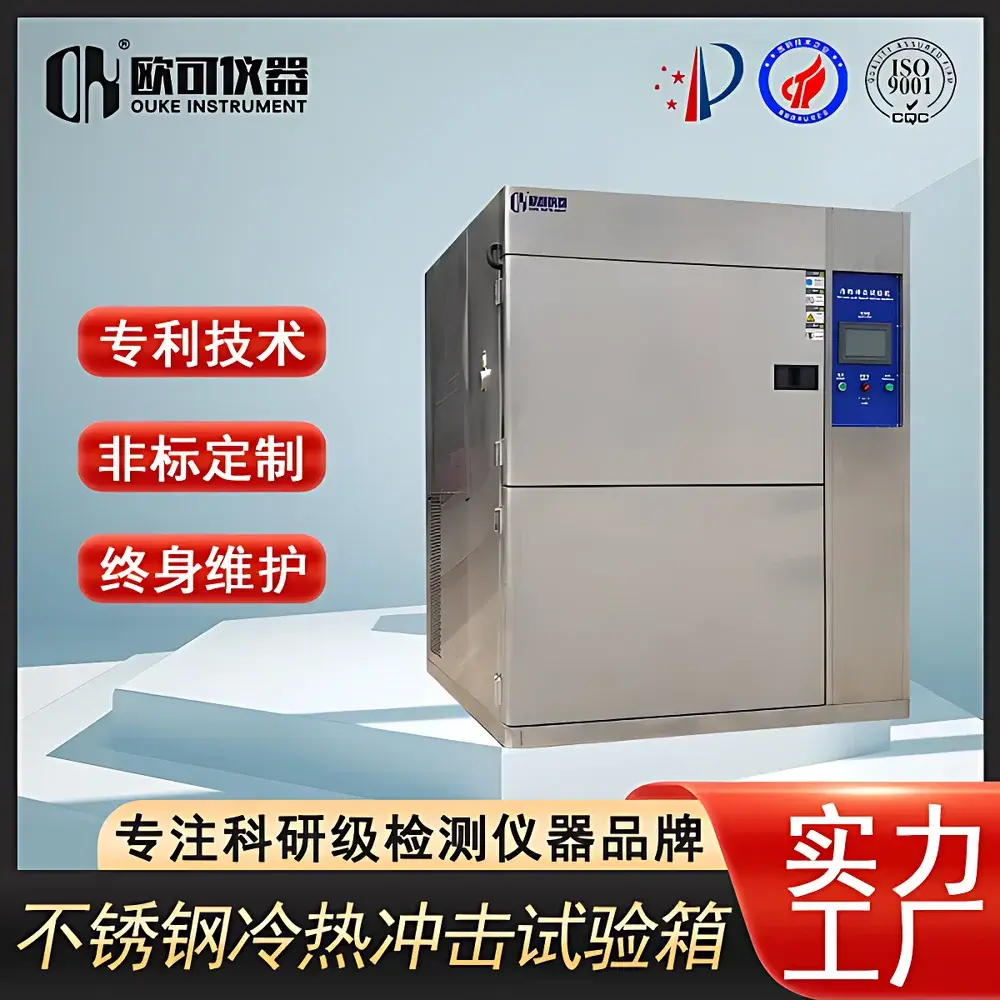
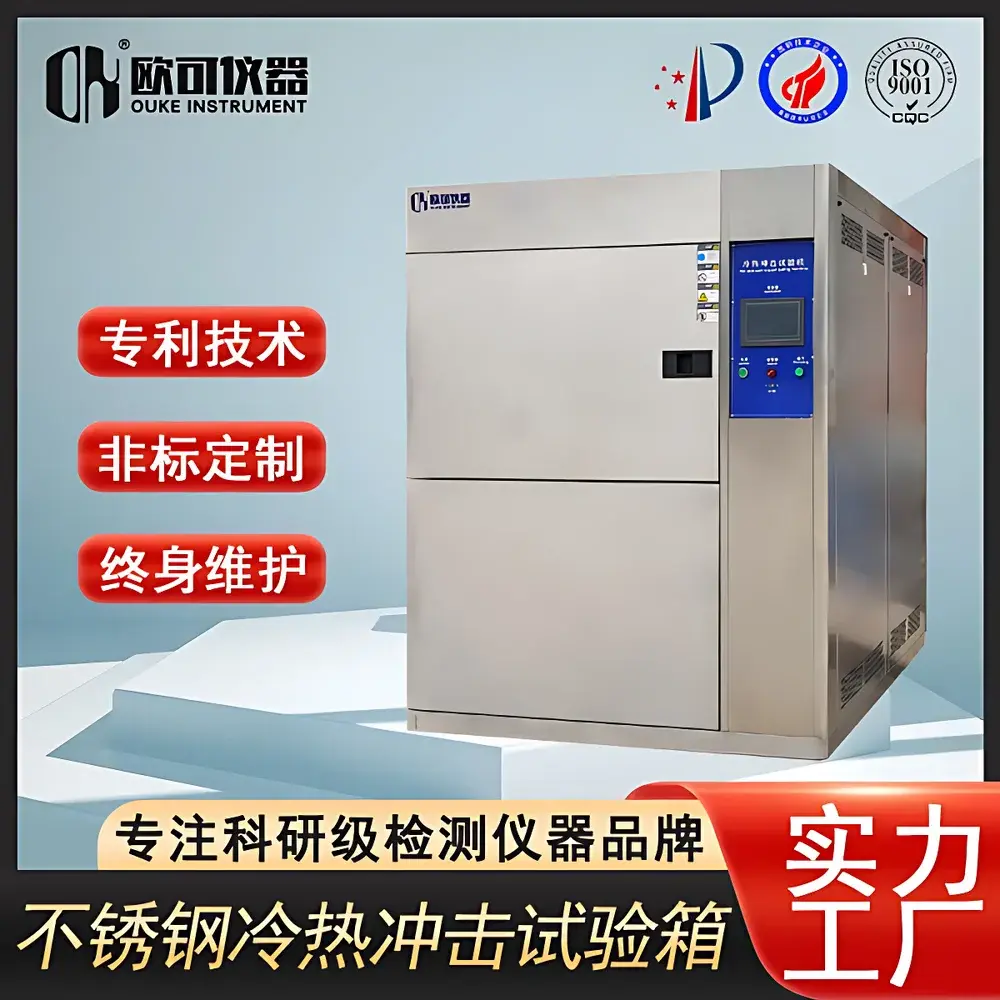
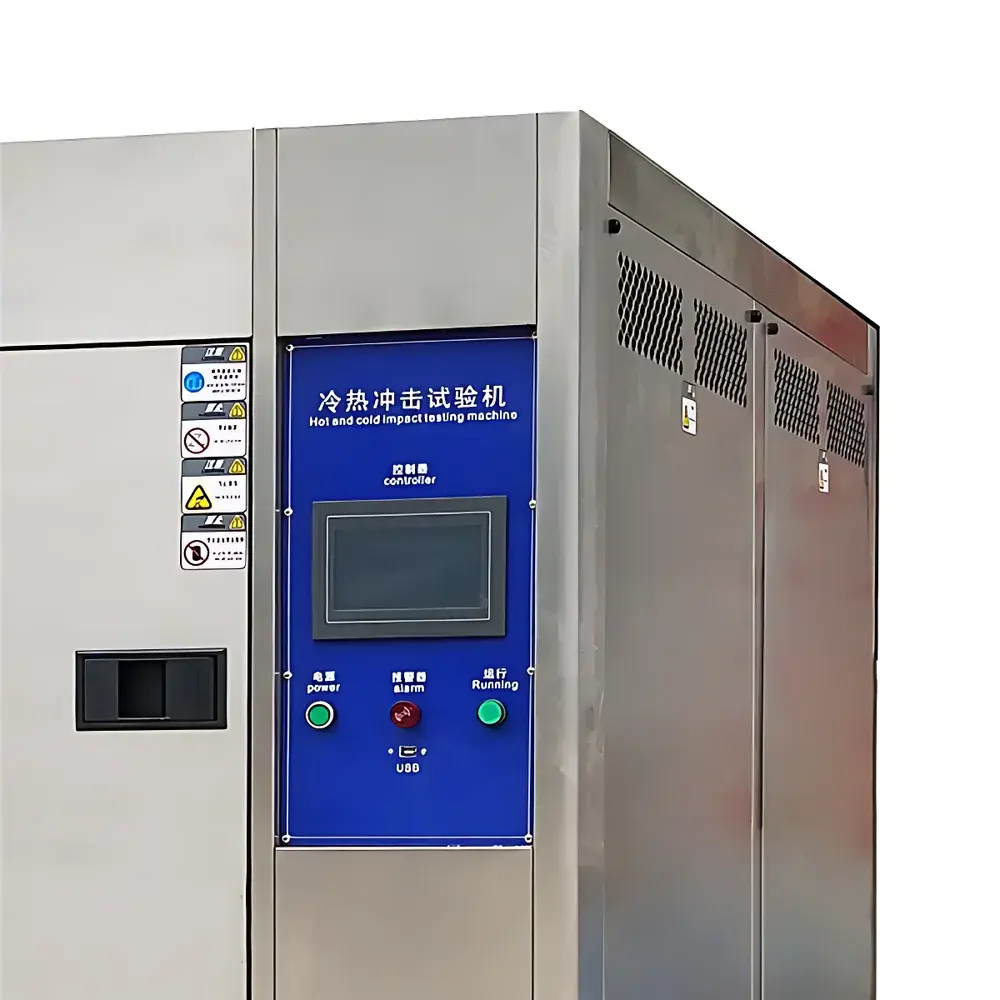
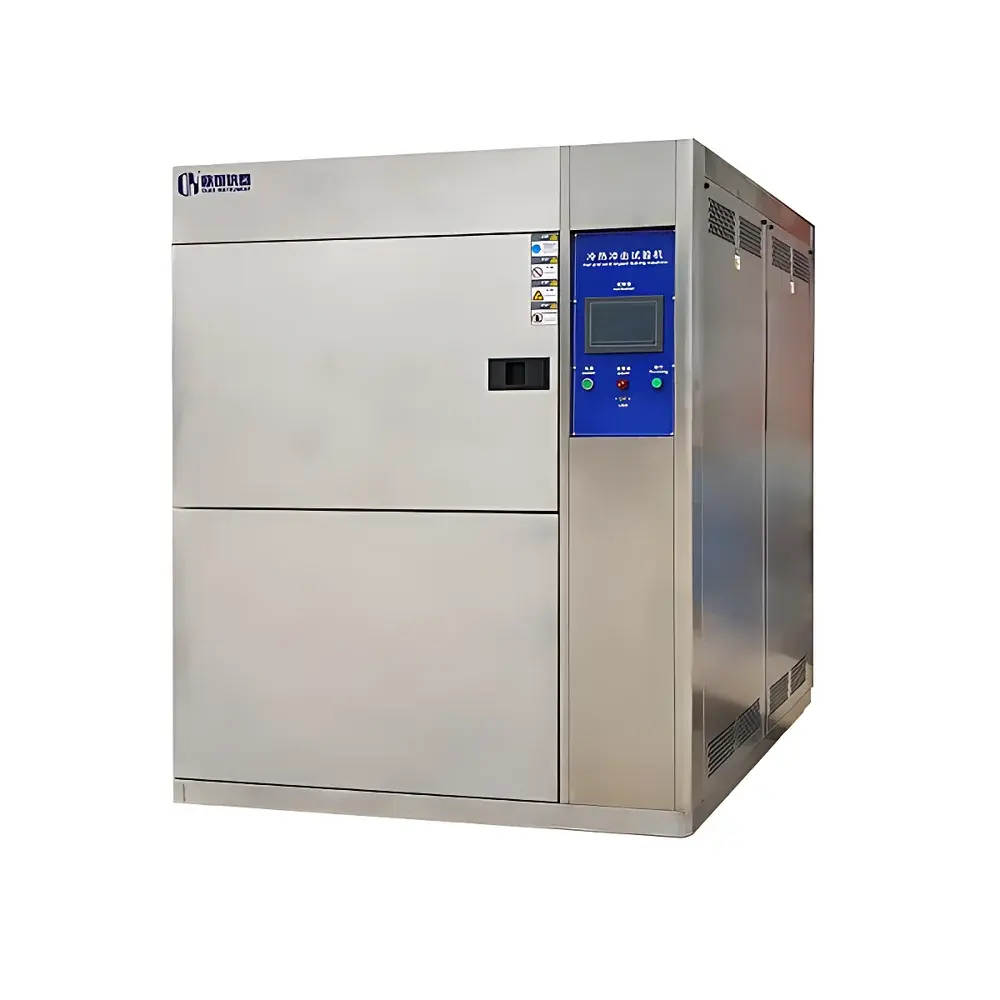
OK-TS-6 Thermal Shock Test Chamber
| Brand | OK Instruments |
|---|---|
| Origin | Guangdong, China |
| Manufacturer Type | OEM/ODM Manufacturer |
| Product Origin | Domestic (China) |
| Model | OK-TS-6 |
| High Temperature Range | +150 °C |
| Low Temperature Range | −50 °C |
| Thermal Shock Range | −50 °C to +150 °C |
| Temperature Stability | ±2 °C |
| Heating Rate | 10 °C/min (empty chamber) |
| Cooling Rate | 10 °C/min (empty chamber) |
| Configuration | Two-Zone (Basket-Transfer) Design |
Overview
The OK-TS-6 Thermal Shock Test Chamber is an engineered environmental stress screening (ESS) system designed for rapid, repeatable thermal cycling between extreme temperature extremes. It operates on the two-zone basket-transfer principle—featuring independent high-temperature (+150 °C) and low-temperature (−50 °C) chambers with a motorized specimen carrier that transfers test samples between zones in under 10 seconds. This architecture ensures minimal thermal lag and maximizes thermal shock intensity, making it suitable for accelerated reliability validation per IEC 60068-2-14, MIL-STD-810H Method 503.7, and GJB 150.5A. Unlike static-air or single-chamber systems, the OK-TS-6 delivers true step-change thermal transients—critical for exposing interfacial delamination, solder joint fatigue, sealant failure, and coefficient-of-thermal-expansion (CTE) mismatch in electronic assemblies, automotive ECUs, aerospace avionics, and advanced composite materials.
Key Features
- Two-zone mechanical transfer architecture with stainless-steel insulated chambers and pneumatic/hydraulic-assisted basket actuation for <10 s transfer time
- Independent PID-controlled heating and refrigeration circuits using high-efficiency cascade refrigeration (R404A/R23) for stable operation at −50 °C
- Dual-sensor monitoring: chamber air sensors + optional embedded thermocouple inputs for real-time specimen surface temperature tracking
- Reinforced structural frame with vibration-dampened mounting and precision linear guides to maintain positional repeatability over >500,000 cycles
- Comprehensive safety suite including over-temperature cut-off, door interlock, refrigerant pressure monitoring, and emergency power-off (EPO) circuit
- Front-access design with double-glazed observation window and internal LED lighting for non-intrusive visual inspection during test execution
Sample Compatibility & Compliance
The OK-TS-6 accommodates specimens up to 400 mm × 400 mm × 400 mm (W×D×H) within its standard basket, with maximum payload capacity of 20 kg. Its thermal performance aligns with internationally recognized qualification protocols: IEC 60068-2-14 (Change of temperature—Method N: Change of temperature by rapid transfer), ISO 16750-4 (Road vehicles—Environmental conditions and testing for electrical and electronic equipment—Part 4: Climatic loads), and MIL-STD-810H Method 503.7 (Temperature Shock). The system supports GLP/GMP-aligned test documentation when paired with optional audit-trail-enabled software (see Software & Data Management). All control firmware complies with IEC 61000-6-2 (immunity) and IEC 61000-6-4 (emission) electromagnetic compatibility standards.
Software & Data Management
Built-in OK-TestControl v3.2 firmware provides intuitive touchscreen operation, programmable multi-step profiles (up to 99 segments), and automatic logging of chamber setpoints, actual temperatures, transfer timestamps, and alarm events. Optional OK-DataLink Pro software enables PC-based remote monitoring, CSV/Excel export, statistical process control (SPC) charting, and 21 CFR Part 11-compliant electronic signatures and audit trails. Data integrity safeguards include cyclic redundancy check (CRC)-verified storage, write-protected archive partitions, and configurable retention policies aligned with ISO/IEC 17025 laboratory requirements.
Applications
- Electronics: Qualification of PCBAs, BGA packages, MEMS sensors, and power modules subjected to CTE-induced stress
- Automotive: Validation of ADAS controllers, battery management systems (BMS), and EV traction inverters per ISO 16750-4
- Aerospace: Screening of flight-critical components—including connectors, RF filters, and optical housings—for thermal shock survivability
- Materials Science: Accelerated aging studies of polymer composites, thermal interface materials (TIMs), and conformal coatings
- Medical Devices: Verification of sterilization-resistant enclosures and implantable electronics per AAMI TIR17 and ISO 14971 risk management frameworks
FAQ
What is the difference between “chamber temperature rate” and “specimen temperature transition time”?
Chamber temperature rate (e.g., 10 °C/min) refers to empty-chamber air temperature change under no thermal load. Specimen transition time—the engineering-critical metric—is measured at the sample surface using calibrated thermocouples and typically ranges from 15–90 seconds depending on mass, geometry, and thermal diffusivity.
Does the OK-TS-6 support custom test profiles beyond standard MIL-STD or IEC cycles?
Yes. Users can define arbitrary ramp-hold sequences, dwell durations, cycle counts, and conditional branching (e.g., pause on alarm, resume after cooldown) via the onboard editor or OK-DataLink Pro.
Is third-party calibration and IQ/OQ/PQ documentation available?
OK Instruments provides NIST-traceable factory calibration certificates and optional vendor-supported Installation Qualification (IQ), Operational Qualification (OQ), and Performance Qualification (PQ) packages compliant with ISO/IEC 17025 and FDA guidance.
Can the system be integrated into an existing MES or LIMS environment?
Yes. OK-DataLink Pro supports OPC UA and Modbus TCP protocols for bi-directional communication with manufacturing execution systems and laboratory information management systems.
What maintenance intervals are recommended for long-term reliability?
Refrigeration oil and filter driers require replacement every 24 months; door gaskets and basket drive belts every 36 months; full system performance verification annually per ISO/IEC 17025 Annex A.3.



