
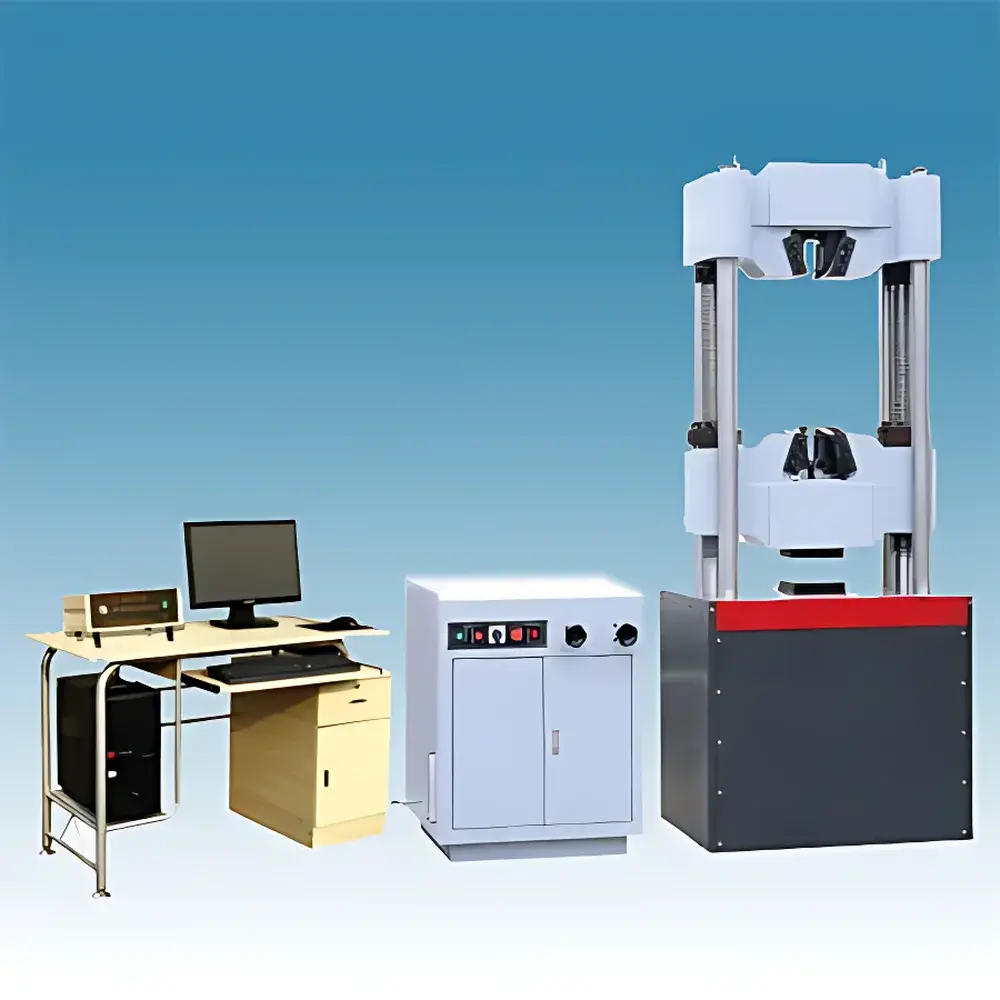
Hengyi HY(WE)100060KLYYH 1000 kN Hydraulic Universal Testing Machine
| Brand | Hengyi |
|---|---|
| Origin | Shanghai, China |
| Manufacturer Type | Direct Manufacturer |
| Country of Origin | China |
| Instrument Type | Hydraulic Universal Testing Machine |
| Maximum Load Capacity | 1000 kN |
| Load Measurement Accuracy | ±0.5% of reading |
| Resolution | ≤0.5% of full scale |
| Compression Space | 600 mm |
| Tensile Space | 600 mm |
| Round Specimen Grip Range | Φ20–Φ60 mm |
| Flat Specimen Thickness Capacity | 0–40 mm |
| Piston Stroke | 150 mm |
| Bend Support Span Adjustment | 100–600 mm |
| Shear Specimen Diameter | Φ10 mm |
| Deformation Measurement Accuracy | ±0.5% of reading |
| Displacement Measurement Accuracy | ±0.5% of reading |
| Stress Rate Control Range | 1–60 N/mm²/s |
| Strain Rate Control Range | 0.00025–0.0025 s⁻¹ |
| Closed-Loop Control Precision (Constant Load/Deformation/Displacement) | ±1% of setpoint |
| Dimensions (W×D×H) | 880 × 580 × 2260 mm |
| Motor Power | 1.5 kW, 3-phase |
| Weight | 3500 kg |
Overview
The Hengyi HY(WE)100060KLYYH is a high-capacity, microprocessor-controlled hydraulic universal testing machine engineered for precision mechanical property evaluation of metallic and non-metallic structural materials under static loading conditions. Designed in accordance with core principles of materials mechanics—including uniaxial tensile, compressive, flexural, and shear deformation analysis—the system implements electro-hydraulic proportional servo control to deliver stable, programmable force application across defined stress and strain rate regimes. Its 1000 kN (100-ton-force) capacity enables rigorous qualification testing of large-scale components such as structural steel members, welded joints, castings, forgings, and heavy-duty fasteners—including high-strength bolts, anchor rods, and threaded assemblies—commonly specified in ASTM A370, ISO 6892-1, ISO 15630-1, EN 10002-1, and GB/T 228.1 standards. The oil-cylinder-underneath architecture provides an open-front test zone with vertical space flexibility, facilitating straightforward specimen installation and alignment for both standard and custom geometries.
Key Features
- Electro-hydraulic proportional closed-loop control system enabling precise regulation of stress rate (1–60 N/mm²/s), strain rate (0.00025–0.0025 s⁻¹), and displacement rate with ±1% setpoint accuracy
- Imported high-precision load cell (±0.5% FS accuracy) and extensometer-compatible displacement transducers (±0.5% FS accuracy) for traceable, repeatable data acquisition
- Adjustable test space: 600 mm tensile clearance and 600 mm compression height, optimized for long or bulky specimens including pipe sections, reinforced concrete prisms, and rail segments
- Hydraulically actuated wedge-type grips with dual clamping zones: round specimen range Φ20–Φ60 mm; flat specimen thickness capacity 0–40 mm
- Integrated bending fixture with adjustable support span (100–600 mm) and standardized shear die (Φ10 mm) compliant with ISO 7500-1 calibration requirements
- Robust cast-iron frame with rigid crosshead guidance and 3500 kg total mass ensuring minimal deflection during high-load operation
- 1.5 kW three-phase motor drive with low-noise, high-efficiency hydraulic power unit meeting ISO 4413 fluid cleanliness specifications
Sample Compatibility & Compliance
This testing machine accommodates a broad spectrum of standardized and application-specific specimens per international material testing protocols. Validated use cases include metal plates and bars (ASTM E8/E8M), fasteners (ISO 898-1, ASTM F606), wire ropes and chains (ISO 17893), structural welds (AWS D1.1), concrete cylinders (ASTM C39), ceramic tiles (ISO 10545-4), and geotechnical reinforcement meshes. All mechanical measurements conform to ISO 7500-1 Class 1 accuracy classification for force measurement systems. The machine’s control software supports audit-ready data logging aligned with GLP and GMP documentation practices, including user access levels, electronic signatures, and timestamped metadata—facilitating compliance with FDA 21 CFR Part 11 where required.
Software & Data Management
Equipped with a Windows-based digital control and analysis platform, the system provides real-time graphical display of load–displacement, stress–strain, and time-dependent curves during active testing. Software modules support automatic yield point detection (0.2% offset method), modulus calculation (tangent/secant), fracture energy integration, and multi-curve overlay for comparative analysis. Test parameters—including target stress rate, hold duration, and failure criteria—are pre-configured via intuitive templates compliant with ASTM E4, ISO 5893, and GB/T 228.1 workflows. Raw data exports to CSV, Excel, and XML formats; reports are customizable with institutional headers, statistical summaries, and embedded calibration certificates. Network connectivity allows centralized data archiving and remote diagnostics without proprietary drivers.
Applications
- Quality assurance of high-strength bolts and anchor systems in bridge construction and wind turbine foundations
- Mechanical validation of pressure vessel components per ASME BPVC Section VIII
- Research-grade tensile characterization of advanced high-strength steels (AHSS) and duplex stainless alloys
- Compressive strength assessment of precast concrete elements and grouted duct systems
- Shear resistance evaluation of mechanical couplers and rebar splices per ACI 318
- Flexural performance testing of railway sleepers, composite decking, and structural laminates
- Calibration verification of secondary force standards in metrology laboratories (ISO/IEC 17025 accredited environments)
FAQ
What standards does this machine comply with for force measurement accuracy?
It meets ISO 7500-1 Class 1 requirements for static force measurement systems, verified through third-party calibration with traceability to national metrology institutes.
Can the system perform constant strain rate tests per ISO 6892-1 Annex G?
Yes—its electro-hydraulic proportional control architecture supports fully programmable strain rate profiles from 0.00025 s⁻¹ to 0.0025 s⁻¹ with closed-loop feedback and ±1% setpoint fidelity.
Is the software compatible with LIMS or enterprise QA databases?
The system exports structured data (CSV/XML) and supports ODBC connectivity for direct integration into laboratory information management systems and enterprise quality databases.
What maintenance intervals are recommended for the hydraulic power unit?
Oil filtration and level checks are advised every 500 operational hours; full hydraulic fluid replacement and filter change every 2000 hours or annually, whichever occurs first, per ISO 4413 maintenance guidelines.
Does the machine support extensometer attachment for true strain measurement?
Yes—standardized mounting interfaces accommodate clip-on and non-contact extensometers compliant with ISO 9513 (Class 1 or Class 2), enabling accurate plastic strain quantification beyond yield.



