
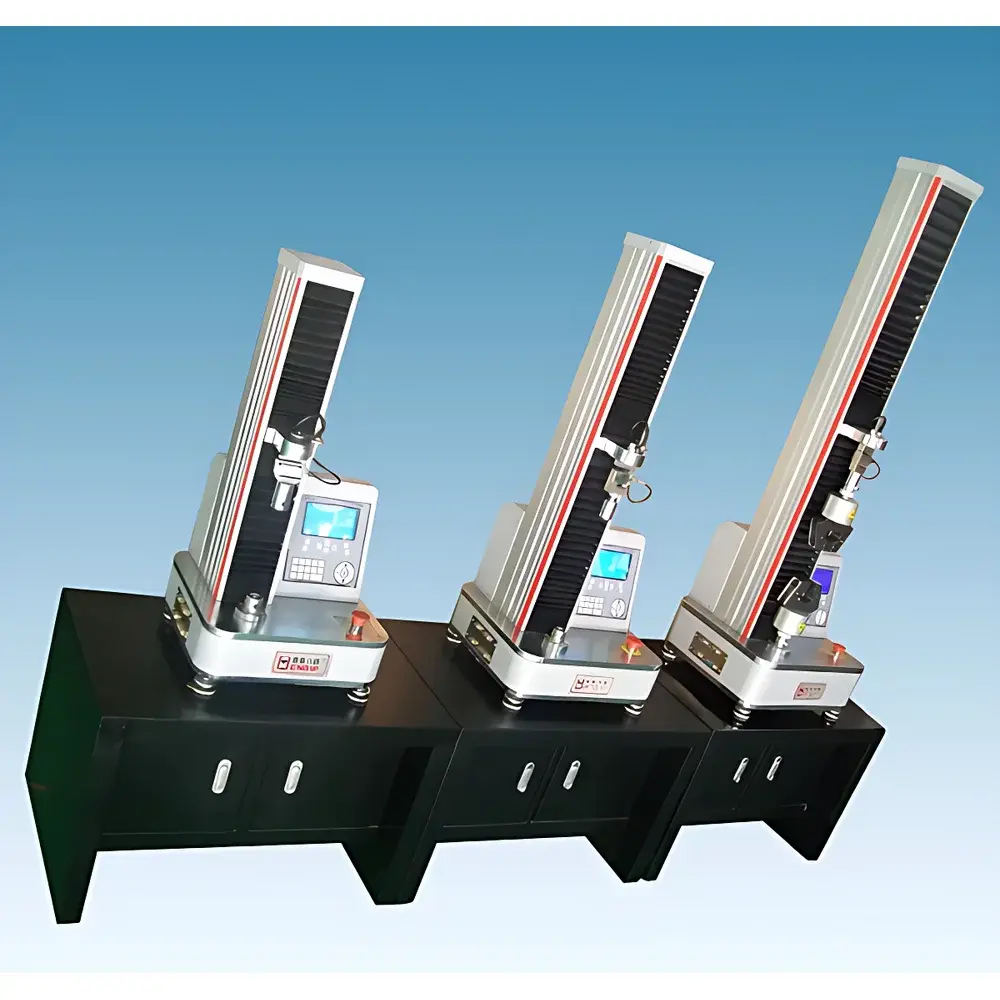
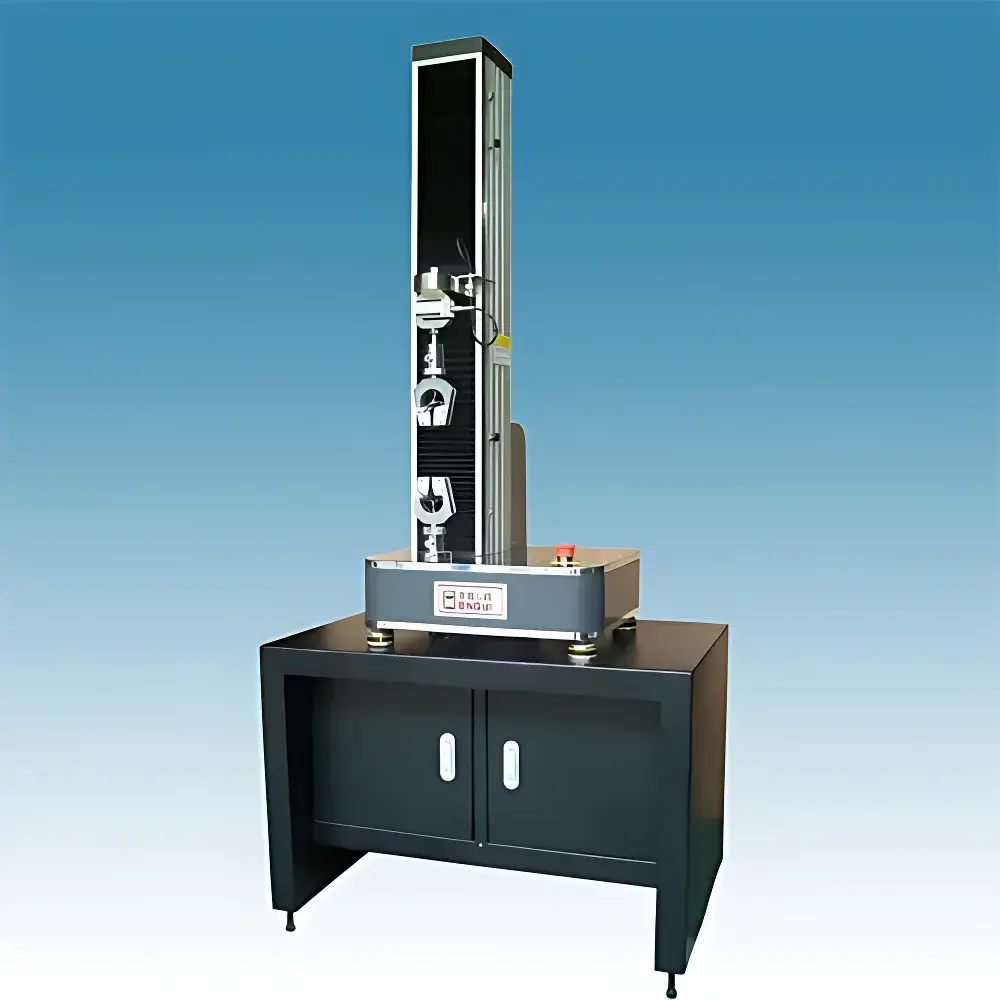
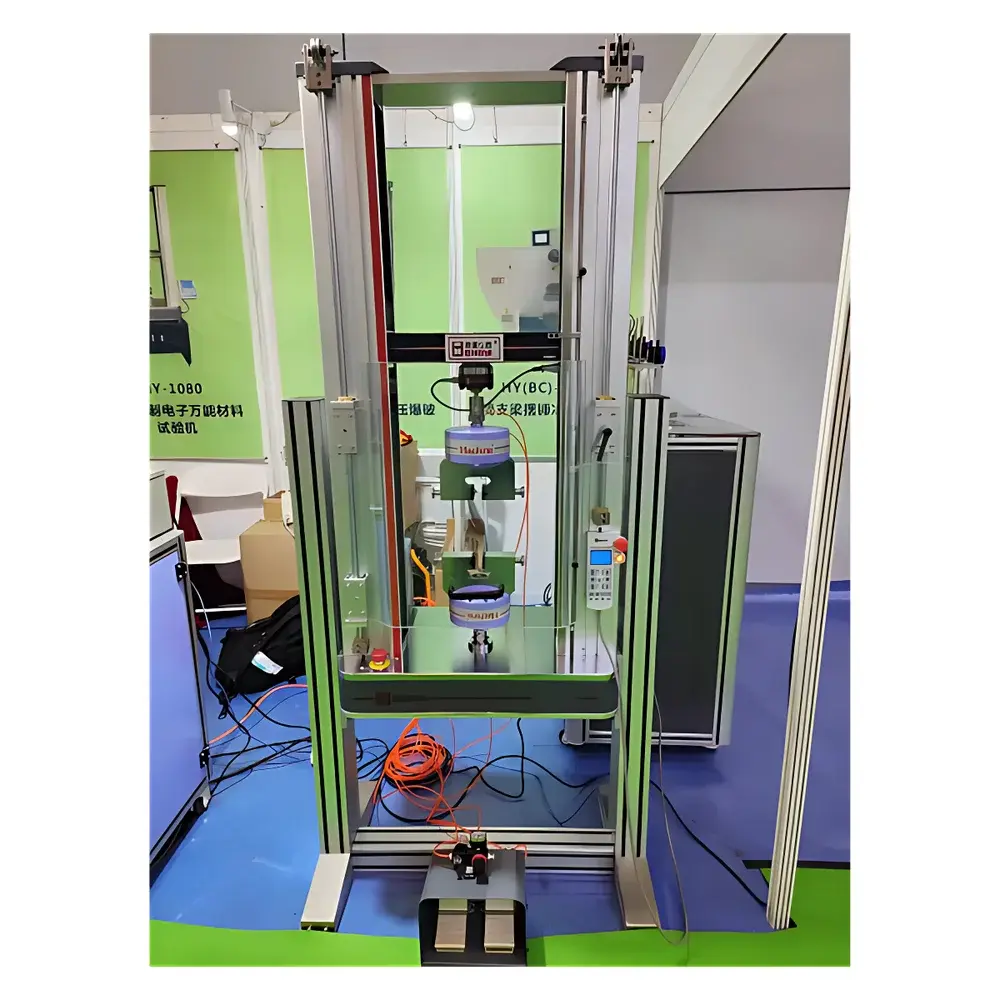
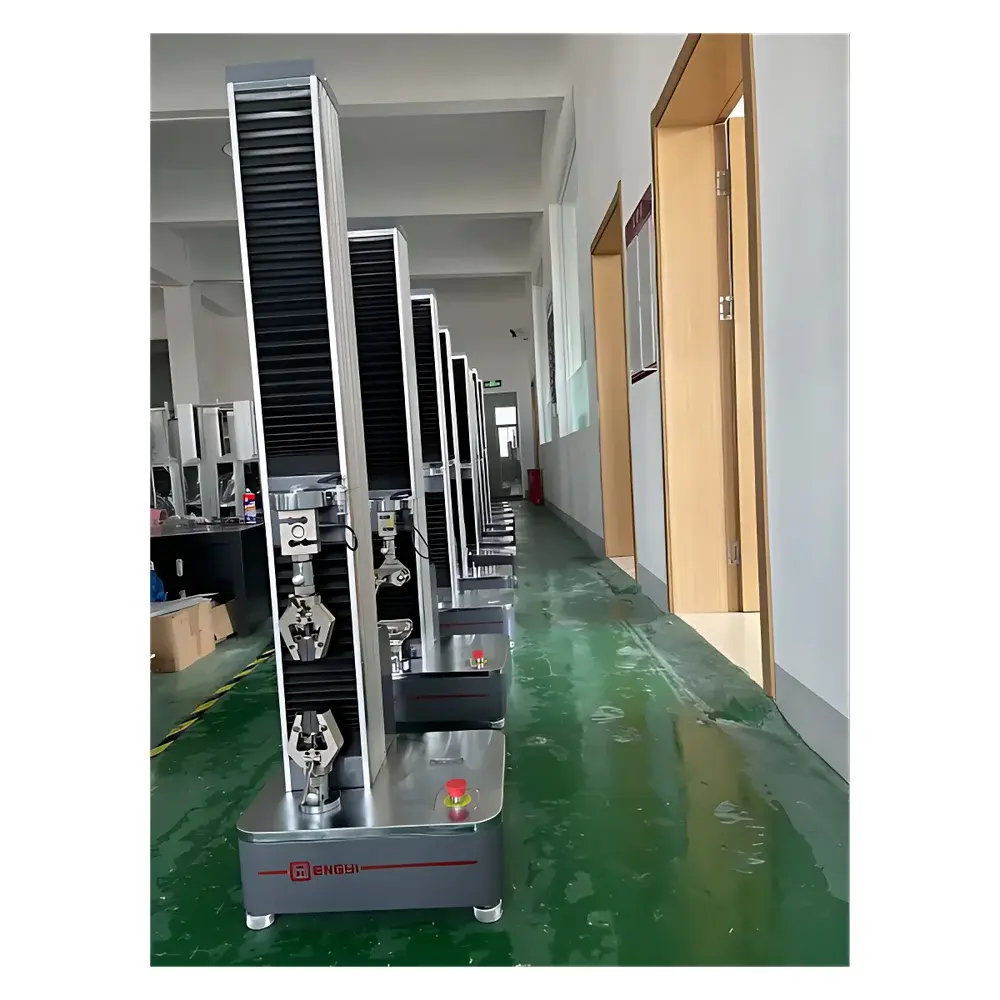
Hengyi HY-0580A Electronic Universal Testing Machine for Non-Metallic Materials
| Brand | Hengyi |
|---|---|
| Origin | Shanghai, China |
| Manufacturer Type | Direct Manufacturer |
| Product Category | Domestic |
| Model | HY-0580A |
| Instrument Type | Electronic Universal Testing Machine |
| Load Capacity | 1 N to 5000 N (selectable) |
| Accuracy Class | 0.5 |
| Effective Test Width | 120 mm |
| Effective Test Height | 800 mm |
| Speed Range | 0.001–500 mm/min |
| Speed Accuracy | ±0.5% of indicated value |
| Force Resolution | ±500000 counts (full-scale, no range switching) |
| Displacement Resolution | 0.0001 mm |
| Strain Resolution | 0.0001 mm |
| Force Measurement Accuracy | ±0.5% of indicated value |
| Strain Control Rate Range | 0.002–6% FS/S |
| Stress Control Rate Range | 0.005–6% FS/S |
| Protection Features | Electronic limit switch, overload protection (>110% FS), automatic fault diagnosis, programmable stop conditions (load/strain/time), manual and auto return |
| Power Supply | 220 V AC, single-phase, 750 W |
| Dimensions (W×D×H) | 470 × 400 × 1510 mm |
| Weight | 95 kg |
Overview
The Hengyi HY-0580A Electronic Universal Testing Machine is a high-precision, servo-controlled mechanical testing system engineered for static and quasi-static tensile, compression, flexural, shear, peel, and tear characterization of non-metallic materials—including polymers, elastomers, composites, ceramics, paper, textiles, adhesives, and leather. Operating on the principle of closed-loop electro-mechanical force and displacement control, the system employs a precision ball-screw-driven crosshead actuated by a brushless AC servo motor and planetary gear reducer. Its tri-closed-loop architecture enables synchronized control of load, displacement, and strain—supporting advanced test protocols such as cyclic loading, low-cycle fatigue, stress/strain ramping, and hold-to-failure sequences. Designed in accordance with GB/T 16491–2008 (equivalent to ISO 7500-1:2018 and ASTM E4), the instrument meets metrological traceability requirements defined in JJG 139–2014 and JJG 475–2008, ensuring compliance for GLP/GMP environments and regulatory submissions.
Key Features
- 0.5-class accuracy certified per GB/T 16491–2008 and ISO 7500-1:2018, with full-scale force resolution of ±500,000 digital counts and no internal range switching
- Ultra-fine displacement and strain resolution at 0.0001 mm, enabling precise detection of micro-deformations in brittle or highly elastic specimens
- Wide dynamic speed range (0.001–500 mm/min) with ±0.5% speed fidelity, supporting both quasi-static creep tests and rapid tear propagation studies
- Tri-closed-loop control architecture for independent, simultaneous regulation of force, displacement, and strain—essential for modulus determination and yield point identification
- Integrated electronic limit switches, over-load protection (110% FS), real-time self-diagnostic routines for drive, sensor, and power subsystems
- Modular fixture interface compatible with standardized grips (pneumatic, wedge, pin, peel, bend), allowing rapid reconfiguration across material classes and test standards
- Compact footprint (470 × 400 × 1510 mm) and low acoustic signature (<65 dB), suitable for shared laboratory spaces and QA/QC cleanrooms
Sample Compatibility & Compliance
The HY-0580A accommodates specimens up to 120 mm wide and 800 mm tall, supporting standardized geometries per ASTM D638 (plastics), ASTM D3039 (composites), ISO 527-2 (tensile), ISO 178 (flexure), ISO 1133 (melt flow index correlation), JIS K6251 (rubber), GB/T 2567 (fiber-reinforced plastics), and EN 13924 (adhesive peel). Its calibrated force train and validated displacement feedback path satisfy audit requirements under FDA 21 CFR Part 11 (with optional electronic signature and audit trail modules), ISO/IEC 17025, and CNAS-accredited testing laboratories. All firmware and calibration coefficients are stored internally with cryptographic checksum integrity verification.
Software & Data Management
Bundled Hengyi TestMaster v4.x software provides intuitive test method creation via drag-and-drop workflow builder, supporting multi-step programs with conditional branching (e.g., “hold at 80% FS for 60 s, then ramp to failure”). Real-time plotting includes dual-axis stress–strain, load–displacement, and time-based derivative curves (dF/dt, dε/dt). Raw data export is available in CSV, XML, and universal .UDF formats compliant with MATLAB, Python (NumPy/Pandas), and Minitab. Audit-ready reporting templates adhere to ISO 14289-1 (PDF/A-2u) and include operator ID, calibration certificate ID, environmental timestamp (temperature/humidity logged via optional external sensor input), and digital signature fields. Optional cloud synchronization enables centralized data governance and remote validation oversight.
Applications
- Tensile strength and elongation-at-break evaluation of thermoplastics (PP, PET, PC), thermosets (epoxy, phenolic), and biopolymers (PLA, PHA)
- Flexural modulus and fracture toughness assessment of ceramic tiles, dental composites, and structural laminates via three-point bending (ASTM C1161, ISO 14125)
- Peel adhesion quantification of pressure-sensitive tapes (ASTM D3330), medical device packaging (ISO 8510-2), and laminated films
- Tear resistance measurement of woven/nonwoven textiles (ASTM D5034, ISO 9073-4), leather hides (ISO 2418), and geotextiles (ASTM D4533)
- Compression yield and crush resistance of foam cores (ASTM D3574), honeycomb panels, and corrugated board (ISO 3037)
- Single-filament tensile analysis for synthetic fibers (ASTM D2256), carbon yarns, and natural bast fibers (flax, jute)
FAQ
What standards does the HY-0580A comply with for international accreditation?
The system conforms to ISO 7500-1:2018 (static calibration), ASTM E4 (force verification), and GB/T 16491–2008. Certificate of Conformance includes traceable calibration against NIM (National Institute of Metrology, China) reference standards.
Can the machine perform low-cycle fatigue testing?
Yes—the tri-closed-loop architecture supports programmable sinusoidal, triangular, or trapezoidal waveforms with frequency up to 5 Hz and peak-to-peak strain control within ±0.5% FS/S accuracy.
Is third-party validation support available for 21 CFR Part 11 compliance?
Hengyi provides IQ/OQ documentation packages, electronic signature implementation guidance, and audit trail configuration templates—compatible with qualified LIMS and ELN systems.
What is the maximum specimen thickness supported in compression mode?
With standard platens, the effective compression height is 800 mm; custom-height platens and spacer kits extend this to 1200 mm upon request.
Does the controller support analog output for integration with external DAQ systems?
Yes—dedicated 0–10 V analog outputs for real-time force, displacement, and strain signals are provided, with isolation-rated channels meeting IEC 61000-4-5 surge immunity requirements.



