
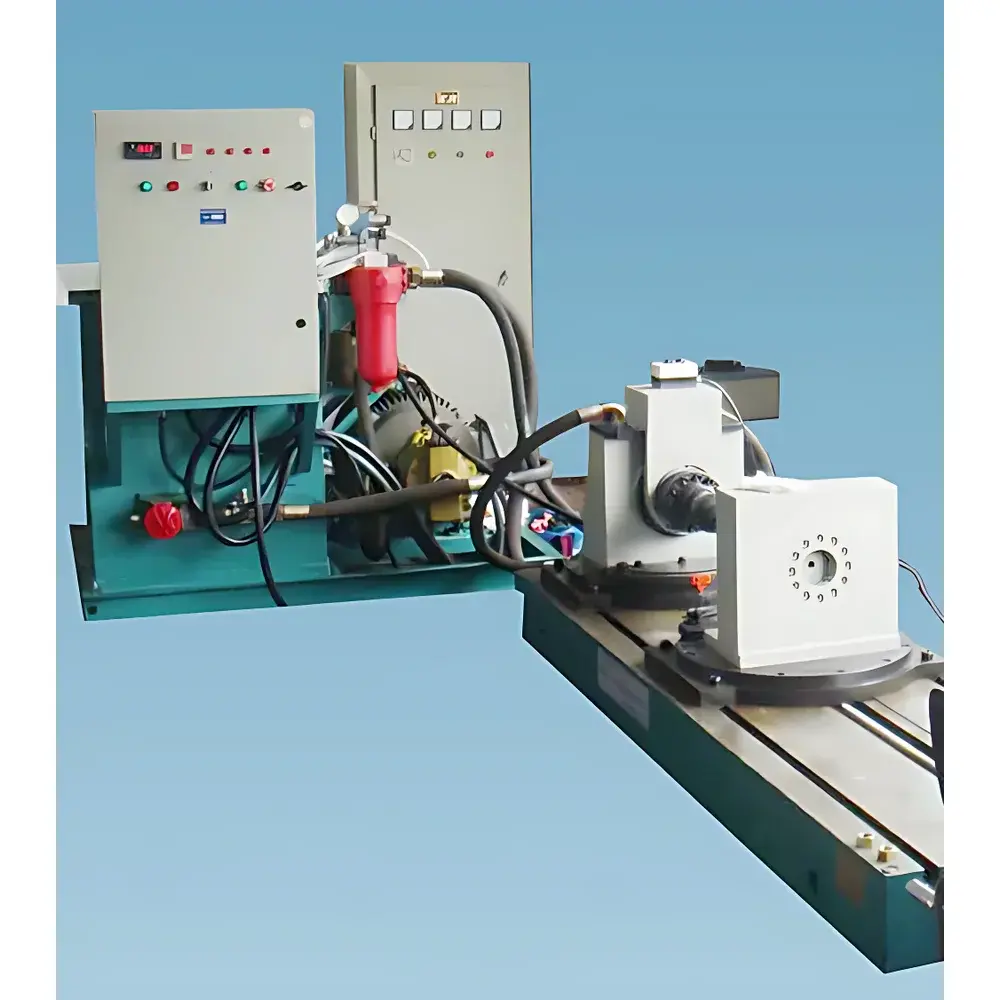
Hengyi HY-5000N·m Computer-Controlled Torsional Fatigue Testing Machine
| Brand | Hengyi |
|---|---|
| Origin | Shanghai, China |
| Manufacturer | Hengyi Precision Instruments Co., Ltd. |
| Model | HY-5000N·m (NZ) |
| Instrument Type | Electro-Hydraulic Servo Fatigue Testing Machine |
| Maximum Test Torque | ±5000 N·m |
| Torque Accuracy | ±1% F.S. (static) |
| Maximum Angular Displacement | ±45° |
| Angular Accuracy | ±0.1° (static) |
| Frequency Range | 0.5–15 Hz |
| Loading Waveform | Sinusoidal |
| Maximum Grip Spacing | 800 mm |
| Control Modes | Torque & Angle |
| Hydraulic Power Unit | Flow Rate 120 L/min, Operating Pressure 21 MPa |
| Host Weight | 3500 kg |
Overview
The Hengyi HY-5000N·m Computer-Controlled Torsional Fatigue Testing Machine is an electro-hydraulic servo system engineered for high-fidelity dynamic and static torsional characterization of structural components under controlled mechanical loading. It operates on the principle of closed-loop hydraulic actuation, where a servo-controlled oscillating cylinder applies precisely regulated torque and angular displacement to test specimens in accordance with standardized torsional fatigue protocols. Designed for rigorous R&D and quality assurance environments—including automotive drivetrain validation, aerospace component certification, and industrial power transmission development—the system supports both symmetrical and asymmetrical cyclic loading profiles, enabling simulation of real-world service conditions such as those experienced by constant-velocity (CV) universal joints mounted in vehicle chassis configurations.
Key Features
- High-capacity torsional actuation: ±5000 N·m maximum static and dynamic torque output, compliant with ASTM E2207 and ISO 1099 for axial-torsional fatigue testing frameworks.
- Dual-mode control architecture: Simultaneous or independent closed-loop regulation of torque and angular displacement, ensuring fidelity across variable stiffness and damping conditions.
- Broad frequency response: Adjustable oscillation range from 0.5 Hz to 15 Hz, supporting low-cycle fatigue (LCF), high-cycle fatigue (HCF), and step-stress testing methodologies.
- Integrated safety interlock system: Real-time monitoring of oil temperature, filter differential pressure, torque/angle over-limit, motor overload, and hydraulic system integrity—with automatic shutdown and audible/visual alerts.
- Rugged mechanical platform: 3500 kg reinforced steel frame with 800 mm adjustable grip spacing, accommodating extended shafts, drive axles, and bridge housings without reconfiguration.
- High-resolution sensing: Precision torque transducer (±1% F.S.) and angular encoder (±0.1° accuracy) calibrated traceably to national metrological standards.
Sample Compatibility & Compliance
The HY-5000N·m system accommodates cylindrical and prismatic specimens up to 300 mm in diameter and 1200 mm in length, including automotive half-shafts, propeller shafts, CV joint assemblies, differential carriers, and forged crankshafts. Fixture adaptability supports custom jaw designs for splined, keyed, flanged, or threaded interfaces. All operational parameters comply with ISO 26203-2 (metallic materials—torsion testing), ASTM E143 (shear modulus determination), and EN 10002-3 (tensile testing—torsional properties). The system architecture meets mechanical safety requirements per ISO 12100 and incorporates fail-safe hydraulic circuit design aligned with ISO 4413. Data acquisition and reporting workflows support GLP/GMP audit readiness through configurable electronic signatures and 21 CFR Part 11-compliant software modules.
Software & Data Management
Control and analysis are executed via GTC450 servo measurement and control software, a Windows-based platform supporting multi-channel synchronous acquisition at up to 10 kHz sampling rate. The interface enables real-time visualization of torque-angle hysteresis loops, cycle-by-cycle parameter logging (peak torque, min/max angle, phase lag, energy dissipation), and waveform synthesis (sinusoidal only, with programmable amplitude, frequency, and mean offset). Test sequences are defined using hierarchical script logic—supporting ramp-to-target, block loading, and staircase protocols. Raw data exports to ASCII, CSV, and universal .tdms formats; post-processing includes fatigue life curve generation (S–N plots), stiffness degradation tracking, and yield point identification per ISO 783. Audit trails record operator ID, timestamp, calibration status, and parameter modifications with immutable timestamps.
Applications
- Automotive driveline validation: Dynamic torsional endurance testing of front/rear drive shafts, dual-clutch transmission input shafts, and electric vehicle e-axle torque tubes.
- Joint kinematics analysis: Functional evaluation of ball-and-cage CV joints under combined angular misalignment and torque load, replicating full-vehicle kinematic boundary conditions.
- Material property mapping: Determination of torsional modulus, yield torque, ultimate torsional strength, and plastic deformation thresholds for alloy steels, aluminum extrusions, and composite drive rods.
- Failure mode investigation: Correlation of crack initiation sites (via post-test micro-CT or dye-penetrant inspection) with localized strain accumulation measured during high-cycle torsional cycling.
- Standards compliance testing: Execution of ISO 1099 Annex D (torsional fatigue of metallic materials) and SAE J2982 (automotive half-shaft durability requirements).
FAQ
What types of waveforms does the system support?
The HY-5000N·m system is configured for sinusoidal loading only, with fully programmable amplitude, frequency, mean torque offset, and cycle count.
Is the system compatible with third-party data acquisition hardware?
Yes—GTC450 software provides OPC UA and TCP/IP APIs for integration with external DAQ systems, PLC networks, or MES platforms.
Does the hydraulic power unit require external cooling?
A dedicated water-cooling module (model JC-2000) is included as standard equipment, maintaining oil temperature within 40–60°C during continuous operation at rated load.
Can static torsional stiffness be measured automatically?
Yes—static ramp tests generate real-time torque-angle curves; the software calculates initial slope (stiffness), yield point (0.2% offset method), and plastic hinge onset automatically.
What maintenance intervals are recommended for the hydraulic system?
Oil analysis and filter replacement every 1,000 operating hours; servo valve recalibration every 2 years or after 500,000 cycles, per manufacturer’s technical bulletin HT-2023-07.



