
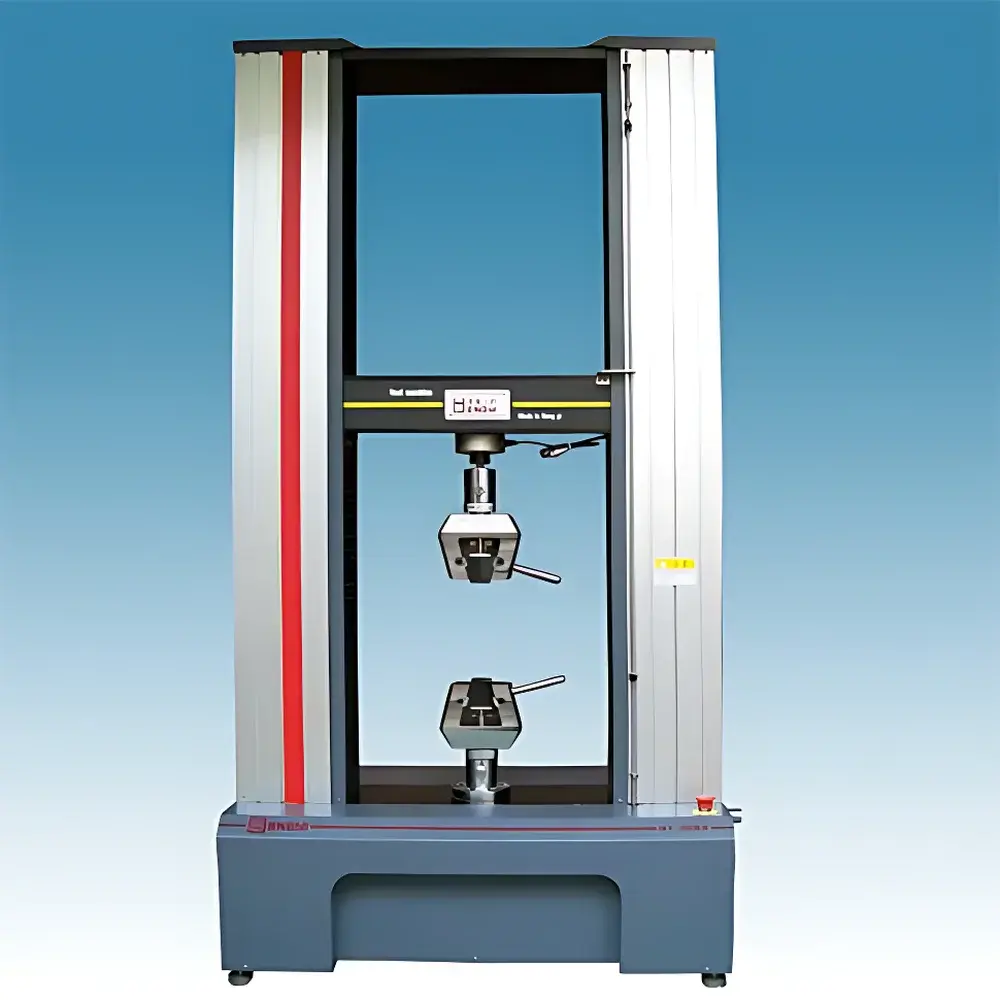
Hengyi HY-10080 Universal Electromechanical Testing System for Tensile, Compression, Flexural and Torsional Strength of Composites
| Brand | Hengyi (hengyitest) |
|---|---|
| Origin | Shanghai, China |
| Manufacturer Type | Direct Manufacturer |
| Country of Origin | China |
| Model | HY-10080TYUY |
| Price Range | USD 28,000 – 70,000 |
| Max Torque | 2000 N·m |
| Torque Measurement Range | 2–2000 N·m |
| Torque Resolution | 1/50,000 |
| Torsion Angle Range | 10,000° |
| Motor Power | 5 kW |
| Accuracy Class | ≤0.5 |
| Load Capacity Options | 1 N to 100 kN (interchangeable load cells) |
| Effective Test Width | 600 mm (expandable) |
| Effective Vertical Stroke | 800 mm (extendable) |
| Test Speed | 0.001–500 mm/min |
| Speed Accuracy | ±0.5% of indicated value |
| Displacement Accuracy | ±0.5% of indicated value |
| Strain Measurement Accuracy | ±0.5% of indicated value |
| Stress Control Rate Range | 0.005–6% FS/s |
| Strain Control Rate Range | 0.002–6% FS/s |
| Force Resolution | ±500,000 counts at full scale, no range switching required |
| Protection Features | Electronic limit switches, overload protection (110% FS), automatic fault diagnosis, emergency stop, programmable test termination (by time, displacement, or load) |
Overview
The Hengyi HY-10080 Universal Electromechanical Testing System is a high-precision, dual-column (portal-type) static mechanical tester engineered for comprehensive mechanical characterization of advanced composite materials, metallic components, polymer systems, and structural assemblies. Unlike dedicated torsion-only or uniaxial tension machines, this system integrates synchronized axial and rotational actuation within a single rigid frame—enabling standardized ASTM D3410, ISO 14129, ISO 527, ASTM D7264, ASTM D3518, and ISO 178-compliant tensile, compression, flexural, shear, peel, tear, cyclic bending, and torsional strength evaluations under controlled stress, strain, or displacement modes. Its modular architecture supports interchangeable load cells (1 N to 100 kN), torque transducers (2–2000 N·m), and environmental accessories (e.g., temperature chambers, humidity control), making it suitable for R&D laboratories, quality control departments, and certification testing facilities requiring traceable, GLP-aligned mechanical data.
Key Features
- Rigid portal frame with 1250 kg mass and reinforced crosshead design ensures minimal deflection (<0.02 mm/kN) and high lateral stiffness—critical for accurate multi-axis loading alignment.
- High-fidelity dual-control architecture: simultaneous independent regulation of axial force/displacement and rotational torque/angle, enabling coupled loading protocols such as torsion-tension or bend-torque superposition.
- Ultra-high-resolution measurement system: 500,000-count A/D conversion for force, 1/50,000 torque resolution, and ±0.5% accuracy across full ranges—meeting ISO 7500-1 Class 0.5 and ASTM E4 verification requirements.
- Programmable test sequencing with up to 20-step profiles; supports conditional termination (e.g., stop on yield point detection, fracture event, or pre-set deformation).
- Dual-speed crosshead actuation (fast jog + precision fine feed) with electronic end-stop protection and auto-return functionality—reducing operator intervention and cycle time.
- Integrated safety subsystem: real-time diagnostics for overvoltage, overcurrent, thermal overload, and mechanical overtravel; automatic shutdown at 110% of selected load cell capacity.
Sample Compatibility & Compliance
The HY-10080 accommodates specimens ranging from micro-scale coupons (e.g., ASTM D3039 dog-bone composites, 2.5 × 10 mm) to large automotive subassemblies (up to 600 mm wide × 800 mm height). Standard fixtures include wedge-action tensile grips, compression platens, three- and four-point bend fixtures, torsion clamps with angular encoders, and peel/tear adapters compliant with ASTM D903 and ISO 8510-2. All hardware conforms to ISO 26203-2 mechanical interface standards. The system’s calibration documentation supports audit readiness for ISO/IEC 17025 accredited labs and satisfies FDA 21 CFR Part 11 requirements when paired with validated software (see Software section).
Software & Data Management
Equipped with Hengyi TestMaster v4.x—Windows-based, multilingual (EN/DE/FR/JP/CN) control and analysis software—the system delivers full compliance with GxP data integrity principles. Features include role-based user access control, electronic signatures, immutable audit trails (timestamped operator actions, parameter changes, and result exports), and raw-data archiving in .tdms or .csv formats. Real-time plotting supports overlay of stress–strain, torque–angle, load–displacement, and hysteresis loops. Post-test analysis modules calculate modulus (E, G), Poisson’s ratio, yield offset (0.2%), ultimate strength, elongation at break, flexural modulus, and interlaminar shear strength (ILSS) per ASTM D2344. Export templates meet ISO 5725 repeatability reporting and internal QA report standards.
Applications
- Mechanical validation of carbon fiber-reinforced polymer (CFRP) laminates under combined axial-torsional loading for aerospace primary structures.
- Interfacial bond strength assessment of adhesive joints in EV battery enclosures using peel and lap-shear protocols.
- Compression-after-impact (CAI) testing per ASTM D7137 on damaged composite panels.
- Creep and stress-relaxation profiling of thermoplastic composites at elevated temperatures (when integrated with environmental chamber).
- Quality conformance testing of wind turbine blade root sections per IEC 61400-23.
- Raw material qualification per OEM specifications (e.g., Boeing BMS 8-276, Airbus AITM 1-0003).
FAQ
Does the HY-10080 support ASTM D5379 torsional testing of composite rods?
Yes—equipped with calibrated torsion grips and angular encoder feedback, it meets all kinematic and resolution requirements specified in ASTM D5379 for ±0.1° angle resolution and <±1% torque linearity.
Can the system be validated to ISO/IEC 17025 requirements?
Yes—Hengyi provides factory calibration certificates traceable to NIM (China National Institute of Metrology), and optional third-party verification services are available upon request.
Is remote operation supported?
TestMaster v4.x includes secure TCP/IP communication and optional VNC-based remote desktop access—configured per client IT security policies.
What is the lead time for custom fixture design?
Standard fixtures ship with the system; application-specific fixtures (e.g., curved surface grips, multi-point bending jigs) require 4–6 weeks after final drawing approval.
How is firmware updated?
Firmware updates are delivered via encrypted USB key with version-controlled release notes and rollback capability—performed by certified service engineers only.
Related Products



