
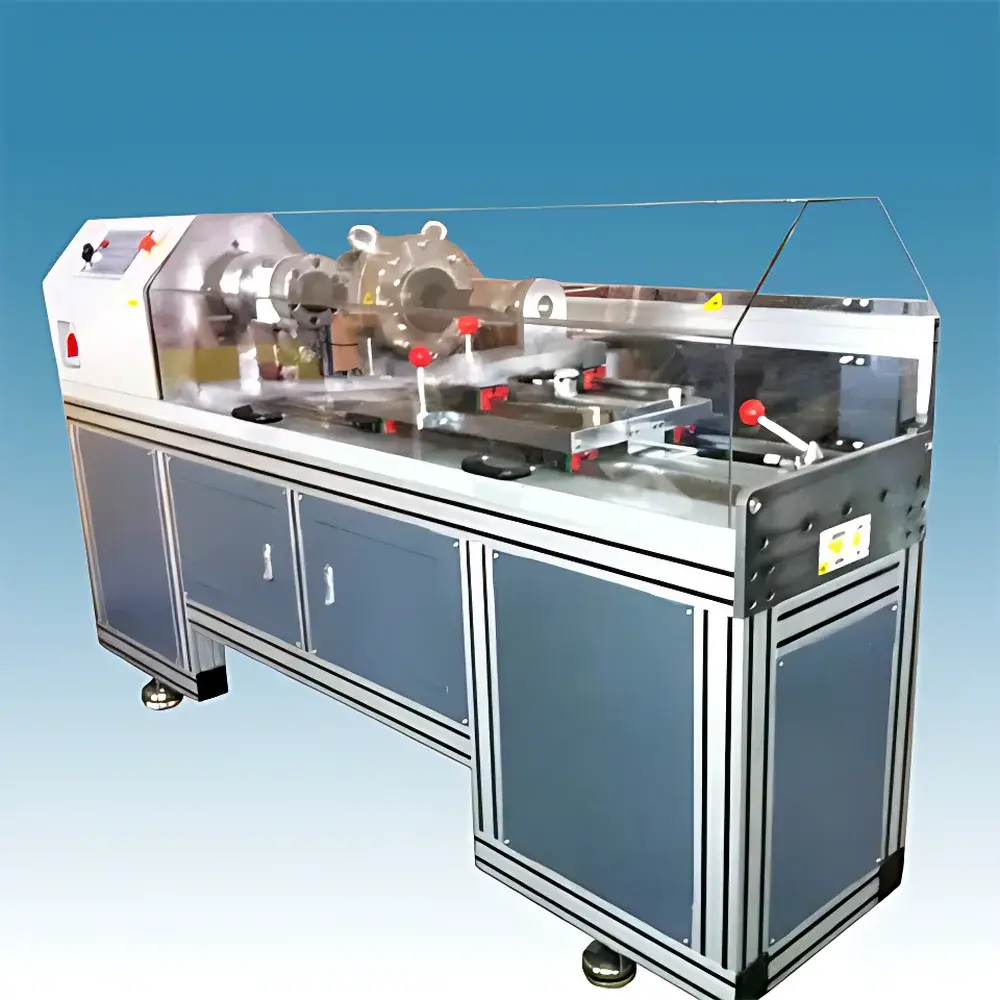
Hengyi HY-1000N·m Self-Locking Nut Friction Coefficient Torsion Testing Machine
| Brand | Hengyi / Hengyitest |
|---|---|
| Origin | Shanghai, China |
| Manufacturer Type | Direct Manufacturer |
| Product Origin | Domestic (China) |
| Model | HY-1000N·mU7JK |
| Max Torque | 1000 N·m |
| Torque Measurement Range | 1–1000 N·m |
| Torque Resolution | 1/500,000 |
| Torsion Angle Measurement Range | 0–100,000° (or continuous) |
| Motor Power | 5 kW |
| Axial Force Range | 3–300 kN |
| Torque Accuracy | ±1% of reading (typ. ±0.5%) |
| Angular Position Accuracy | ±1% of reading (typ. ±0.5%) |
| Rotational Speed Accuracy | ±0.5% of set value |
| Speed Range | 5–40 rpm (bidirectional) |
| Clamping Range | M8–M22 (customizable) |
| Gauge Length Adjustment | up to 600 mm |
| Compliance Standards | ISO 16047, GB/T 3098.9–2002, ASTM F512, DIN 267-27 |
Overview
The Hengyi HY-1000N·m Self-Locking Nut Friction Coefficient Torsion Testing Machine is a precision-engineered electromechanical system designed for quantitative mechanical characterization of threaded fasteners under controlled torsional loading. It operates on the principle of coupled axial-torsional force measurement—simultaneously capturing real-time torque, rotational angle, and axial preload (clamp force) during tightening or loosening cycles. This dual-sensor architecture enables decomposition of total applied torque into three physically distinct components: thread friction torque, bearing surface (underhead) friction torque, and elastic torsion contribution—thereby permitting direct calculation of thread friction coefficient (µthread), bearing surface friction coefficient (µbearing), total friction coefficient (µtotal), and torque coefficient (K). The system integrates a high-stiffness load frame, servo-controlled AC motor with planetary gearbox, optical encoder-based angular displacement feedback, and dual high-accuracy transducers (torque sensor ±0.02% FS, axial load cell ±0.5% FS), all synchronized via a proprietary 32-bit ARM-based digital control platform.
Key Features
- Simultaneous multi-parameter acquisition: real-time torque (1–1000 N·m), axial force (3–300 kN), and torsion angle (0–100,000°, extendable)
- High-resolution torque measurement with 1/500,000 internal resolution and verified accuracy of ±0.5% of reading across 0.2–100% of full scale
- Bidirectional torsional actuation (clockwise/counterclockwise) at programmable speeds from 5 to 40 rpm, with speed stability ≤ ±0.5%
- Modular clamping system accommodating standard fastener sizes M8–M22; custom tooling available for non-standard geometries
- Integrated thermal management and rigid cast-iron base (1800 × 540 × 1250 mm, 1800 kg) ensuring minimal frame deflection during high-torque testing
- Fully autonomous test sequencing: pre-defined protocols for ISO 16047 Annex A/B/C, GB/T 3098.9–2002, ASTM F512, and DIN 267-27 compliant evaluations
Sample Compatibility & Compliance
This machine is validated for testing metallic and composite threaded fasteners—including self-locking nuts, prevailing torque nuts, nylon-insert locknuts, all-metal deformable nuts, and high-strength bolts (e.g., Grade 8.8, 10.9, 12.9). It supports both static torque-angle ramp tests and dynamic cyclic torsion protocols (low-cycle fatigue, relaxation, re-torque verification). All measurement subsystems comply with ISO/IEC 17025 traceability requirements. Data acquisition meets FDA 21 CFR Part 11 criteria for electronic records and signatures when configured with audit-trail-enabled software. Test reports include full metadata (operator ID, calibration dates, environmental conditions) and are exportable in CSV, PDF, and XML formats compatible with LIMS integration. Reference standards implemented include ISO 16047 (determination of torque–tension characteristics), GB/T 3098.9–2002 (mechanical properties of fasteners — torque-clamp force testing), ASTM F512 (standard test method for determining prevailing torque of prevailing torque type nuts), and DIN 267-27 (fasteners — testing of locking devices).
Software & Data Management
The proprietary Hengyi TestMaster v4.x software provides a deterministic real-time control environment built on deterministic Windows OS extensions. It features synchronized multi-channel sampling at up to 1 kHz, automatic derivation of friction coefficients using standardized equations per ISO 16047 Clause 6, and K-factor calculation per VDI 2230 methodology. All raw data streams are time-stamped with microsecond resolution and stored in encrypted binary archives with SHA-256 checksum validation. Software includes role-based access control (RBAC), electronic signature workflows, and full audit trail logging compliant with GLP/GMP documentation practices. Export modules support direct transfer to statistical analysis platforms (JMP, Minitab) and enterprise quality systems (SAP QM, ETQ Reliance). Calibration certificates are digitally embedded and version-controlled within each test file.
Applications
- Quantitative validation of self-locking performance for aerospace fasteners (ASNA, NASM, MS specifications)
- Friction coefficient benchmarking across lubricant formulations (molybdenum disulfide, zinc flake, dry film lubricants)
- Process qualification of thread rolling, plating, and surface treatment processes
- Root-cause analysis of joint loosening in automotive powertrain and chassis assemblies
- Development and verification of torque-tension prediction models for digital twin implementation
- Compliance testing for ISO/TS 16949 and AS9100 manufacturing audits
FAQ
What standards does this machine directly support for friction coefficient calculation?
ISO 16047, GB/T 3098.9–2002, ASTM F512, and DIN 267-27 are natively implemented in test templates and reporting logic.
Can the system measure axial force and torque independently during dynamic loosening tests?
Yes—dual transducer synchronization ensures phase-aligned capture of clamp force decay and back-out torque profiles at ≥500 Hz sampling rate.
Is calibration traceable to national metrology institutes?
All torque and force sensors are calibrated against NIM (National Institute of Metrology, China) certified reference standards, with full uncertainty budgets provided per ISO/IEC 17025.
Does the software support automated pass/fail evaluation against specification limits?
Yes—user-defined acceptance criteria (e.g., µthread ∈ [0.12, 0.18], K ∈ [0.18, 0.22]) trigger real-time alerts and auto-generate nonconformance reports.
What maintenance intervals are recommended for long-term accuracy retention?
Biannual verification of torque/axial calibration and annual encoder linearity check are advised; full system recalibration is recommended every 24 months or after 10,000 test cycles.



