
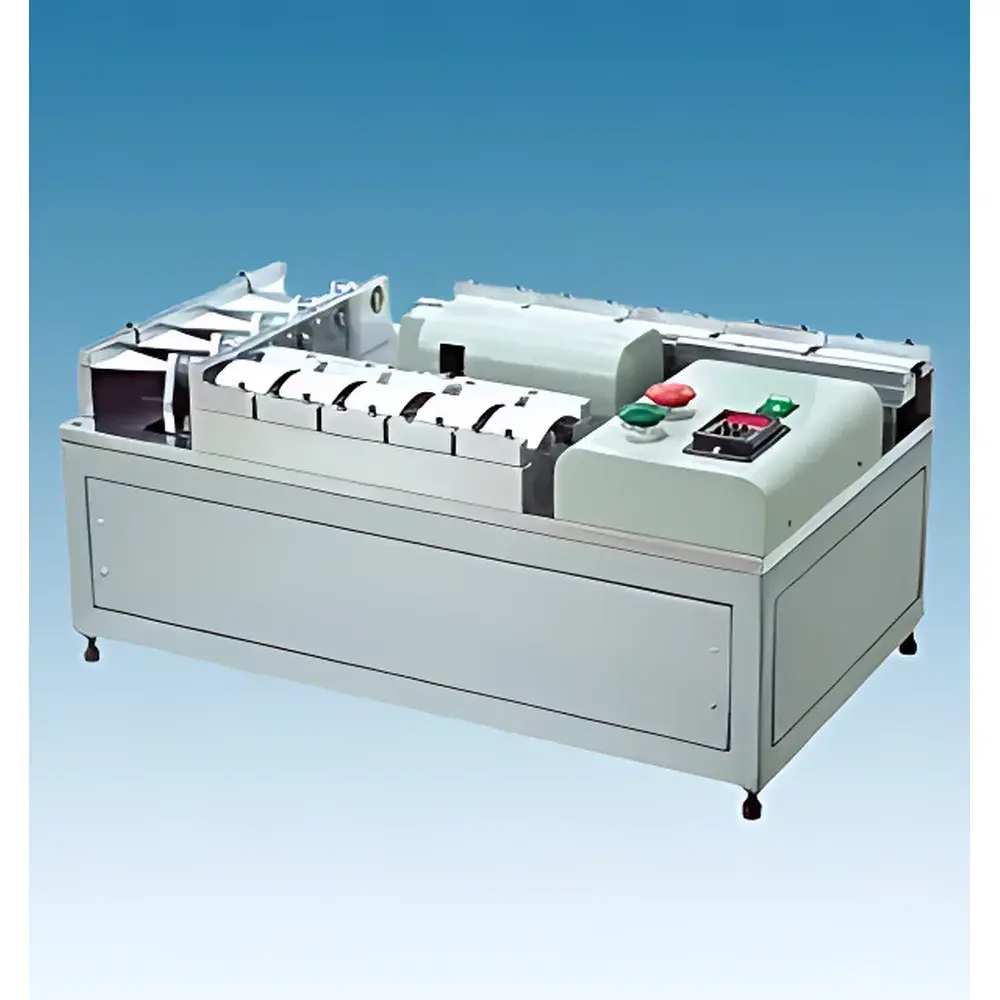
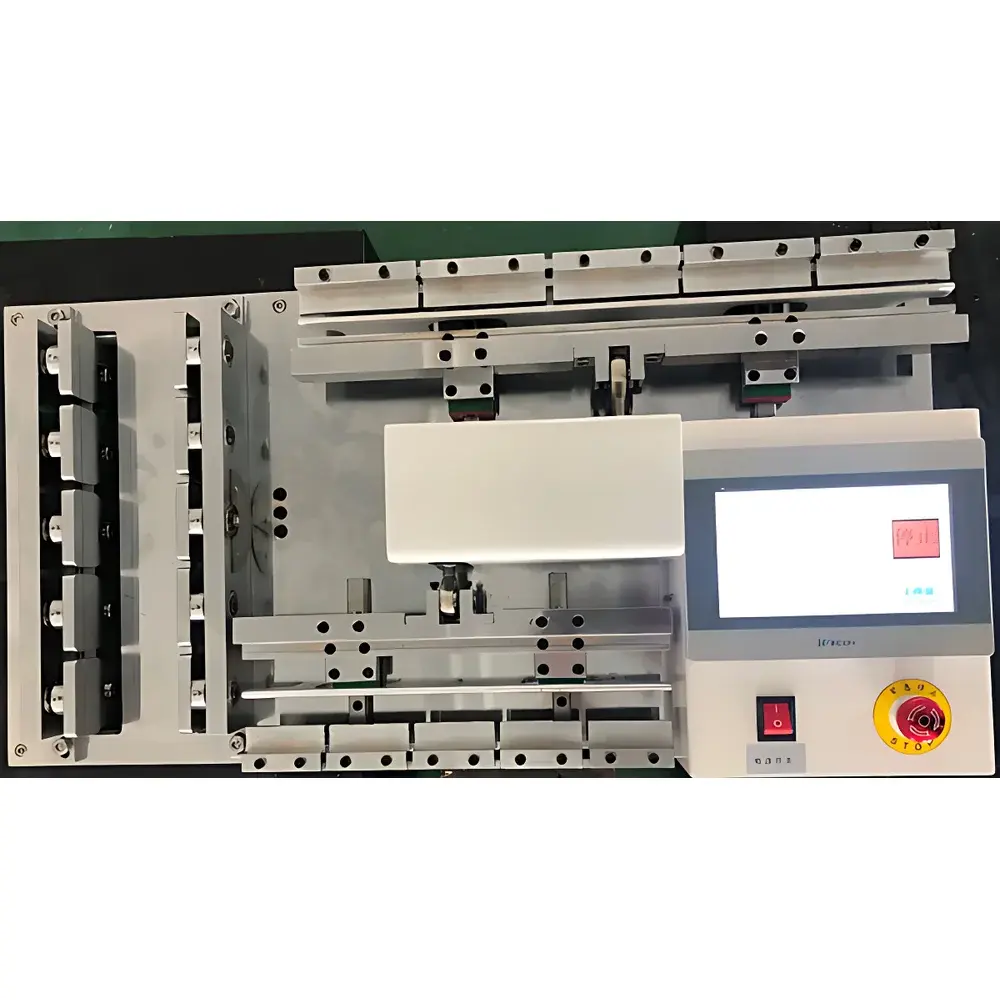
HY (IC) Dynamic Bending and Bidirectional Torsion Tester for Smart Cards
| Brand | Hengyi Test |
|---|---|
| Origin | Shanghai, China |
| Manufacturer Type | Direct Manufacturer |
| Country of Origin | China |
| Model | HY(IC)TYBB |
| Pricing | Upon Request |
Overview
The HY (IC) Dynamic Bending and Bidirectional Torsion Tester is an electromechanical durability testing system engineered specifically for evaluating the mechanical robustness of contact and contactless smart cards—particularly those conforming to ISO/IEC 7816-3, ISO/IEC 10373-6, GB/T 16649.1, and GB/T 17554.1–2006. It operates on a precisely synchronized dual-motion principle: simultaneous or independent dynamic bending (along long and short edges) and bidirectional torsional loading about the card’s central axis. The instrument implements a non-contact optical counting method—replacing legacy mechanical switch-based counters—to ensure metrological stability over extended test cycles (up to 9,999 cycles), eliminating contact wear and significantly improving long-term repeatability and uptime. Designed for laboratory-grade reliability in QC labs, R&D centers, and third-party certification facilities, the tester supports standardized pass/fail assessment of card substrate integrity, embedded chip adhesion, antenna bond strength, and laminate delamination resistance under repetitive mechanical stress.
Key Features
- Fifteen independent test stations: five configured for long-edge bending, five for short-edge bending, and five for bidirectional torsion—enabling parallel evaluation across multiple samples or test modes.
- Optical cycle counter with zero-contact sensing architecture; eliminates mechanical fatigue and ensures traceable, repeatable cycle registration up to 9,999 cycles per test sequence.
- Adjustable displacement control: long-edge deflection range 2–20 mm (±0.5 mm tolerance); short-edge deflection 1–10 mm (±0.5 mm tolerance); torsional amplitude ±15° (±1° accuracy), total angular excursion 30° (±2°).
- Precise motion synchronization: bending and torsion speeds independently controllable at 30 rpm or 0.5 Hz, with programmable dwell time and direction reversal logic.
- Standard-compliant fixture geometry: all clamping dimensions and actuation kinematics strictly adhere to ISO/IEC 7816–1 and ISO/IEC 10373–6 mechanical interface specifications.
- Compact benchtop footprint (670 × 380 × 220 mm) and low power consumption (35 W, AC 220 V ±5%) enable integration into regulated lab environments without HVAC or dedicated power conditioning.
Sample Compatibility & Compliance
The HY (IC) tester accommodates standard ISO/IEC 7816–1 ID-1 format smart cards (85.6 × 53.98 × 0.76 mm), including PVC, PET, polycarbonate, and composite laminates used in EMV-compliant payment cards, SIM cards, eID documents, and transit fare media. It supports magnetic stripe cards, contact IC cards (with embedded microcontrollers), and contactless RFID/NFC cards (e.g., MIFARE DESFire, ISO/IEC 14443 Type A/B). All test protocols are fully aligned with mandatory mechanical test clauses in ISO/IEC 7816–1 (Clause 7.2: Bending), ISO/IEC 7816–2 (Clause 6.2: Torsion), and ISO/IEC 10373–6 (Annex C: Dynamic Bending and Twisting). Data output and test logs may be structured to support GLP/GMP audit readiness when integrated with validated laboratory information management systems (LIMS).
Software & Data Management
The system operates via embedded STK AC speed-control motor drivers and high-precision gear-reduction actuators, managed through a deterministic real-time control loop—not PC-dependent software. Cycle count, direction state, and actuator position feedback are logged internally and accessible via front-panel LCD display and RS-232 serial interface. Optional firmware upgrade paths support timestamped CSV export for external data aggregation. While the base unit does not include FDA 21 CFR Part 11–compliant electronic signatures or audit trails, its deterministic hardware architecture enables seamless integration with validated LIMS platforms that enforce user authentication, electronic records retention, and change control per ISO/IEC 17025 requirements.
Applications
- Pre-certification validation of smart card designs prior to submission to national accreditation bodies (e.g., China National Accreditation Service for Conformity Assessment, CNAS).
- Comparative fatigue analysis of alternative substrate materials (e.g., bio-PVC vs. traditional PVC) under repeated flexural strain.
- Quality assurance screening of card batches from OEM manufacturers supplying utilities, banking institutions, and government ID programs.
- Failure mode analysis of delamination, antenna fracture, or chip detachment following accelerated life testing.
- Development of custom test profiles simulating real-world usage scenarios—such as wallet flexing, pocket insertion/removal, or automated kiosk handling.
FAQ
Does this tester meet ISO/IEC 10373-6 Annex C requirements for dynamic twisting?
Yes—the torsional amplitude, angular resolution, and bidirectional symmetry comply with Clause C.3.2 of ISO/IEC 10373-6:2021.
Can the bending displacement be calibrated traceably to national standards?
Displacement actuators are factory-aligned using NIST-traceable gauge blocks; calibration certificates are available upon request.
Is the optical counter certified for metrological traceability?
The photointerrupter module conforms to IEC 60730-1 Class B requirements for safety-related sensing; full metrological validation requires periodic verification against reference encoder standards.
What maintenance intervals are recommended for long-term operation?
Annual inspection of gear train lubrication and optical sensor alignment is advised; no consumables require replacement under normal use conditions.
Can the system be integrated into an automated test line?
Yes—RS-232 command set supports remote start/stop, cycle query, and status polling for PLC or SCADA-level orchestration.



