
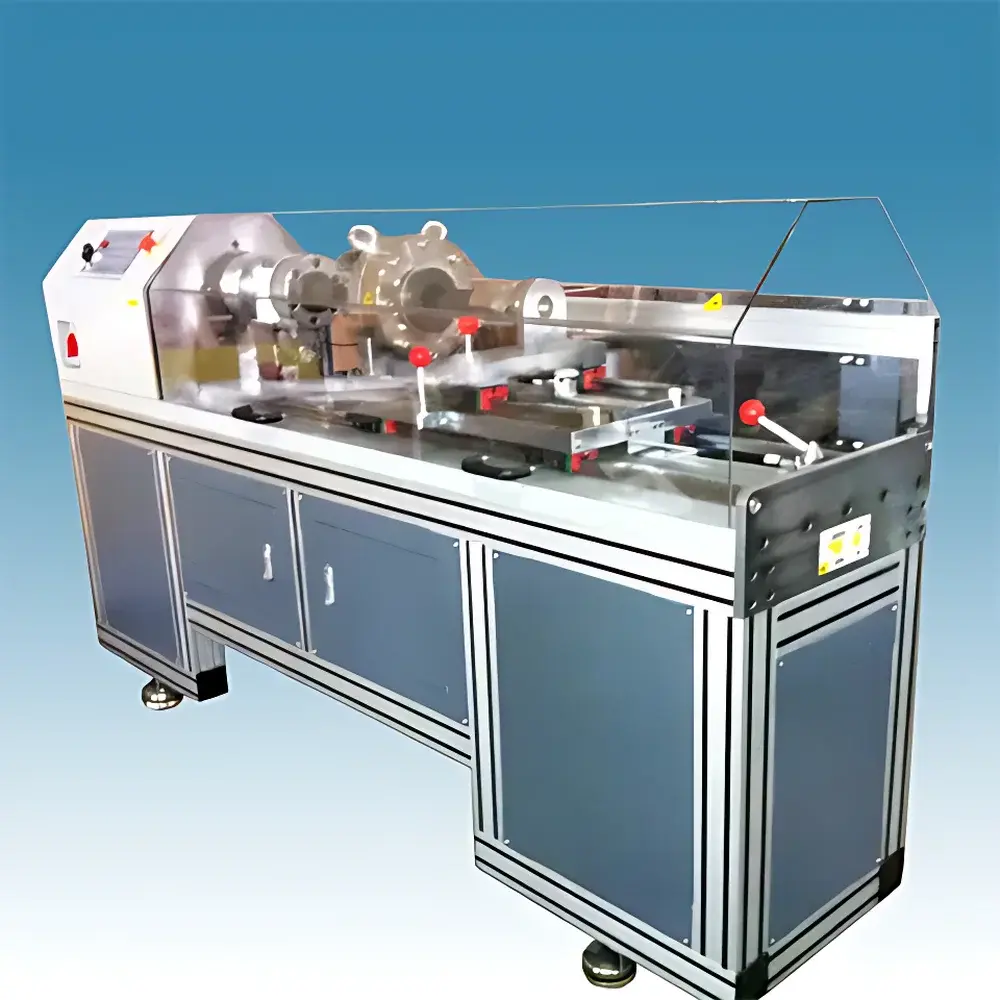
Hengyi HY-1000N·m Thread Friction Coefficient Tester for Anchor Bolts
| Brand | Hengyi |
|---|---|
| Origin | Shanghai, China |
| Manufacturer Type | Direct Manufacturer |
| Regional Classification | Domestic (China) |
| Model | HY-1000N·m |
| Max Torque | 1000 N·m |
| Torque Measurement Range | 1–1000 N·m |
| Torque Resolution | 1/500,000 full scale |
| Torsion Angle Measurement Range | 10,000° |
| Motor Power | 5 kW |
Overview
The Hengyi HY-1000N·m Thread Friction Coefficient Tester is a precision torsion testing system engineered for quantitative characterization of frictional behavior in bolted joints—specifically designed to isolate and measure thread friction coefficient (µth), bearing surface friction coefficient (µb), total coefficient of friction (µtot), torque coefficient (K), clamp force development, yield clamping load, and ultimate fastener performance under controlled tightening conditions. Based on the principle of controlled quasi-static torsional loading with simultaneous axial force acquisition, the instrument implements dual-sensor measurement architecture: a high-stability torque transducer co-located with a calibrated load cell to capture real-time torque–angle–axial force triad data. This enables compliance with standardized test protocols for fastener qualification, including ISO 16047:2019 (Fasteners — Testing of preloading properties of metric threaded fasteners), GB/T 16823.3–2010 (Mechanical properties of fasteners — Part 3: Mechanical and physical properties of fasteners made of stainless steel), and EN 14399 series (High-strength structural bolting assemblies for preloading). The system is purpose-built for anchor bolts used in wind turbine towers, steel structure foundations, civil infrastructure anchoring, and heavy industrial equipment mounting—where consistent preload control directly impacts structural integrity and service life.
Key Features
- High-resolution torque measurement system with 1/500,000 full-scale resolution and ±0.5% accuracy per ISO 376:2011 calibration traceability
- Integrated dual-axis acquisition: synchronized recording of applied torque (N·m), rotational angle (°), and axial clamping force (kN) at up to 1 kHz sampling rate
- Brushless servo motor drive with closed-loop speed control (5–40 rpm standard; extendable to 200 rpm), ensuring smooth low-speed operation without stick-slip or torque ripple
- Modular jaw design accommodating threaded fasteners from M10 to M30 (customizable for non-standard diameters and lengths up to 1000 mm gauge length)
- Rigid C-frame construction (1800 kg mass) with reinforced base plate and precision-ground guide rails, minimizing deflection during high-torque testing
- Dedicated HYtest controller and modular software platform supporting real-time curve overlay, multi-curve statistical comparison, and automated parameter extraction per ISO 16047 Annex A
Sample Compatibility & Compliance
The HY-1000N·m tester accommodates a broad range of structural and high-strength fasteners, including but not limited to: anchor bolts (carbon steel, galvanized, epoxy-coated), wind tower foundation bolts (ASTM A325/A490 equivalents), high-tensile hex bolts (ISO 898-1:1999 Class 10.9/12.9), shear-controlled twist-off bolts (EN 14399-1/3/6), weld studs (AWS D1.1), and custom-engineered double-end rods and stud bolts. All mechanical and software functions are aligned with metrological requirements of GLP and GMP environments. Data audit trails, user access levels, electronic signatures, and report generation comply with FDA 21 CFR Part 11 principles when configured with optional validation packages. Test reports include timestamped raw data export (CSV, XML), metadata annotation (operator ID, calibration date, environmental conditions), and automatic conformance flags against specified limits per GB/T 3098.9–2002 and EN 14399-3:2006.
Software & Data Management
The HYtest v5.x software suite provides an ISO 17025-aligned workflow—from test method definition and instrument calibration management to post-test analysis and certificate generation. Users define multi-step tightening profiles (e.g., ramp-to-yield, stepwise torque hold, angle-controlled tightening), assign material-specific parameters (thread pitch, nominal diameter, coating type), and apply correction algorithms for thermal drift compensation and cross-talk minimization between torque and axial channels. Analytical modules automatically compute µth, µb, K-value, yield point (by 0.2% offset method), and energy absorption area under the torque-angle curve. Export formats include PDF test certificates with digital signature support, Excel-ready datasets, and native .hys binary archives for long-term archival. All data files are SHA-256 hashed and time-stamped via integrated NTP synchronization to ensure forensic-grade data integrity.
Applications
- Pre-qualification of anchor bolt batches prior to installation in wind energy infrastructure
- Root-cause analysis of joint slippage or premature bolt fracture in steel erection projects
- Development and validation of anti-friction coatings (e.g., molybdenum disulfide, zinc flake, PTFE-based lubricants)
- Verification of torque-tension relationships for assembly process validation (PFMEA support)
- Calibration and verification of field torque tools (click wrenches, hydraulic tensioners, electric pulse tools)
- Research into tribological interactions between thread geometry, surface roughness, and lubricant rheology
FAQ
What standards does this instrument fully support for friction coefficient reporting?
ISO 16047:2019, GB/T 16823.3–2010, EN 14399-1/3/6:2005–2006, and ASTM F2329 (for zinc-coated fasteners) are natively embedded in test method templates and calculation engines.
Can the system measure both thread and bearing surface friction independently?
Yes—using the dual-sensor architecture and ISO 16047 Annex A methodology, the software decomposes total torque into thread torque and bearing torque components, enabling independent derivation of µth and µb.
Is third-party calibration certification available?
Yes—traceable calibration certificates (including torque, force, and angular displacement) issued by CNAS-accredited laboratories are available upon request, with documented uncertainty budgets per ISO/IEC 17025.
Does the software support automated pass/fail evaluation against specification limits?
Yes—user-defined tolerance bands for K-value, µtot, yield torque, and clamp force can be assigned per batch; results are color-coded and flagged in summary dashboards.
What maintenance intervals are recommended for long-term measurement stability?
Annual recalibration of torque and load sensors is recommended; biannual verification of angular encoder linearity and motor encoder alignment is advised under continuous operation (>2000 test cycles/year).



